Addressing Gaps in Traditional PunchOut Integrations

Introduction
PunchOut has become a standard part of enterprise procurement. For many organizations, it is not an optional capability, but a requirement to work with procurement driven buyers and systems.
However, while PunchOut is widely adopted, the way it is implemented has not always kept pace with how B2B commerce is evolving. Many implementations were designed to solve immediate integration needs, without fully accounting for long-term flexibility, scalability, or maintainability.
Over time, this has led to a set of recurring challenges. Integrations become difficult to maintain, changes in commerce systems introduce risk, and onboarding new buyers requires increasing effort.
This article focuses on those challenges, and how they can be addressed through a more structured and maintainable approach to PunchOut.
Challenges in Traditional PunchOut Implementations
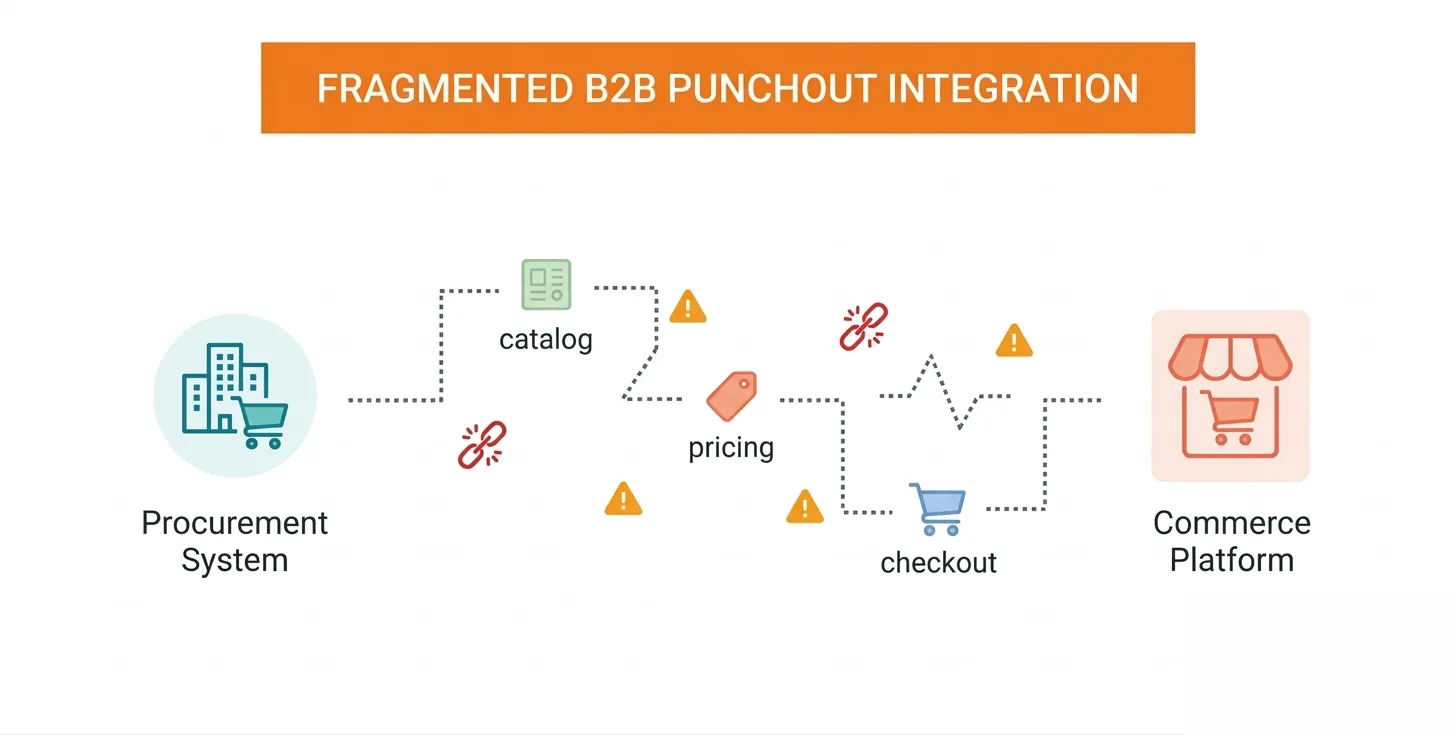
In many cases, PunchOut integrations are built closely around the existing commerce setup. While this may work initially, it creates dependencies that are difficult to manage over time.
Some of the common challenges include:
• tight coupling between PunchOut and core commerce logic
• fragile integrations that are affected by system changes
• high effort required to onboard new buyers or procurement systems
• difficulty supporting different formats, protocols, and authentication methods
• increasing pressure to meet security, compliance, and data handling requirements across enterprise systems
• managing different levels of data isolation, compliance, and configuration needs across multiple buyer organizations
• lack of a consistent internal structure to handle varied request and response formats across procurement systems
• complexity in handling user access and session control when buyers move from procurement systems into ecommerce environments
• challenges in supporting multiple PunchOut authentication methods securely across different systems
Catalog structures, contract-based pricing rules, and checkout flows are often directly tied to the integration. As a result, even small changes can introduce unexpected disruptions.
As systems evolve, these integrations tend to become harder to maintain. Updates to product data, pricing logic, or internal workflows often require rework, testing, and coordination across teams.
On top of that, enterprise buyers now expect stronger controls around how data is handled, validated, and accessed. Aligning integrations with internal IT policies and compliance requirements adds another layer of complexity.
In many cases, each buyer organization also brings its own expectations around how data should be separated, validated, and managed. Without a structured way to handle these differences, integrations become harder to scale and maintain consistently.
Onboarding new buyers also becomes more complex. Each integration may require custom configuration, making it difficult to scale efficiently.
These are not isolated issues. Alongside integration complexity, growing expectations around security, compliance, and data control further influence how well PunchOut can support ongoing change and scale.
Why PunchOut Needs to Be Treated as an Integration Layer
To address these challenges, it helps to shift how PunchOut is viewed. Rather than treating it as a one-time connector between two systems, PunchOut can be seen as a layer that sits between procurement platforms and commerce systems.
This layer acts as the point of interaction, handling communication while allowing both sides to evolve independently. It also introduces a consistent internal structure, where different request and response formats can be normalized into a common model before being processed.
Procurement systems continue to change, with different standards, workflows, and security requirements. At the same time, commerce platforms evolve with new catalog structures, pricing models, and user experiences.
If PunchOut is tightly embedded within either side, every change creates risk. But when it is treated as a separate integration layer, it can remain stable even as the surrounding systems change.
A well-structured middleware layer not only supports scale, but also makes it easier to extend the integration over time. New formats, authentication methods, or downstream processes can be introduced without reworking existing connections.
This shift creates a more controlled and predictable way to manage integrations over time.
.webp)
Keeping PunchOut Independent from Core Commerce Changes
In traditional setups, PunchOut is often directly connected to catalog data, contract-based pricing logic, and checkout processes. While this simplifies the initial setup, it creates limitations as systems evolve.
This typically leads to situations where:
• catalog updates require integration changes
• pricing logic updates create inconsistencies
• checkout changes affect how PunchOut behaves
Separating PunchOut from these components changes how updates are handled.
• catalog changes can be made without affecting integrations
• contract-based pricing logic can evolve independently
• checkout flows can be adjusted without breaking procurement connections
This approach helps contain the impact of changes and makes the overall system easier to manage over time.
Handling Differences Across Procurement Systems and Formats
One of the practical challenges in PunchOut integrations is the variation across procurement systems.
Different platforms may use different message formats, follow slightly different protocols, or require specific authentication methods. Even when standards like cXML or OCI are used, implementations can vary.
This means that no two integrations are exactly the same.
A more flexible approach allows these differences to be handled without rebuilding the integration each time. Request and response formats can be configured to match specific requirements, while still being mapped to a consistent internal structure that keeps the overall system predictable.
Support for multiple protocols ensures that integrations are not limited to a single standard. Flexible authentication methods allow organizations to meet different security requirements without introducing additional complexity.
Instead of forcing all systems into a single pattern, the integration layer adapts to them.
.webp)
Reducing Effort in Onboarding and Maintenance
In many traditional setups, onboarding a new buyer or procurement system involves significant effort. Each connection may require manual configuration, testing, and coordination between teams.
Over time, this creates a growing operational burden. A more structured approach changes this dynamic. When integrations are designed to be repeatable, onboarding becomes more predictable. The same patterns can be applied across multiple clients, reducing the need for custom work each time.
Maintenance also becomes more manageable. Changes in one area do not require reworking the entire integration or disturbing existing buyer and supplier connections, allowing new integrations to be added without affecting those already in place.
This shift reduces dependency on manual effort and makes it easier to support a growing number of clients and systems.
Meeting Enterprise Procurement and Integration Requirements
Enterprise environments come with specific expectations that go beyond basic integration.
These typically include:
• secure and controlled access to systems
• stable and reliable integrations
• consistent experience across procurement and commerce platforms
To support this, additional capabilities are often required:
• flexible mapping of requests and responses to match different procurement systems
• the ability to normalize different formats into a consistent internal structure
• support for varying data structures and formats across clients
• flexible handling of PunchOut authentication methods across systems
• the ability to adapt user access and login flows with minimal changes to the ecommerce platform
• scalability to support operations across regions and multiple buyer environments
This level of flexibility allows each integration to meet specific client requirements while still maintaining a consistent and scalable foundation.
These are not additional features, but necessary elements for operating in enterprise procurement environments. A well-structured PunchOut approach needs to account for these from the beginning.
Moving Toward a More Maintainable PunchOut Approach
.webp)
As B2B commerce continues to evolve, the role of PunchOut is also changing.
What was once implemented as a one-off integration is now expected to support long-term growth, changing business models, and increasing complexity. This requires a shift toward a more structured and maintainable approach.
By treating PunchOut as a dedicated integration layer, separating it from core commerce logic, and designing it to handle variation across systems, organizations can reduce risk and improve scalability.
PunchOut should not slow down change. It should support it, while also creating a foundation for extending into related processes such as purchase orders, invoicing, and reconciliation over time.
At Clouda, this perspective shapes how PunchOut capabilities are designed and implemented. The focus is not only on making integrations work, but on ensuring they remain stable, adaptable, and aligned with how businesses grow over time.
Introduction
Challenges in Traditional PunchOut Implementations
Why PunchOut Needs to Be Treated as an Integration Layer
Keeping PunchOut Independent from Core Commerce Changes
Handling Differences Across Procurement Systems and Formats
Reducing Effort in Onboarding and Maintenance
Meeting Enterprise Procurement and Integration Requirements
Moving Toward a More Maintainable PunchOut Approach
Get Your Free Punchout Feature Guide
PunchOut integrations often become difficult to maintain as more buyers, systems, and requirements are added.
Schedule a session to review your current setup and identify where a more structured approach can reduce complexity, improve stability, and make onboarding easier.
PunchOut integrations often become difficult to maintain as more buyers, systems, and requirements are added.
Schedule a session to review your current setup and identify where a more structured approach can reduce complexity, improve stability, and make onboarding easier.