B2B Pricing Strategies in 2025: How Quote-to-Cart Automation Powers Contract, Tiered, and Dynamic Pricing Models

Introduction
In 2025, B2B pricing strategies are rapidly evolving, driven by advances in technology and changing market dynamics. Businesses face increasing pressure to optimize their pricing models to stay competitive, maximize profit margins, and meet the complex needs of their diverse customer base. Quote-to-cart automation is emerging as a game-changing solution that streamlines the pricing process, enabling companies to efficiently set prices, manage contracts, and apply discounts with greater accuracy and speed. This automation not only reduces errors and administrative burdens but also empowers sales teams with real-time data and advanced analytics to make informed pricing decisions. As a result, businesses can deliver more personalized pricing structures, respond swiftly to market changes, and enhance customer experience, ultimately driving growth, increasing market share, and strengthening customer retention in an increasingly competitive B2B landscape.
B2B Pricing
B2B pricing is the strategic process businesses use to determine the prices of goods or services sold to other businesses. It plays a critical role in driving profitability, maintaining competitive advantage, and fostering long-term customer relationships. Unlike consumer pricing, B2B pricing often involves complex negotiations, bulk purchases, and customized pricing models tailored to different customer segments.
One key difference between B2B and B2C pricing models lies in their complexity and flexibility. B2B pricing typically involves multiple stakeholders, longer sales cycles, and pricing structures that vary by customer, whereas B2C pricing tends to be more straightforward, standardized, and transparent. This complexity requires businesses to carefully balance production costs, competitor pricing, and the perceived value delivered to potential customers.
Customer value and perceived value are central to effective B2B pricing decisions. Understanding how much customers are willing to pay based on the benefits and value proposition offered allows businesses to set prices that reflect true value rather than just costs. Incorporating value-based pricing alongside cost-plus and competitor-based pricing helps companies capture more value, avoid leaving money on the table, and respond effectively to market demand and price changes.
Popular B2B Pricing Models
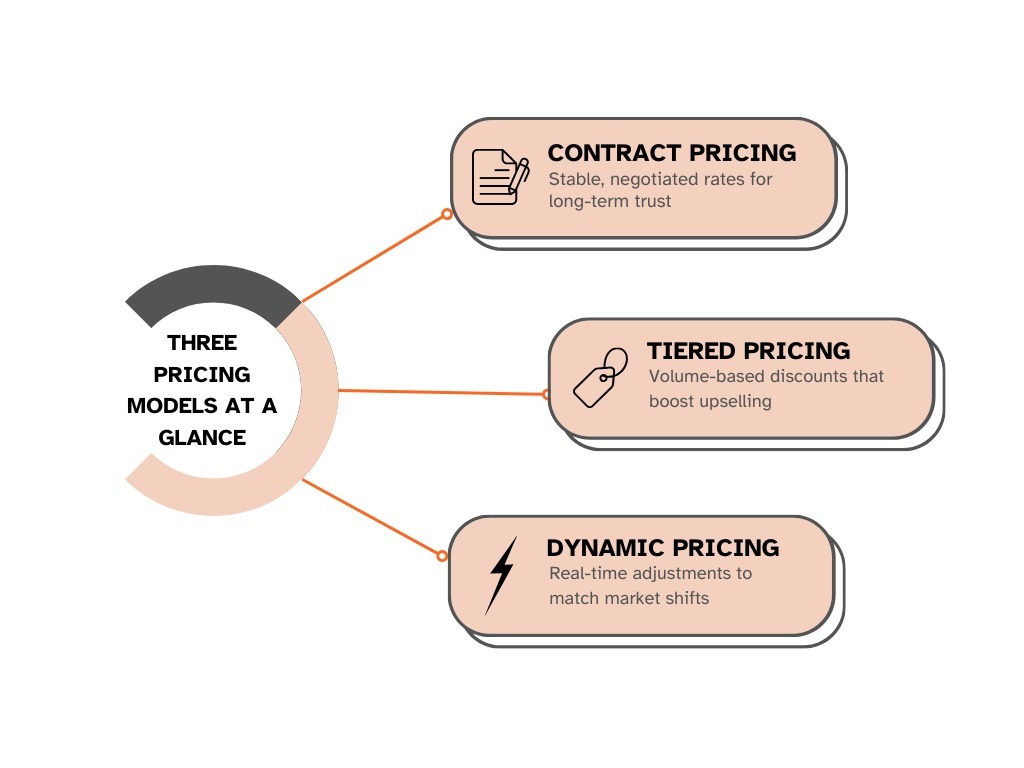
1. Contract Pricing
Contract pricing is a model where prices are set through negotiated agreements between businesses and their customers, providing stability and tailored terms.
• Sets specific prices based on negotiated agreements between businesses and customers
• Provides predictability and stability, securing long-term relationships and consistent revenue
• Customized terms tailored to individual customer needs
• Improves budgeting accuracy for both parties
• Reduces negotiation time for repeat purchases
• Automation streamlines contract creation, approval, and enforcement
• Quote-to-cart automation applies negotiated discounts automatically
• Ensures compliance with pricing agreements
• Reduces administrative overhead and errors
• Accelerates the sales process, empowering sales teams
2. Tiered Pricing
Tiered pricing offers different price points depending on volume or features, encouraging customers to buy more or upgrade services.
• Offers multiple price points based on purchase volume, features, or service levels
• Incentivizes larger orders or upgrades with discounts or added benefits
• Provides flexibility to meet diverse customer needs
• Creates upselling opportunities and clearer value communication
• Common in software subscriptions, bulk purchases, and service packages
• Aligns pricing with customer value to improve retention
• Encourages ongoing customer engagement
3. Dynamic Pricing
Dynamic pricing adjusts prices in real time by analyzing market demand and competitor actions to maximize profits and competitiveness.
• Adjusts prices in real time based on market demand, competitor pricing, and inventory
• Enables swift response to changing market conditions
• Optimizes profit margins and maintains competitive advantage
• Relies on advanced analytics and real-time data for actionable insights
• Analyzes customer behavior, price elasticity, and market trends
• Supports informed pricing decisions to maximize revenue
• Enhances customer experience with personalized, timely price adjustments
Features of Modern B2B Pricing
Modern B2B pricing encompasses a wide range of advanced features designed to optimize pricing strategies, streamline sales processes, and enhance customer experience:
Dynamic Pricing: Real-time price adjustments based on market demand, competitor pricing, and inventory levels to maximize profitability.
Contract-Based Pricing: Customized pricing agreements negotiated directly with customers for long-term stability and tailored terms.
Tiered Pricing: Different price points based on volume, customer type, or service levels, encouraging bulk purchases and upselling.
Real-Time Competitor Price Matching: Automated monitoring and adjustment of prices to stay competitive in the market.
Cost-Plus Pricing Automation: Streamlined calculation of prices by adding a markup to production costs, ensuring desired profit margins.
AI-Powered Price Optimization: Leveraging artificial intelligence to analyze data and recommend optimal pricing strategies.
Seasonal and Time-Based Pricing: Adjusting prices according to seasonal trends or specific time periods to capture demand fluctuations.
Demand-Based Price Elasticity Modeling: Understanding how price changes affect customer demand to set effective price points.
Automated Approval Workflows: Simplifying and speeding up the pricing approval process to reduce administrative overhead.
Bulk Purchasing Support: Features like CSV or SKU file uploads, automatic volume discounts, smart cart optimization, and multi-currency & tax-aware bulk pricing facilitate large orders efficiently.
Payment Terms Management: Flexible options including net payment terms (30, 60, 90 days), credit line management, credit card payments, invoice-based payments, split and partial payments, and tax and compliance handling.
Predictive Replenishment Pricing and Bid-Based Bulk Pricing: Advanced pricing models that anticipate customer needs and optimize bulk order pricing.
Shipping Cost Calculations: Tools such as pallet/LTL shipping cost calculators to incorporate logistics costs into pricing.
Together, these features empower businesses to create well-designed pricing strategies that improve profit margins, increase market share, and enhance customer satisfaction in the competitive B2B landscape.
Advanced Tools and Technologies Powering B2B Pricing
1. Centralized Product Data Hub
Aggregate all your product data attributes, SKUs, specs, certifications into one central location. Eliminate the chaos of spreadsheets and disconnected systems. This centralized platform empowers ecommerce managers, marketing teams, and IT professionals to access and manage product data efficiently.
2. Product Content Enrichment
Create detailed product descriptions, add multilingual translations, manage technical documentation, and attach media assets like videos, CAD files, and installation guides. Akeneo supports digital asset management (DAM) systems capabilities, enabling teams to store and organize rich media content alongside product data.
3. Automated Data Quality & Validation
Leverage AI-powered rules and workflows to detect incomplete, duplicated, or outdated data. Artificial intelligence helps maintain high product data quality standards across product records, reducing manual errors and ensuring compliance with industry standards.
4. Multi-Channel Syndication
Format and distribute product information tailored for each channel—distributor portals, retailer platforms, B2B eCommerce sites, marketplaces, and mobile apps—without duplicating effort. This omnichannel approach ensures consistent and engaging content reaches customers wherever they shop.
5. Compliance Management
Ensure your product data complies with regional standards and certifications. Track expiration dates, upload compliance documents, and flag missing requirements before products go live. This supports data governance and regulatory compliance.
6. Supplier Data Onboarding
Distributors can onboard supplier catalogs directly into Akeneo, standardizing formats and ensuring compatibility with internal product structures and customer-facing platforms. This reduces repetitive tasks and speeds up data integration.
7. Collaborative Workflows
Enable sales, marketing, and technical teams to collaborate on product content with built-in roles, approvals, and task management streamlining operations and improving operational efficiency.
Advanced Tools and Technologies Powering B2B Pricing
Beyond quote-to-cart automation and advanced analytics, a suite of sophisticated tools and technologies is transforming how businesses approach B2B pricing. AI-powered pricing software harnesses machine learning algorithms to analyze vast datasets, including historical sales, competitor pricing, customer behavior, and market trends, to recommend optimal price points dynamically. These platforms can predict price elasticity and simulate pricing scenarios, helping businesses maximize revenue while maintaining competitive advantage.
Configure, Price, Quote (CPQ) systems integrate product configuration, pricing, and quoting processes into a seamless workflow. CPQ tools enable sales teams to generate accurate, customized quotes quickly, incorporating complex pricing rules like contract terms, volume discounts, and tiered pricing structures. This reduces errors, accelerates sales cycles, and ensures pricing consistency across the organization.
Pricing optimization platforms combine AI, real-time data, and automation to continuously monitor market conditions and adjust pricing strategies accordingly. They support multiple pricing models simultaneously, such as cost-plus, value-based, and dynamic pricing, giving businesses the flexibility to tailor pricing by customer segment, region, or product line. Integration with CRM and ERP systems ensures pricing decisions are aligned with inventory levels, sales forecasts, and financial goals.
By leveraging these advanced tools, businesses can respond instantly to market fluctuations, competitor moves, and customer demands, driving better pricing performance and improved profit margins.
Discounts and Promotions in B2B Pricing
Discounts and promotions are important factors in B2B pricing strategies, helping businesses attract and retain customers while maintaining profitability. Various types of discounts are commonly used to incentivize purchases and build long-term relationships:
1. Volume-based discounts
Offered to customers who purchase large quantities, encouraging bulk purchases and increasing sales volume.
2. Seasonal discounts
Applied during specific times of the year to stimulate demand during slower periods or capitalize on peak seasons.
3. Loyalty discounts
Reward repeat customers to foster customer retention and strengthen business relationships.
4. Early payment discounts
Incentivize prompt payment, improving cash flow and reducing accounts receivable.
Quote-to-Cart Automation
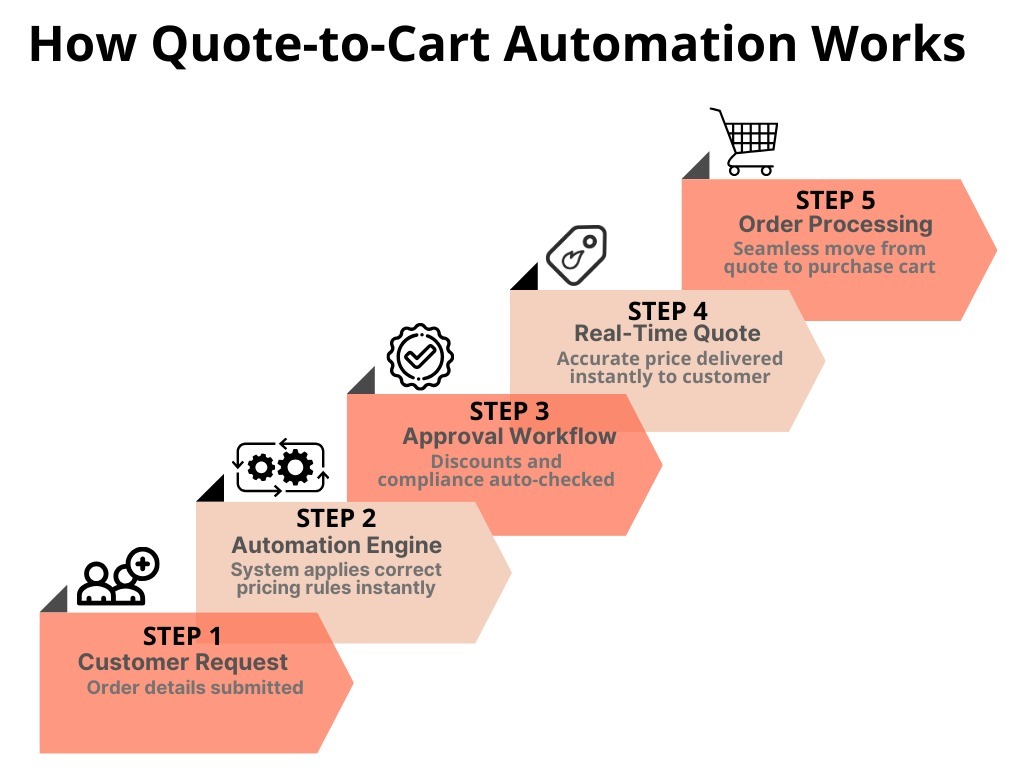
Quote-to-cart automation plays a crucial role in efficiently managing the application of these discounts. By automating discount calculations and approvals, it ensures accuracy, compliance with pricing policies, and reduces administrative errors. This automation empowers the sales force to apply appropriate discounts quickly, accelerating the sales process without sacrificing profitability.
Strategically setting discount price points is essential to balance competitive pricing with maintaining healthy profit margins. Businesses must analyze market demand, competitor pricing, and customer behavior to determine discount levels that provide value to customers while avoiding reduced profitability. Well-designed discount strategies enhance competitive advantage by making offerings more attractive to potential customers and improving customer retention through perceived value.
Benefits of Quote-to-Cart Automation
• Streamlining the sales process for sales teams and business units, enabling faster and more accurate pricing decisions by automating complex calculations and approvals
• Enhancing customer experience with transparent, flexible, and personalized pricing options that cater to different customer segments and buying behaviors
• Reducing errors and ensuring compliance with business objectives and negotiated agreements by minimizing manual input and standardizing pricing rules across the organization
• Leveraging real-time data and advanced analytics to respond swiftly to market changes, competitor pricing, and price elasticity, allowing businesses to optimize profit margins and maintain a competitive edge
• Automating discount application and approval workflows to maintain profitability while offering competitive price points, ensuring discounts are applied consistently and appropriately
• Enabling better collaboration between sales, finance, and pricing teams through centralized pricing data and streamlined communication channels
• Supporting scalable pricing strategies such as contract pricing, tiered pricing, and dynamic pricing, which can adapt to evolving market demands and customer needs
• Improving forecasting accuracy and inventory management by integrating pricing decisions with sales data and market trends, ultimately driving better business outcomes
Best Practices for Implementing B2B Pricing Strategies
• Align your pricing approach closely with your overall business goals to ensure consistency and support for long-term growth.
• Continuously monitor pricing performance by leveraging advanced pricing tools and real-time data analytics to make informed adjustments.
• Incorporate thorough market research and detailed customer behavior analysis to understand demand, price sensitivity, and competitive positioning.
• Test various pricing structures and discount strategies across different groups of customers through A/B testing or pilot programs to identify the most effective approaches.
• Foster collaboration between sales teams, finance, and marketing to ensure pricing decisions align with customer needs and business objectives.
• Regularly review and update pricing models to respond to market changes, competitor pricing, and shifts in customer value perception.
• Use automation, such as quote-to-cart systems, to streamline pricing workflows, reduce errors, and speed up the sales process.
• Maintain transparency and clear communication around pricing policies to build trust and strengthen customer relationships.
Conclusion
A well-designed B2B pricing strategy powered by quote-to-cart automation is essential for thriving in today’s competitive market. By automating complex pricing calculations, approvals, and discount applications, businesses can streamline their sales process and empower sales teams to make faster, more accurate pricing decisions. This leads to optimized profit margins through dynamic response to market demand, competitor pricing, and customer behavior. Moreover, personalized and flexible pricing structures enhance the customer experience, fostering stronger relationships and improving customer retention. Ultimately, integrating advanced pricing tools and automation supports businesses in increasing market share, driving sustainable growth, and maintaining a competitive advantage in the evolving B2B landscape.