Beyond Rankings: How to Become the Brand AI Recommends in the Age of Answer Engines

Search is no longer the only place where buying decisions begin. Increasingly, business leaders are asking ChatGPT, Perplexity, Claude, Copilot, and Google's AI experiences to explain complex topics, compare vendors, recommend platforms, and summarize markets before they ever visit a website. That shift has introduced a new challenge for marketers: it's no longer enough to rank well in search results,you also need to become a source that AI systems trust, understand, and reference.
That change has also created a wave of new terminology. SEO, AEO, GEO, AI Search Optimization, AI Visibility,the market suddenly has multiple labels for what appears to be the same problem. Unfortunately, much of the advice surrounding these concepts focuses on tactics before explaining the underlying shift. The reality is simpler. Traditional search optimization is still essential, but it is no longer the whole picture. Organizations now need content that is discoverable by search engines, understandable by AI systems, and authoritative enough to become part of the answers those systems generate.
Search Has Changed, but Trust Still Wins
For two decades, digital visibility largely meant earning a position on a search engine results page. Success was measured through rankings, impressions, and clicks. Today, many buyers receive an answer before they ever see a list of links. AI systems retrieve, summarize, compare, and explain information, often reducing dozens of sources into a single response.
Industry analysts expect this behaviour to accelerate. Gartner has projected a significant decline in traditional search volume as conversational AI becomes part of everyday information discovery, while Adobe's acquisition of Semrush in late 2025 signaled that AI visibility is now a strategic investment rather than an experimental marketing trend. At the same time, multiple B2B studies indicate that a growing percentage of buyers already use AI assistants during vendor research, particularly in complex purchasing decisions.
This shift does not mean SEO is becoming obsolete. It means visibility now exists across multiple layers. A page still needs to be discoverable, but it also needs to be structured in a way that allows AI systems to extract information accurately and confident enough in its authority to reference it when generating answers.
Stop Thinking About SEO, AEO and GEO as Competing Strategies
One of the biggest misconceptions is that Answer Engine Optimization (AEO) and Generative Engine Optimization (GEO) replace SEO. In reality, they build on it. Industry researchers, including Column Five, Hunter & Bard, and Surmado, have reached a similar conclusion: while the labels differ slightly, the practical disciplines overlap far more than they differ.
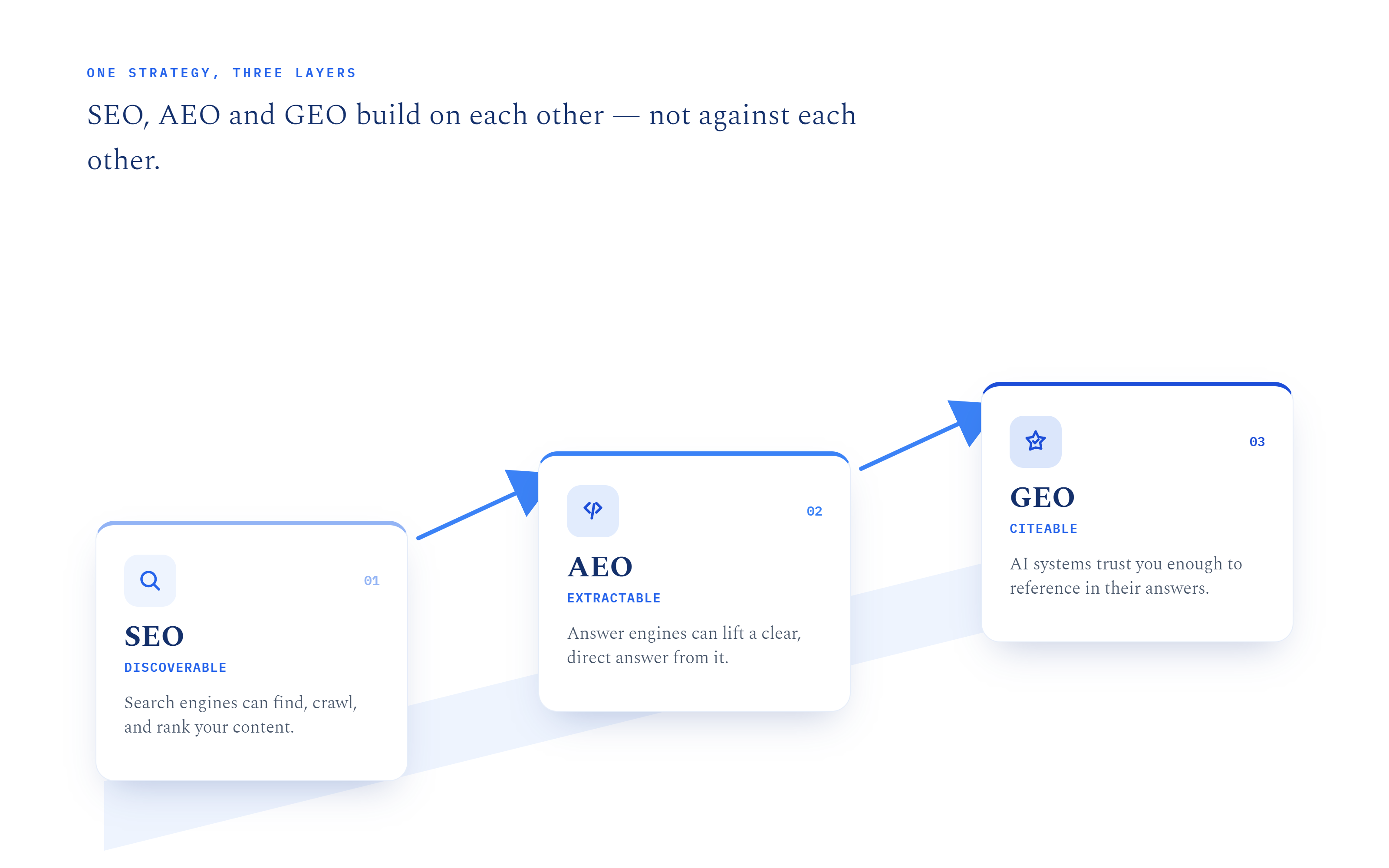
A useful way to understand the relationship is to think of visibility as three connected stages.
- SEO makes your content eligible by ensuring search engines can discover, crawl, and rank it.
- AEO makes your content extractable by presenting information in a structured, direct, and easily understood format that answer engines can surface.
- GEO makes your brand citeable by demonstrating expertise, credibility, and evidence that AI systems are more likely to reference when generating responses.
These are not separate marketing programs. They are different layers of the same visibility strategy. Organizations that chase only one layer often miss the larger opportunity because AI systems increasingly combine search signals, content quality, structured information, citations, and overall authority when deciding which sources deserve attention.
The Question Every Executive Should Be Asking
Many organizations are still asking whether their website is optimized for AI. That is a useful question, but it is not the most important one.
A better question is this:
When a potential customer asks an AI platform to recommend companies in your category, what does it say about your business?
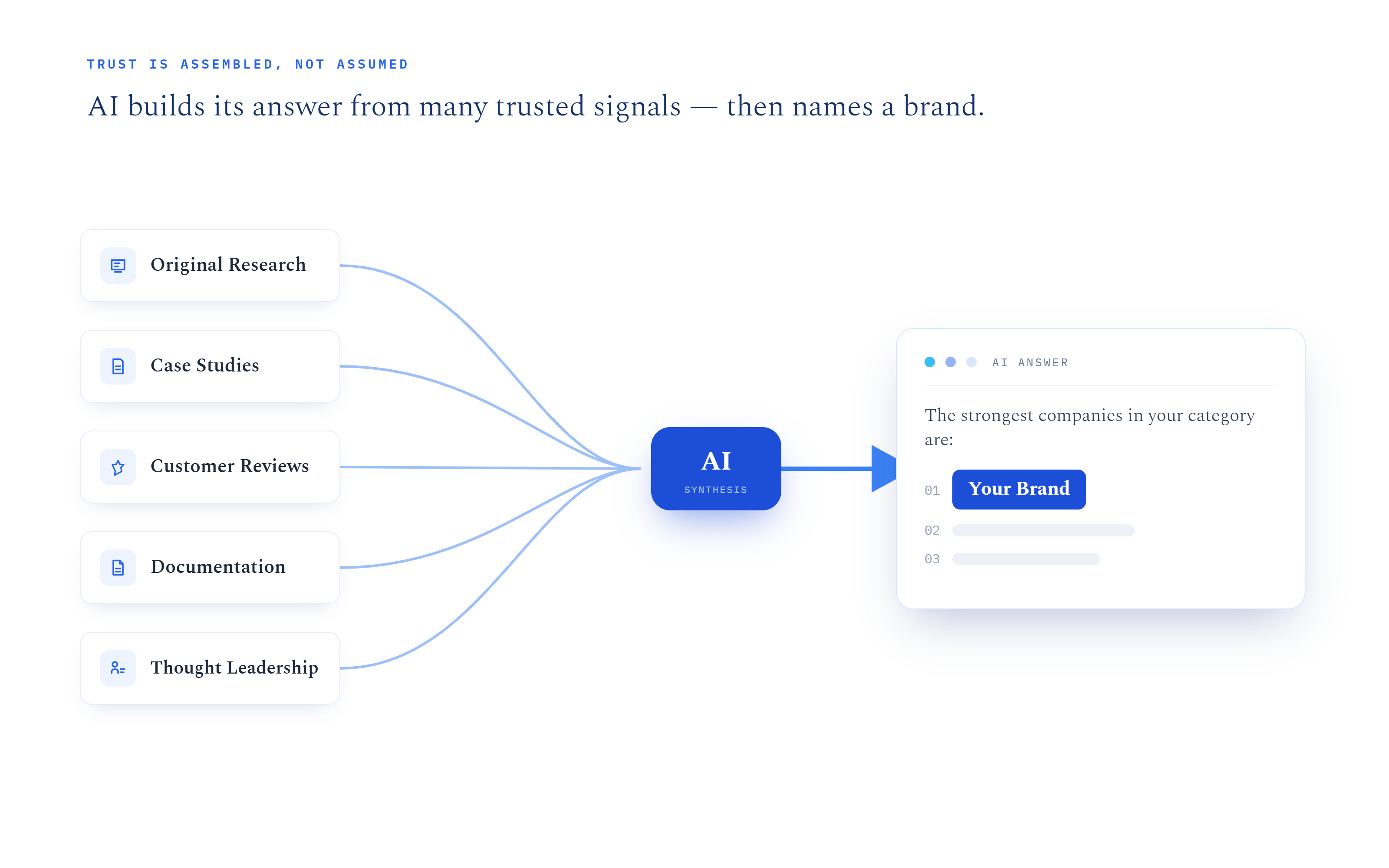
That single question changes the conversation completely. It shifts attention away from metadata and keyword density toward reputation, expertise, consistency, and evidence. AI systems are increasingly synthesizing information from multiple trusted sources rather than simply repeating website copy. They compare claims, evaluate authority, and look for supporting signals across the wider web.
This means AI visibility is no longer only a marketing challenge. It becomes an organizational one. Your documentation, research, case studies, technical expertise, customer outcomes, product information, and public thought leadership all contribute to the picture AI systems build about your company. The answer generated is rarely based on one page alone,it reflects the credibility your business has established across its entire digital presence.
What Actually Increases AI Visibility?
The good news is that emerging research is beginning to identify patterns that consistently improve visibility across AI-powered search experiences. One of the most referenced studies, conducted by researchers at Princeton University using more than 10,000 queries, found that certain content characteristics significantly increased the likelihood of being incorporated into AI-generated responses.
Among the strongest signals were:
- Expert quotations that demonstrate genuine subject matter expertise.
- Original statistics supported by reliable sources.
- Credible external citations that strengthen factual claims.
- Comprehensive explanations rather than shallow summaries.
- Clear structure with descriptive headings and logical progression.
Notice what is missing from that list. There is no mention of keyword stuffing, publishing dozens of near-identical articles, or chasing algorithm shortcuts. The evidence points toward something much closer to traditional editorial quality: well-researched content that answers real questions with clarity, depth, and supporting evidence.
For B2B organizations, this represents an opportunity rather than a disruption. Companies that already invest in original thinking, customer insights, technical expertise, and educational content are often building exactly the kind of assets that answer engines prefer. The challenge is making that expertise easier for both humans and AI systems to understand.
Different AI Engines Don't All Work the Same
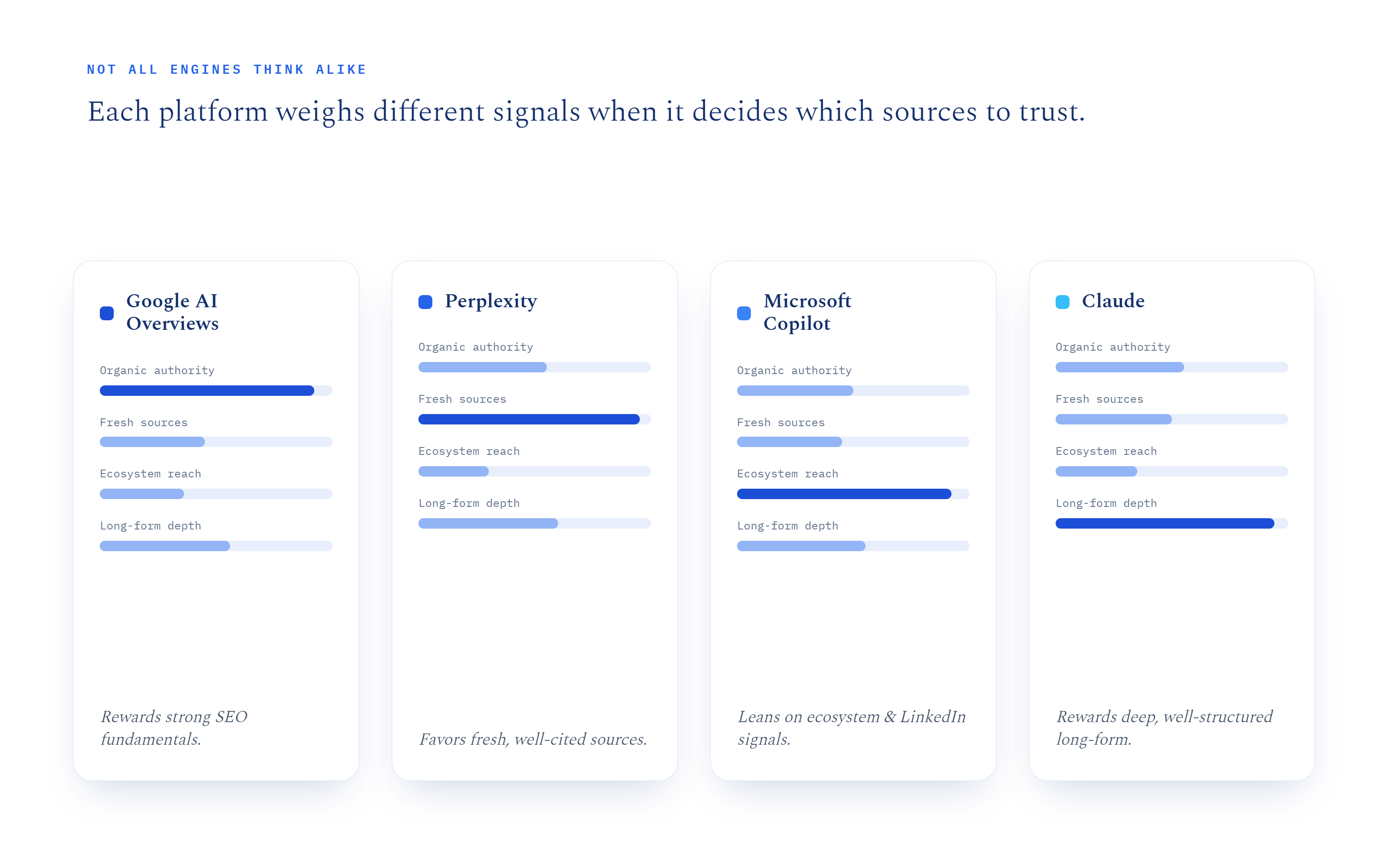
One of the biggest mistakes businesses make is treating AI visibility as though every platform retrieves and evaluates information in the same way. They don't. While the underlying objective is similar,providing accurate, helpful answers,the way each platform finds and weighs information varies considerably.
Understanding these differences helps explain why content that performs well in one AI platform may be almost invisible in another.
Google AI Overviews
Google still relies heavily on its traditional search infrastructure. Pages with strong organic authority, technical SEO, and consistent topical depth are more likely to appear in AI-generated summaries. Existing SEO fundamentals remain highly relevant.
Perplexity
Perplexity places greater emphasis on fresh information, source attribution, and authoritative references. It openly cites the sources used in its answers, making well-researched and regularly updated content particularly valuable.
Microsoft Copilot and Enterprise AI
Copilot combines web results with Microsoft's broader ecosystem, including Microsoft Graph and, in many B2B scenarios, professional content from sources such as LinkedIn. Organizations with visible executive expertise and credible business content often gain additional authority signals.
Claude and Long-Form Reasoning
Claude generally performs best with comprehensive, well-structured articles that explore a topic thoroughly rather than answering only a single question. Long-form educational content that builds a logical argument tends to align well with how Claude synthesizes information.
The implication is straightforward: there is no universal checklist for AI visibility. The organizations seeing consistent success focus less on platform-specific tricks and more on producing authoritative, structured content that remains valuable regardless of where it is discovered.
AI Visibility Starts Long Before Content Is Published
Many discussions around AEO and GEO focus on writing techniques, but the foundation is built much earlier. AI systems can only explain what an organization has made clear and consistent across its digital presence. If product information differs between channels, service descriptions change from page to page, or expertise is buried inside PDFs and internal documents, even excellent writing struggles to compensate.
The organizations building long-term visibility are investing in the quality of their information before they invest in producing more content. Common characteristics include:
- Maintaining consistent product, service, and company information across every channel.
- Publishing original research, customer insights, and practical expertise instead of repeating industry opinions.
- Supporting claims with credible evidence and transparent sourcing.
- Creating structured knowledge that can be reused across websites, documentation, case studies, and AI-powered experiences.
This is where marketing, commerce, and operations begin to overlap. Clean product data, connected systems, and governed information management are no longer only operational concerns,they directly influence how accurately AI systems understand and represent a business. The same structured information that powers ecommerce experiences and internal AI initiatives increasingly supports visibility in answer engines as well.
Measuring Success Beyond Rankings
Traditional SEO reporting revolves around rankings, impressions, click-through rates, and traffic. Those metrics remain important, but they no longer tell the complete story. As AI-generated answers become a larger part of the buyer journey, new indicators of visibility are beginning to matter just as much.
Forward-looking marketing teams are starting to evaluate questions such as:
- Is our brand being cited when AI platforms answer questions about our market?
- Are we consistently included alongside the competitors we want to be compared with?
- Do AI-generated summaries accurately describe what our business actually does?
- Are buyers encountering our expertise before they ever visit our website?
These measurements are less about individual page performance and more about overall market authority. While no platform currently offers a perfect dashboard for AI visibility, citation frequency, brand mentions, and share of voice within AI-generated answers are emerging as meaningful indicators of long-term digital presence. The objective is not simply to generate more clicks,it is to ensure your organization is represented accurately wherever buying decisions begin.
 Trust Is Assembled, Not Assumed
AI systems are not simply indexing websites; they are evaluating expertise, connecting evidence, and constructing answers from multiple trusted sources.
Visibility Is Becoming a Business Capability, Not a Marketing Tactic
The conversation around SEO, AEO, and GEO often starts with content, but it ultimately ends with organizational credibility. AI systems are not simply indexing websites; they are evaluating expertise, connecting evidence, and constructing answers from multiple trusted sources. Businesses that continue treating visibility as a collection of isolated marketing activities will find it increasingly difficult to stand out in an environment where trust is assembled rather than assumed.
The organizations that will succeed over the next decade are unlikely to be those producing the highest volume of content. They will be the ones building reliable knowledge, maintaining consistent data across every customer touchpoint, publishing genuine expertise, and creating information that both people and AI systems can understand with confidence. SEO remains the foundation, while AEO and GEO extend that foundation into a world where recommendations increasingly come from intelligent systems instead of search results.
For business leaders, the challenge is no longer simply ranking on the first page of Google. It is ensuring that when an AI is asked to recommend the best companies in your industry, your organization is represented accurately, confidently, and for the reasons you want to be known. That is not a new marketing channel. It is becoming the new standard for digital authority.
Search Has Changed, but Trust Still Wins
Stop Thinking About SEO, AEO and GEO as Competing Strategies
The Question Every Executive Should Be Asking
What Actually Increases AI Visibility?
Different AI Engines Don't All Work the Same
AI Visibility Starts Long Before Content Is Published
Measuring Success Beyond Rankings
Visibility Is Becoming a Business Capability, Not a Marketing Tactic
Identify and Execute AI Opportunities With Clouda
Fill out the form and schedule a session with our team to assess your operations and identify where AI can create real impact.
Learn how our seven-stage engagement framework turns AI opportunities into practical, measurable business outcomes.
Fill out the form and schedule a session with our team to assess your operations and identify where AI can create real impact.
Learn how our seven-stage engagement framework turns AI opportunities into practical, measurable business outcomes.