Citation Rate Is the New CTR: How to Measure Whether AI Actually Mentions You

For a long time, marketing ran on one clean loop: publish something useful, rank for it, earn the click. If the click showed up in analytics, the content worked. If it didn't, you tweaked and tried again.
That loop is quietly breaking.
Your buyers are asking ChatGPT, Claude, Perplexity, and Google's AI Overviews to do the early research for them. They're comparing vendors, building shortlists, and forming opinions inside a chat window, often before they land on anyone's website. So the first impression of your brand isn't your homepage anymore. It's the sentence an AI writes about you.
Which raises an uncomfortable question. If the answer is being assembled before the click, is Click-Through Rate even measuring the part that matters?
The better question to ask now is simpler: when a buyer asks about your category, do you show up in the answer at all?
That's what Citation Rate measures.
 Key Takeaways
As buyers research vendors inside AI assistants, Click-Through Rate no longer captures the influence that happens before the click. Citation Rate, the share of category prompts where an AI system references your brand, is the new signal to track, alongside citation share, generative share of voice, AI recommendation rate, and AI framing. Winning it comes from specific, quotable, well-sourced content built to be cited, not from more blog volume.
What is Citation Rate?
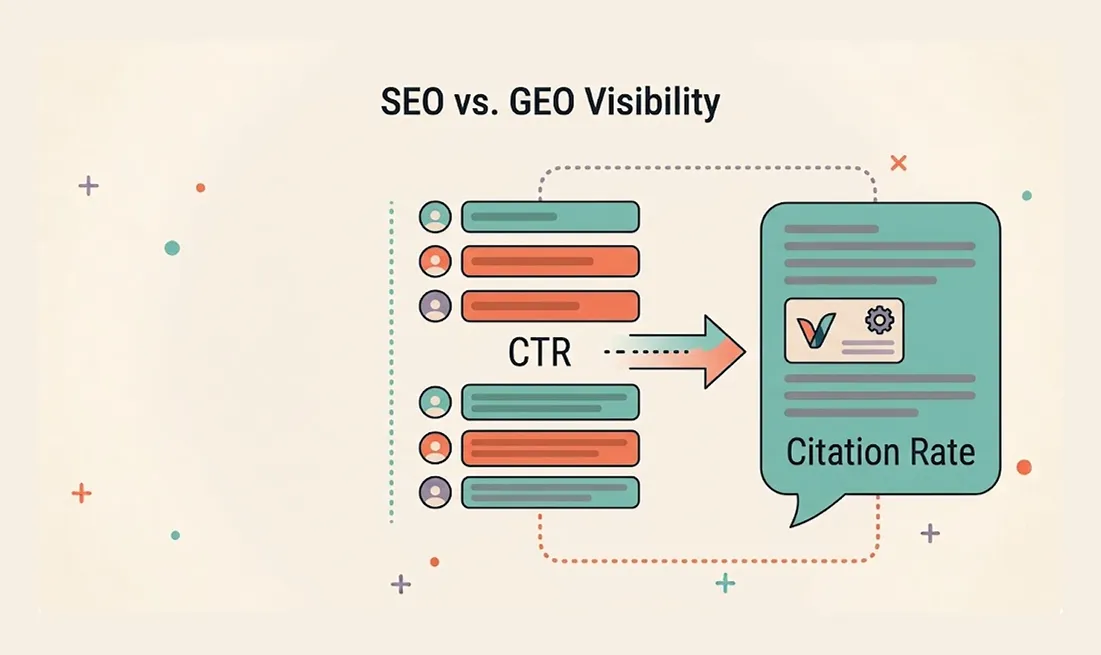
Citation Rate is the percentage of relevant buyer questions where an AI system references your brand or content in its answer. If you tested 100 category prompts and your domain got cited in 22 of them, your Citation Rate is 22%.
Here's the formula:
Citation Rate = (prompts where your content is cited ÷ total relevant prompts tested) × 100
When a model pulls in your comparison page, quotes your pricing guide, or leans on your original research to answer a "which vendor should I pick" question, that's not a vanity mention. That's your content earning a seat at the table during an active buying decision.
The short version: Citation Rate isn't a content metric. It's an authority signal.
Why CTR is losing its grip
CTR was built for a search-first world, where your job was to out-rank nine other blue links and win the click. It did that job well for two decades.
But people don't always scroll ten results anymore. They ask one direct question and trust the model to synthesize the field for them. A lot of influence now happens in that gap, before a single visit ever registers in your analytics.
Picture a typical path today. A buyer sees your brand cited in an AI answer. They mentally compare you against two competitors the model named alongside you. They shortlist you without clicking. Days later they come back through a branded search, and that visit is the one your dashboard credits.
If you only track the final click, you're measuring the last step of a decision that was mostly made somewhere you can't see.
What buyers are actually trying to figure out
B2B buyers use AI for the same reason they used to use analyst reports: to cut effort and cut risk. When they ask about a category, they're really asking a stack of questions:
- What does this product actually do?
- Who is it a good fit for, and who isn't it for?
- How does it compare to the alternatives?
- What does pricing realistically look like?
- How painful is implementation?
- Can I trust this vendor?
This is exactly why soft marketing language stopped working. "Streamline your operations" and "unlock efficiency" don't help a buyer decide anything, and they give an AI model nothing concrete to quote. Specific, checkable content is what gets pulled into answers. Fluff gets skipped.
The metrics worth tracking now
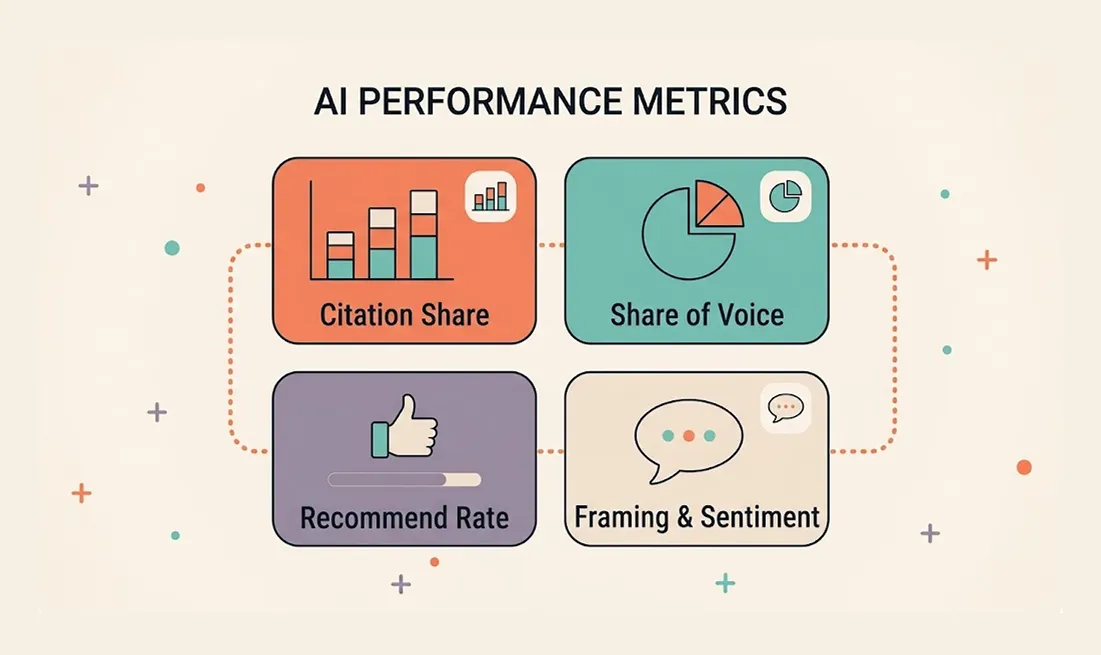
Traffic and rankings still have their place, but they don't tell you what's happening inside the models. These four do:
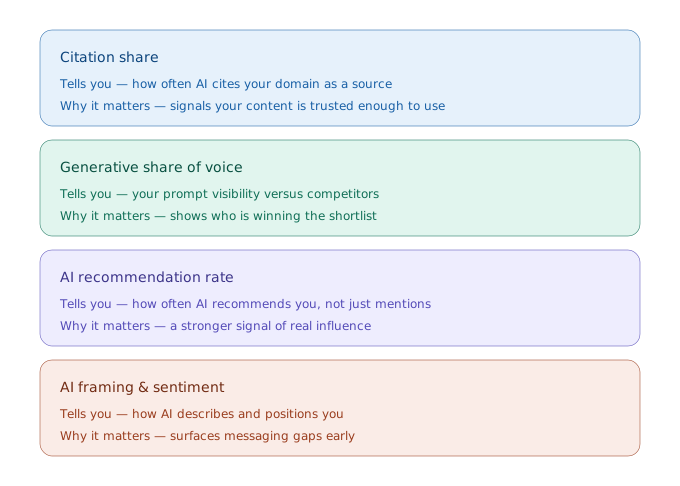
The thread connecting all four: they measure what happens before the click, while the shortlist is still being formed.
What to stop reporting
Some numbers look great in a slide and tell you almost nothing about whether buyers trust you. Quietly retire these:
- Total brand mentions with no prompt context
- Blended scores mashed across every AI engine at once
- Isolated organic clicks with no assisted attribution
- Raw traffic spikes that don't map to any real intent
They're not wrong, exactly. They just can't tell you whether your brand made the cut at the moment of decision, which is the only thing this exercise is about.
How to build a baseline (without an enterprise budget)
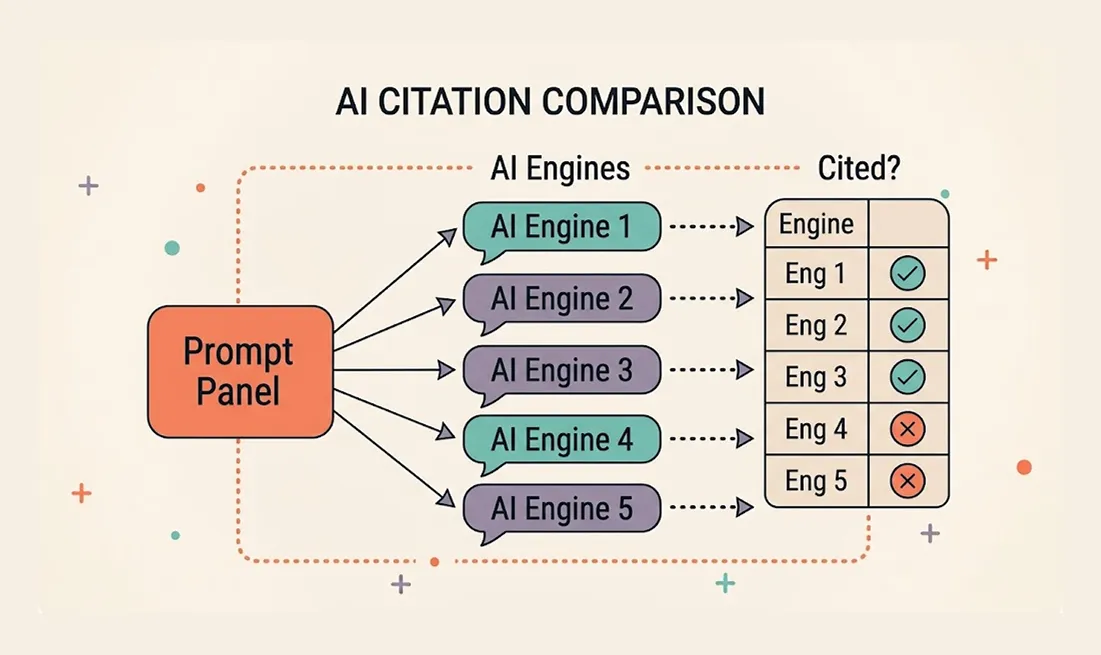
You don't need a fancy platform to start. You need a repeatable test.
- Build a prompt panel. Pull real questions from sales calls, demo forms, support tickets, competitor comparisons, and customer interviews. Group them into buckets: problem awareness, vendor comparison, pricing, implementation, and switching risk.
- Run the panel across the major engines. Ask the same questions in Google AI Overviews, Perplexity, ChatGPT, Claude, and Copilot. For each, note three things: did they cite you, did they recommend you, and which competitors showed up instead.
- Isolate AI-assisted referrals. In analytics, separate traffic from AI referral sources where you can, and compare it against organic and direct. These visitors often convert better, because they've already done most of the evaluation before they arrive.
- Just ask your buyers. Add one open field to your forms: "How did you first hear about us?" Plenty of people will name an AI assistant long before your attribution model catches up.
Re-run the panel monthly. The trend line matters more than any single score.
What strong AI visibility actually looks like
Being mentioned is table stakes. Being described well is the goal.
Brands that consistently get cited tend to share a few habits. They define their category in plain language. They publish comparison-ready pages instead of hiding behind demos. They put out original data and research the models can attribute. They earn consistent third-party references. And they answer buyer questions directly, in language that's easy to lift and quote.
Here's the catch worth sitting with: a page built purely to rank is not automatically a page built to be cited. Those are two different jobs. Ranking rewards keyword coverage and links. Citation rewards clarity, specificity, and quotable proof.
What this means for Clouda
Clouda works with B2B commerce companies, manufacturers and distributors, connecting fragmented ERP, commerce, and CRM systems and then layering AI on top for automation and forecasting. It's a considered, high-trust purchase, and the research now starts in an AI chat.
So the shift is direct. When a distribution or manufacturing leader asks an assistant "how do I connect my ERP to my commerce platform" or "who modernizes fragmented B2B operations," the win isn't just being found later. It's being the source the model reaches for when it builds the shortlist.
That takes more than blog volume. It takes clear positioning, real proof, honest comparisons, and structured content a model can cite with confidence. In practice, that means turning what Clouda already knows, about integration, pricing, and implementation in B2B commerce, into pages built to be quoted, not just ranked.
Frequently Asked Questions
How is Citation Rate different from CTR?
CTR measures clicks after someone finds you in search results. Citation Rate measures whether an AI system mentions you while forming its answer, influence that happens before, or entirely without, a click.
Which AI engines should I test?
Start with the ones your buyers use: Google AI Overviews, ChatGPT, Perplexity, Claude, and Microsoft Copilot. Run the same prompt panel across all of them so results are comparable.
How often should I measure it?
Monthly is a sensible cadence. Models and their sources shift constantly, so a single snapshot is a weak signal; the trend over time is what you act on.
What kind of content gets cited most?
Specific, checkable content: clear category definitions, comparison pages, pricing guidance, and original data or research. Vague benefit language rarely gets pulled into an answer.
The takeaway
CTR still matters. It's just no longer the whole story. If your buyer meets you inside an AI answer, that answer is now part of your funnel, and Citation Rate is how you measure whether you're showing up where decisions actually begin.
Want to see how often AI assistants cite you in your category? Talk to Clouda about building your first AI-visibility baseline.
What is Citation Rate?
Why CTR is losing its grip
What buyers are actually trying to figure out
The metrics worth tracking now
What to stop reporting
How to build a baseline (without an enterprise budget)
What strong AI visibility actually looks like
What this means for Clouda
Frequently Asked Questions
The takeaway
Identify and Execute AI Opportunities With Clouda
Fill out the form and schedule a session with our team to assess your operations and identify where AI can create real impact.
Learn how our seven-stage engagement framework turns AI opportunities into practical, measurable business outcomes.
Fill out the form and schedule a session with our team to assess your operations and identify where AI can create real impact.
Learn how our seven-stage engagement framework turns AI opportunities into practical, measurable business outcomes.