Expanding the Limits of Traditional B2B Product Discovery

Recap: The Product Discovery Challenge in Modern B2B Commerce
In the previous article, we explored why product discovery remains a persistent challenge in B2B ecommerce.
Many organizations focus their digital commerce efforts on ERP integrations, complex pricing structures, customer portals, and contract-based purchasing. Yet an equally important issue often receives less attention: how buyers identify the correct product within complex catalogs. Modern B2B catalogs can contain tens of thousands of SKUs, many requiring technical understanding to evaluate. Buyers must interpret specifications, compatibility requirements, and compliance standards before making a decision.
Despite this complexity, most B2B platforms still rely on traditional discovery tools such as keyword search, categories, and attribute filters. These tools assume users already know the correct terminology and product type.
In reality, many engineers and procurement teams begin with a technical problem rather than a product name, making product discovery slower and more difficult in complex B2B environments.
Moving Beyond Keywords: Intent-Driven and Adaptive Discovery
Most traditional B2B platforms rely on a combination of keyword search and attribute filters. While effective in simple cases, these methods often fall short when queries are vague, incomplete, or expressed in non-standard terminology. As a result, relevant products may be missed, and users are forced to repeatedly refine their searches.
Since traditional search struggles because buyers begin with problems rather than product names, a more advanced product discovery system should interpret those problems rather than relying on keyword combinations.
This is where intent understanding becomes important.
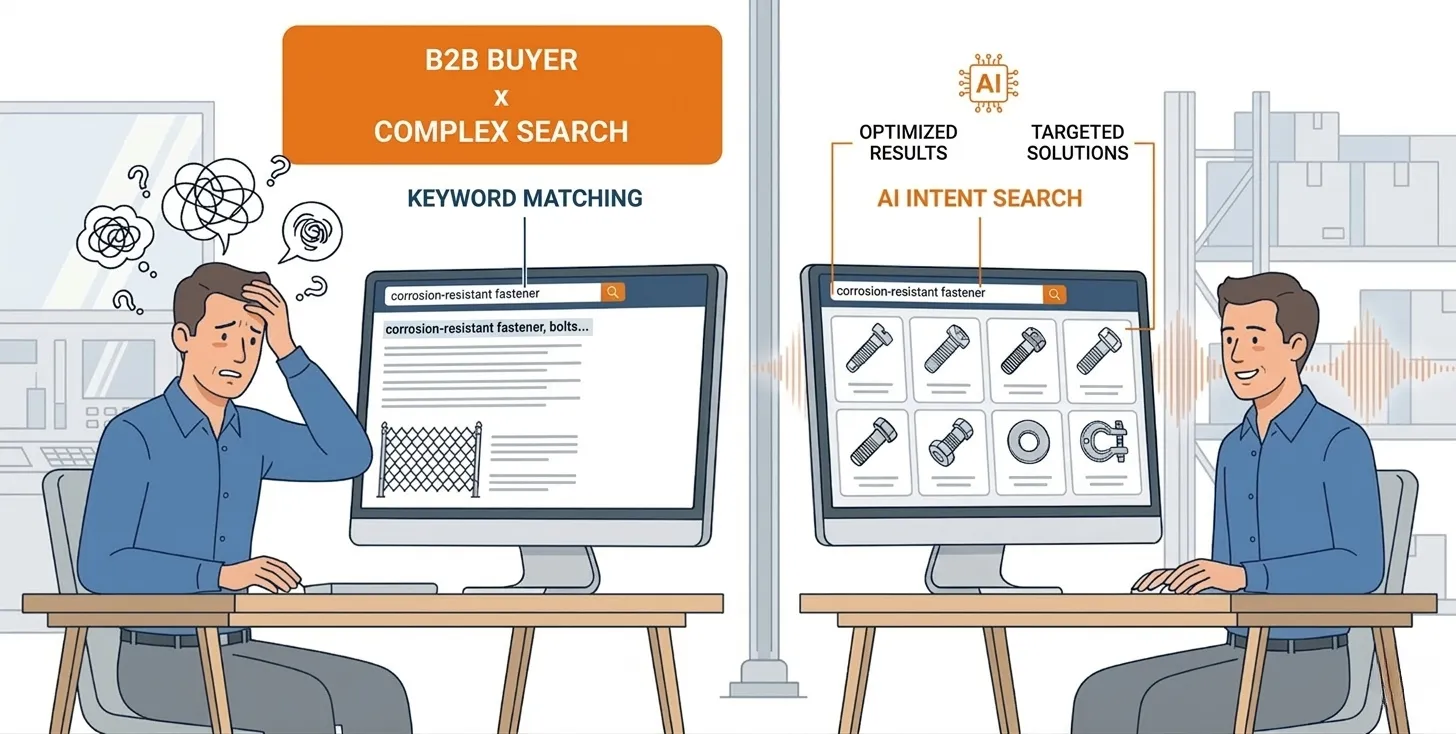
Most traditional product discovery systems match words, not meaning. For example, a search for “corrosion-resistant fastener” returns products with similar terms—but doesn’t fully capture what the user is trying to achieve.
Intent-based approaches focus on the underlying objective behind a query—including operating conditions, constraints, and success criteria.
So a request like: “Find a corrosion-resistant fastener”
may actually involve factors like environmental exposure, load conditions, or compliance requirements. The goal is not just to match keywords, but to identify a product that performs reliably under those conditions.
When product discovery systems can interpret this deeper layer of intent, discovery shifts. Engineers can describe the problem, and the system maps it to relevant product categories, specifications, and constraints.
Combined with multi-strategy search, this creates a more flexible and effective discovery process—one that adapts to both precise and exploratory queries.
Product discovery moves from a catalog-first process to a problem-first, adaptive experience, better aligned with how engineers actually work.
From Product Listings to Engineering-Justified Recommendations
While an intent-driven search improves how products are found, another challenge still remains: understanding why a product is the right choice.
Most B2B platforms stop at returning a list of SKUs. Engineers are then left to evaluate each option manually—reviewing specifications, checking compatibility, and determining whether a product truly fits their application. In complex environments, this step often takes more time than the search itself.
A more advanced approach is to move beyond listings and provide engineering-justified recommendations.
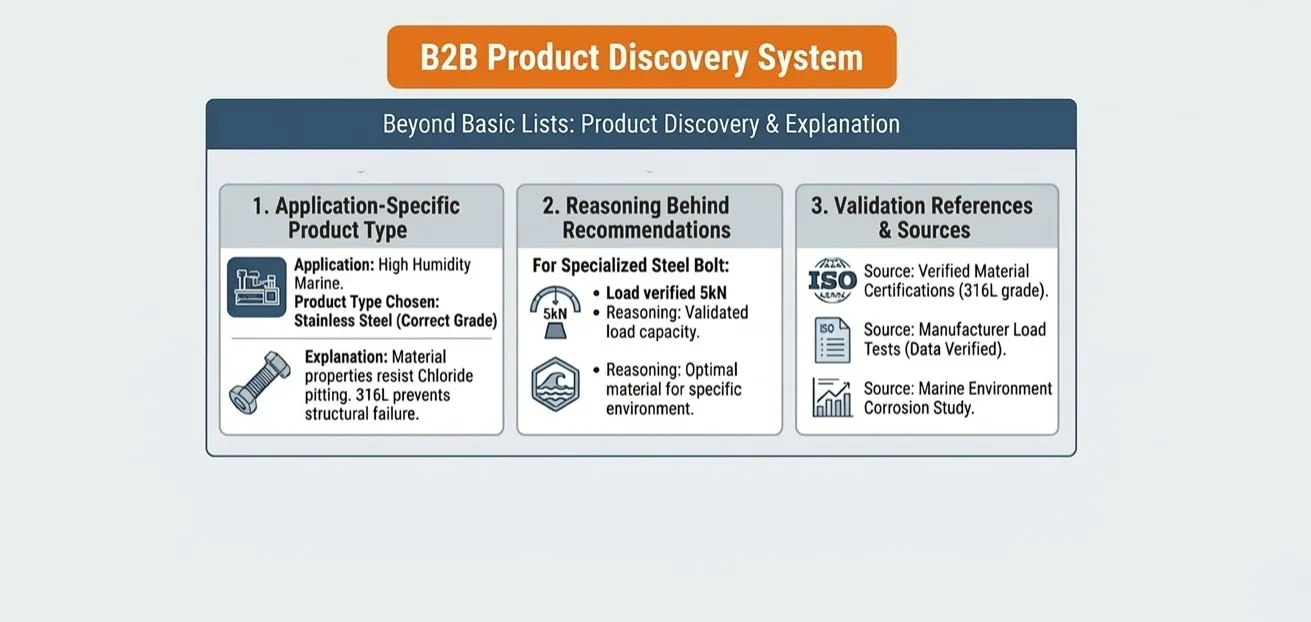
Instead of simply showing products, a modern b2b product discovery system explains:
• why a specific product type fits the application
•the reasoning behind each recommendation
•supporting references or sources that validate the selection
This separates the design logic from the catalog, making the decision process more transparent.
For example, let’s say an engineer selecting a fastener for an offshore oil platform might see a traditional result like:
• A4-80 stainless steel bolt
• galvanized hex bolt
• coated alloy fastener
At this point, they must manually determine:
• which material resists saltwater corrosion
• whether coatings will degrade over time
• if the fastener meets load and safety requirements
With engineering-justified recommendations, an advanced b2b product discovery system instead presents: Recommended: A4-80 stainless steel bolt
• Reason: High resistance to chloride-induced corrosion, suitable for marine environments
• Conditions matched: saltwater exposure, high humidity
• Reference: Relevant marine corrosion standards
Instead of just seeing options, the engineer immediately understands why this product fits the application.
For engineers, this has a meaningful impact. It becomes easier to:
•trust the recommendations
•reuse explanations in design reviews
•validate decisions against internal standards
As a result, product discovery evolves from a simple search task into a guided engineering decision process—where users are not just finding products, but understanding and justifying their choices.
Standards-Grounded Selection and Decision-Ready Outputs
As recommendations become more structured and explainable, the next step is ensuring they are also compliant and ready for action.
In many organizations, product selection does not end with identifying a suitable component. Engineers must still verify that it meets relevant standards, document their reasoning, and prepare information for procurement and approval.
This process is often manual and time-consuming.
Modern product discovery systems are beginning to integrate these steps directly into the workflow by embedding standards and compliance checks into product selection itself.
Instead of treating compliance as a separate task, a state-of-the-art b2b product discovery system can:
• identify relevant engineering standards and requirements
• verify that recommended products meet those criteria
• present supporting references alongside each recommendation
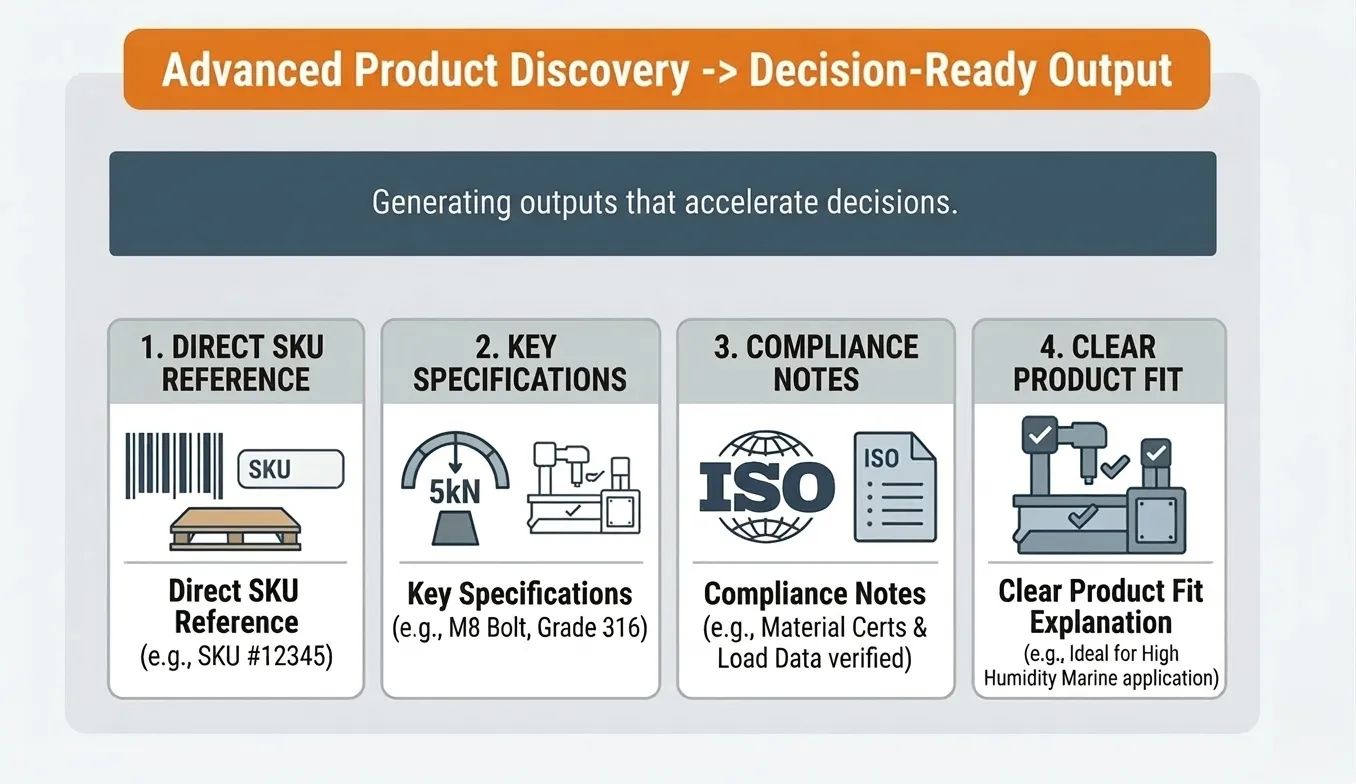
In addition, these advanced systems can generate decision-ready outputs, such as:
• direct SKU references
• key specifications
• compliance notes
• clear explanations of product fit
This reduces the need for manual documentation and makes it easier to move from discovery to decision.
For organizations, the impact is significant:
• lower compliance and regulatory risk
• faster design approvals
• simplified audit and documentation processes
• more efficient procurement workflows
Product discovery, in this sense, becomes not just about finding the right product—but about preparing decisions that are ready to be validated and executed.
Bridging Engineering Knowledge and Product Catalog Intelligence
At the core of these improvements is a deeper shift in how product discovery systems are structured.
Traditional platforms treat engineering knowledge and product catalogs as separate layers. One provides technical understanding, while the other stores product data. Connecting the two is left to the user.
Modern approaches aim to bridge this gap.
Instead of only displaying product listings, product discovery systems can first engage with the engineering problem itself—answering questions about operating conditions, materials, or performance requirements—before mapping those insights to available products.
This is made possible by combining engineering knowledge with structured catalog intelligence.
For example, a modern b2b product discovery system can interpret and evaluate attributes such as:
• diameter ranges
• thread pitch
• coatings and surface treatments
• corrosion resistance ratings
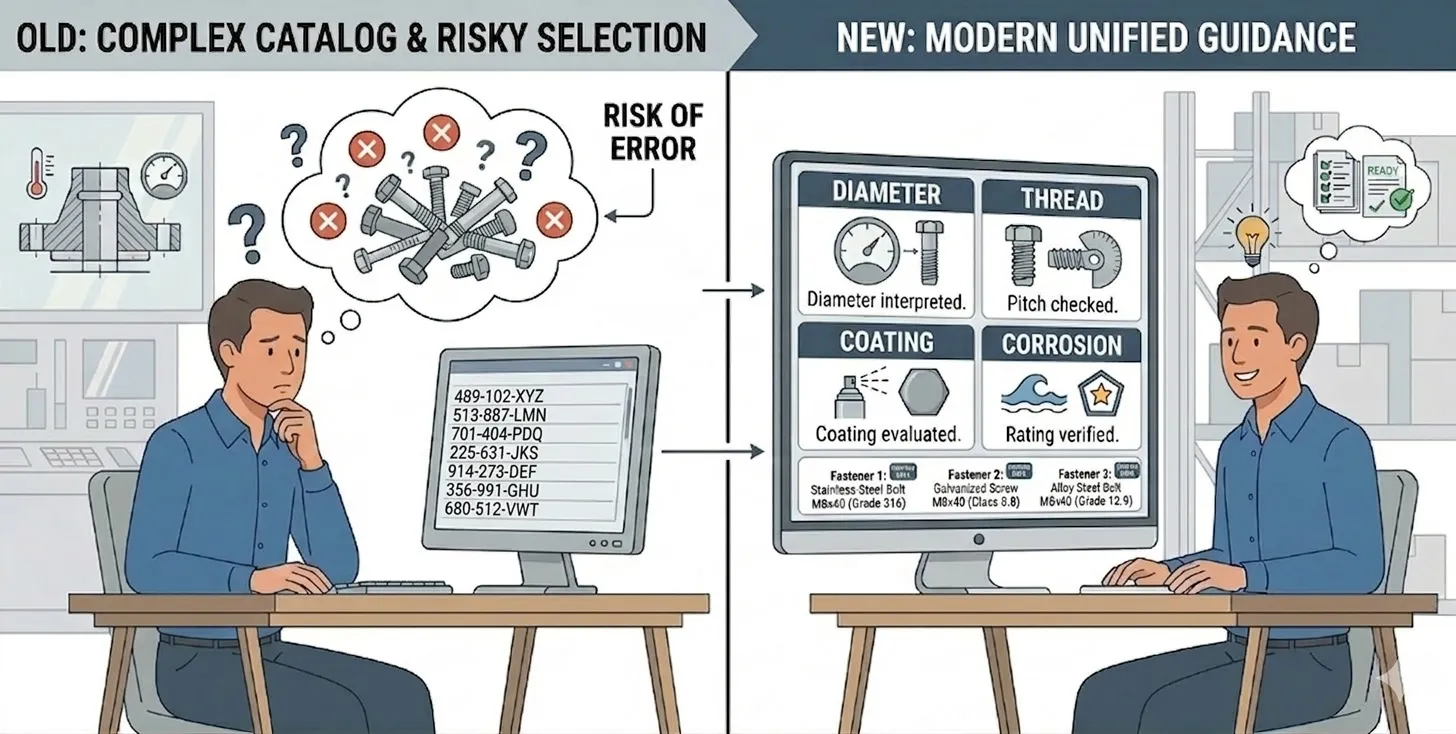
By understanding both the technical context and the structured product data, the product discovery system can recommend options that more precisely match real-world requirements.
Just as importantly, these recommendations are grounded in actual catalog inventory, ensuring that every suggested product corresponds to a real, available SKU.
This eliminates the risk of “hallucinated” or non-existent products—an important consideration in procurement environments.
For engineers and procurement teams, this creates a more unified experience:
• technical guidance and product options are delivered in one place
• the risk of near-miss or incorrect selections is reduced
• specification accuracy improves across the workflow
• procurement decisions remain tied to verified, real-world products
In effect, product discovery becomes a bridge between how engineers think about problems and what organizations can actually purchase and deploy.
Recap: The Product Discovery Challenge in Modern B2B Commerce
Moving Beyond Keywords: Intent-Driven and Adaptive Discovery
From Product Listings to Engineering-Justified Recommendations
Standards-Grounded Selection and Decision-Ready Outputs
Bridging Engineering Knowledge and Product Catalog Intelligence
Get Your Free Product Discovery Feature list
Fill out the form and choose a time that works for you. Before the call, we’ll share a Product Discovery feature overview, so you can see how the system approaches real-world product selection.
Fill out the form and choose a time that works for you. Before the call, we’ll share a Product Discovery feature overview, so you can see how the system approaches real-world product selection.