The Four Stages of Enterprise AI Adoption And Why Most Organisations Never Reach the Last One

Artificial intelligence has moved beyond experimentation. Most enterprise organisations have already introduced AI into at least one part of the business, whether through customer service, software development, operational planning, or internal productivity. The conversation has shifted from whether to adopt AI to how far organisations can integrate it into the way they operate.
Despite that momentum, maturity varies dramatically. Some organisations continue to treat AI as a collection of isolated pilots, while others are redesigning entire operating models around intelligent systems and connected data. Research from Boston Consulting Group suggests that only a small percentage of companies have reached this highest level of maturity, yet those organisations are reporting substantially stronger revenue growth and cost improvements than their peers. The gap is not explained by larger technology budgets or access to better models. It is explained by how AI has been embedded into the business itself.
AI Adoption Is Not the Same as AI Maturity
Enterprise leaders often measure progress by the number of AI initiatives underway. Dashboards list pilots, departments report successful proofs of concept, and vendors showcase new capabilities introduced across the organisation. While these activities demonstrate momentum, they reveal very little about whether AI is changing how the business performs.
True maturity reflects something different. It measures how deeply AI supports operational decisions, how consistently it is used across business functions, and whether it delivers measurable improvements rather than isolated efficiencies. Organisations with high AI maturity rarely describe their initiatives as separate projects because AI has become part of everyday operations instead of a technology programme running alongside them.
This distinction matters because many organisations mistake activity for progress. Introducing more AI tools does not necessarily increase maturity if the underlying workflows, data foundations, and governance remain fragmented.
Understanding the Four Stages of AI Maturity
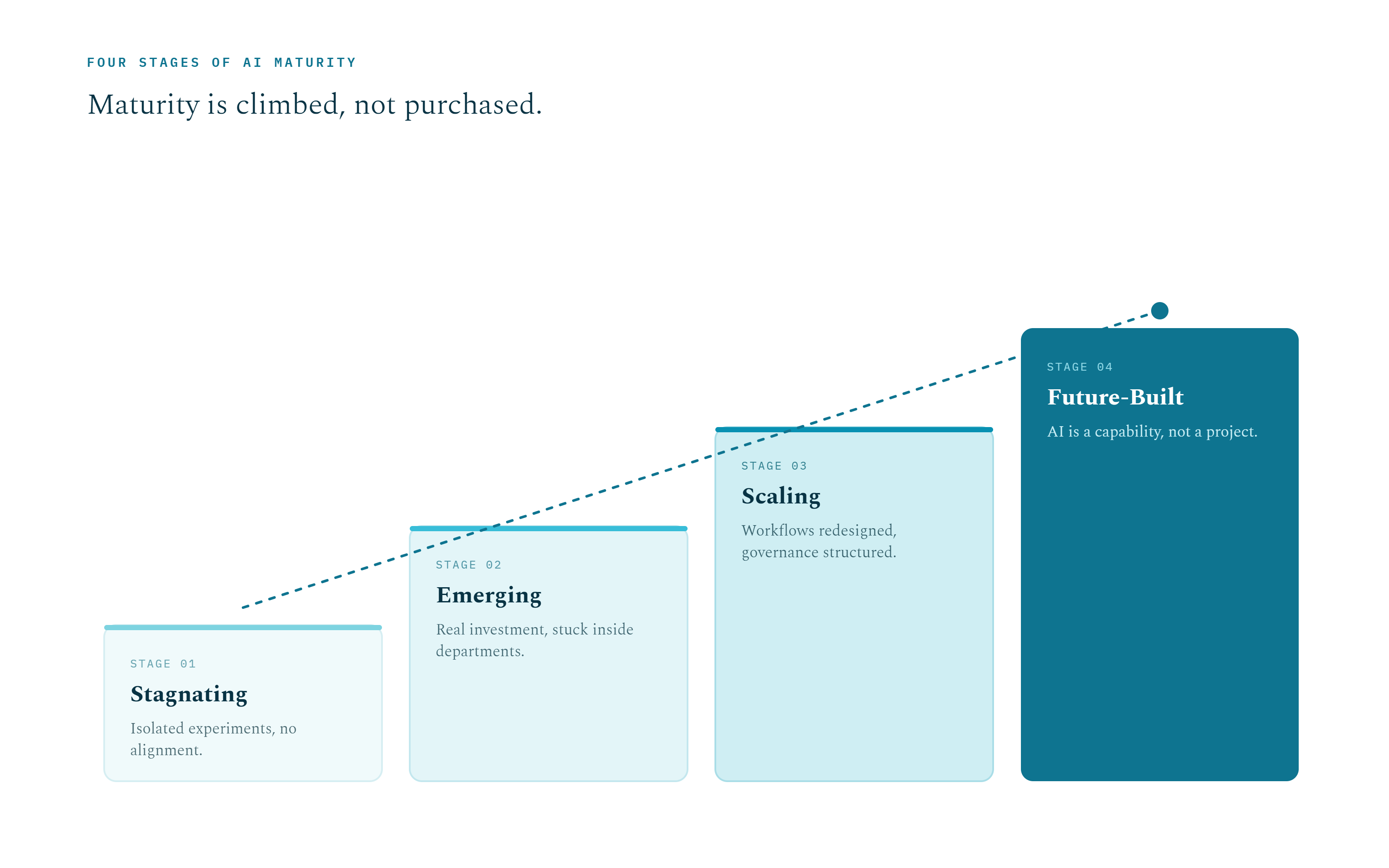
Enterprise AI maturity develops gradually rather than through a single transformation programme. Most organisations move through predictable stages as they build confidence, improve governance, and connect their operational environment.
Stage One — AI Stagnating
AI remains experimental and disconnected from core operations. Individual teams test isolated tools with limited executive alignment, and projects rarely progress beyond demonstrations.
Stage Two — Emerging
The organisation begins investing seriously in AI, but adoption remains concentrated within individual departments. Early successes appear, although governance, integration, and operational consistency are still developing.
Stage Three — Scaling
AI becomes part of multiple business functions. Workflows are redesigned around connected systems, governance becomes more structured, and successful use cases begin expanding across the organisation instead of remaining isolated.
Stage Four — Future-Built
AI operates as an organisational capability rather than a collection of projects. Data, processes, governance, and decision-making work together to support continuous improvement, allowing new AI capabilities to be introduced without repeatedly rebuilding the operational foundation.
These stages should not be viewed as a checklist completed within a fixed timeframe. Organisations progress at different speeds depending on leadership priorities, operational complexity, and the quality of the foundations supporting AI adoption.
Why Most Organisations Plateau in the Emerging Stage
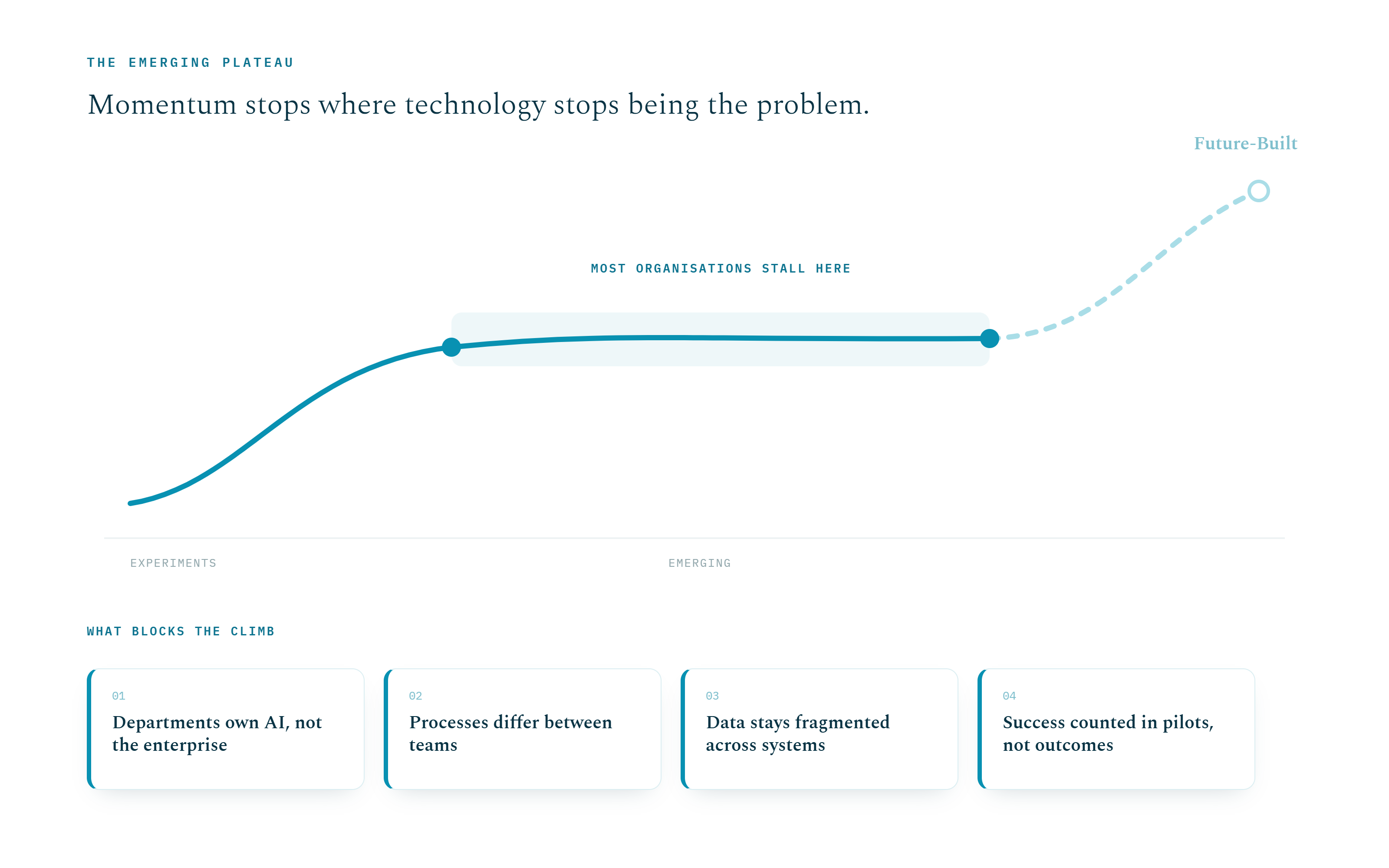
Research indicates that the largest proportion of organisations currently sits within the Emerging stage. They have moved beyond experimentation, invested in new technologies, and demonstrated successful use cases, yet relatively few continue progressing toward enterprise-wide adoption.
Several factors consistently contribute to this plateau:
- AI initiatives remain owned by individual departments rather than becoming enterprise programmes.
- Business processes continue to differ significantly between teams, making standardisation difficult.
- Data remains fragmented across operational systems, limiting the ability to scale successful use cases.
- Governance evolves more slowly than technology adoption, creating uncertainty around ownership and decision-making.
- Success is measured by the number of pilots completed instead of measurable operational outcomes.
None of these challenges suggest that AI has failed. Rather, they indicate that organisations have reached the point where technology alone is no longer enough. Advancing further requires operational alignment, executive sponsorship, and a deliberate redesign of how work moves across the business.
What Separates the Most Mature Organisations
Reaching the highest level of AI maturity is not about deploying more AI. It is about creating an operating environment where new capabilities can be introduced quickly, governed consistently, and measured against business outcomes. The organisations that achieve this level rarely treat AI as a standalone programme. Instead, it becomes part of how decisions are made, work is coordinated, and value is delivered across the enterprise.
Research from Boston Consulting Group highlights the business impact of this approach. Organisations classified as Future-Built report significantly stronger financial performance than their peers, achieving around five times greater revenue gains and three times greater cost reductions. Those outcomes are not driven by access to better technology. They reflect years of investment in operational discipline, connected systems, data governance, and leadership alignment.
The difference is that mature organisations no longer ask where AI can fit into the business. They have already redesigned the business so AI becomes a natural extension of everyday operations.
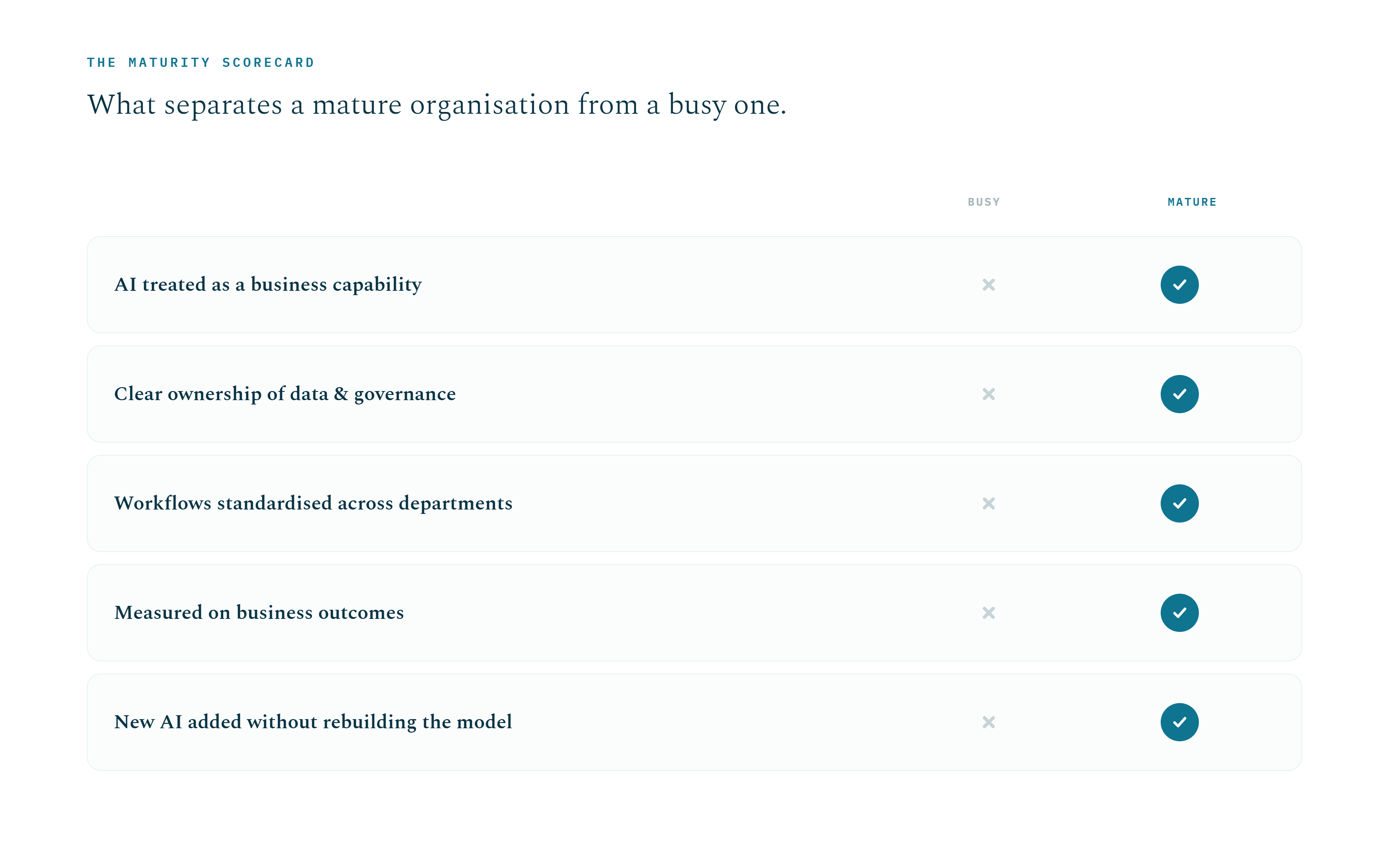
Although every organisation follows its own transformation journey, the companies making sustained progress consistently demonstrate a similar set of operational characteristics.
They typically:
- Treat AI as a business capability rather than an isolated technology initiative.
- Establish clear ownership for data, governance, and operational decision-making before scaling automation.
- Standardise workflows across departments to ensure AI operates against consistent business rules.
- Measure success through business performance indicators such as revenue growth, customer experience, operational efficiency, and cycle times instead of counting AI deployments.
- Continuously refine processes as new technologies emerge rather than rebuilding their operating model with every innovation.
These organisations also recognise that maturity is cumulative. Each successful initiative strengthens the next because the underlying operational environment has already been designed to support continuous improvement.
Measuring Progress Beyond Technology
Many executive teams ask whether they are "ready for AI." A more useful question is whether the organisation is becoming progressively more capable of adopting AI at scale. Readiness is a point in time. Maturity is an ongoing organisational capability.
A practical assessment should extend beyond software and infrastructure. Leaders should examine whether operational processes are consistent across business units, whether data moves reliably between systems, whether governance supports responsible decision-making, and whether departments are working from shared objectives rather than isolated priorities. These factors ultimately determine whether successful pilots become enterprise capabilities or remain confined to individual teams.
The most effective organisations review AI maturity in the same way they evaluate operational performance. Rather than treating transformation as a one-off programme, they establish regular reviews that identify where progress has slowed, which capabilities require further investment, and what barriers continue preventing broader adoption.
Questions Every Leadership Team Should Be Asking
A useful maturity discussion often begins with straightforward operational questions rather than technical ones.
- Are our most important business processes consistent across departments?
- Can employees access the information they need without switching between multiple disconnected systems?
- Do we measure AI initiatives against business outcomes or technology adoption?
- Are governance responsibilities clearly defined as AI becomes more embedded in everyday decisions?
- Could we introduce another AI capability today without redesigning the surrounding operational environment?
The answers to these questions often reveal far more about organisational maturity than the number of AI tools currently in use.
 Maturity Is Earned, Not Purchased
The greatest competitive advantage belongs not to the organisations adopting the most AI, but to those building an operating model capable of sustaining it.
AI Maturity Is Built Through Operational Discipline
Artificial intelligence will continue evolving at a remarkable pace, but organisational maturity develops more gradually. It reflects leadership decisions, operational consistency, governance, and a willingness to redesign how work moves through the business before introducing new technology. Those foundations cannot be accelerated simply by purchasing another platform or launching another pilot.
The organisations achieving the strongest results have recognised that AI maturity is not defined by experimentation alone. It is earned through connected operations, standardised workflows, measurable outcomes, and a long-term commitment to continuous improvement. Research increasingly supports this conclusion: the greatest competitive advantage belongs not to the organisations adopting the most AI, but to those building an operating model capable of sustaining it.
For enterprise leaders, the question is no longer whether AI should become part of the organisation. That decision has largely been made. The more important question is where the organisation sits on its maturity journey today—and what operational changes are required to move confidently to the next stage. That perspective shifts AI from being another technology investment to becoming a lasting business capability, capable of delivering value well beyond the current generation of tools.
AI Adoption Is Not the Same as AI Maturity
Understanding the Four Stages of AI Maturity
Why Most Organisations Plateau in the Emerging Stage
What Separates the Most Mature Organisations
Characteristics Shared by High-Maturity Organisations
Measuring Progress Beyond Technology
Questions Every Leadership Team Should Be Asking
AI Maturity Is Built Through Operational Discipline
Identify and Execute AI Opportunities With Clouda
Fill out the form and schedule a session with our team to assess your operations and identify where AI can create real impact.
Learn how our seven-stage engagement framework turns AI opportunities into practical, measurable business outcomes.
Fill out the form and schedule a session with our team to assess your operations and identify where AI can create real impact.
Learn how our seven-stage engagement framework turns AI opportunities into practical, measurable business outcomes.