Governed AI Agents: Why the Next Competitive Advantage Is Trust, Not Automation

Artificial intelligence is entering a new phase of enterprise adoption. The conversation has moved beyond copilots that generate text or answer questions and towards AI agents capable of carrying out work on behalf of people. These systems can process documents, update records, monitor supply chains, prepare quotations, coordinate workflows, and interact with multiple business applications with minimal human intervention. For organisations looking to improve efficiency at scale, the opportunity is considerable.
The challenge is that every new capability introduces a new layer of operational risk. An AI agent making decisions from incomplete data, accessing information it should not see, or triggering actions without appropriate oversight can create problems far more quickly than a manual process ever could. Recent enterprise research reflects this growing concern. The 2026 Writer Enterprise AI Survey found that 67% of executives believe their organisation has already experienced a data breach linked to unauthorised AI usage. The future of enterprise AI will therefore depend not only on what these systems can automate, but on how well organisations govern them.
Automation Without Governance Creates New Operational Risks
For years, businesses have focused on automating repetitive work wherever possible. AI agents appear to extend that ambition by taking on increasingly complex tasks, from handling customer enquiries to coordinating procurement activities and supporting financial operations. Yet automation alone does not guarantee better outcomes. When governance is absent, organisations often accelerate existing weaknesses instead of eliminating them.
Consider an AI agent responsible for preparing customer quotations. If pricing information comes from multiple systems, contract rules differ between departments, or approval policies are inconsistently applied, the agent has no reliable operational framework to follow. It may generate quotations more quickly, but it cannot distinguish between an outdated rule and an approved one unless the organisation has already established clear governance around data ownership, business logic, and decision authority.
This explains why governance is becoming a board-level discussion rather than simply an IT responsibility. AI agents are no longer isolated productivity tools; they are beginning to participate in business processes that directly affect customers, revenue, compliance, and operational performance.
What Governed AI Actually Means
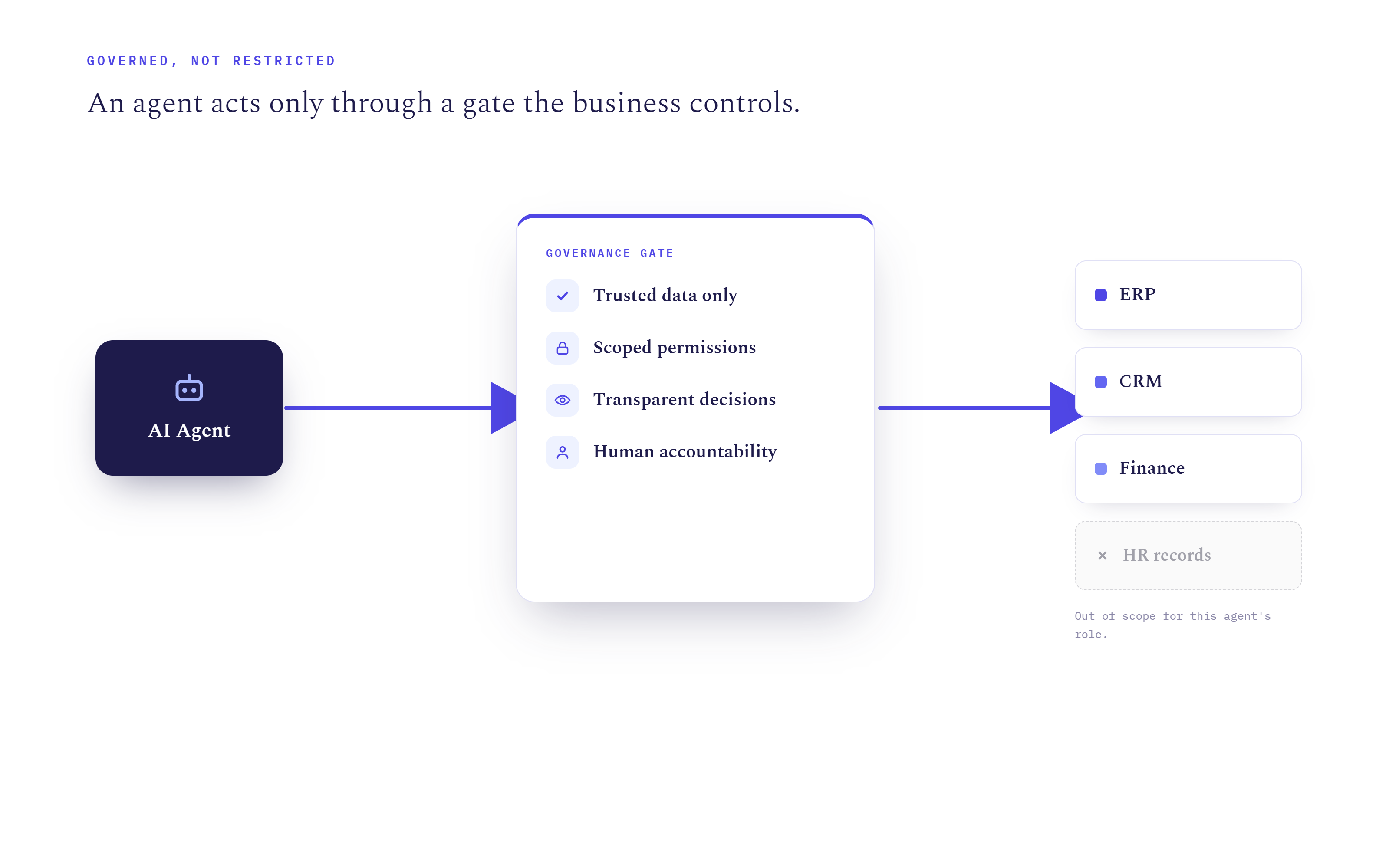
Governance is often associated with restriction, approval processes, or slowing innovation. In practice, effective AI governance exists to make innovation sustainable. It creates the operational boundaries that allow organisations to deploy intelligent systems confidently across critical business functions.
Connected to trusted business data
AI agents should operate using authoritative information drawn from governed enterprise systems rather than copied spreadsheets, exported files, or disconnected databases. Consistent data remains the foundation of reliable decision-making.
Operating within defined permissions
Not every agent requires access to every system. Permissions should reflect business responsibilities, ensuring AI only accesses the information necessary for its assigned role while maintaining existing security policies.
Producing transparent decisions
Enterprise AI should never function as a black box. Organisations need visibility into what information influenced an outcome, what actions were taken, and where human intervention occurred throughout the process.
Supporting human accountability
AI may automate tasks, but accountability remains with the organisation. Critical decisions involving financial commitments, compliance obligations, or customer outcomes should continue to include clearly defined human oversight where appropriate.
These principles are not barriers to adoption. They are the conditions that allow AI to move beyond isolated pilots into trusted operational capability.
The Hidden Cost of Shadow AI
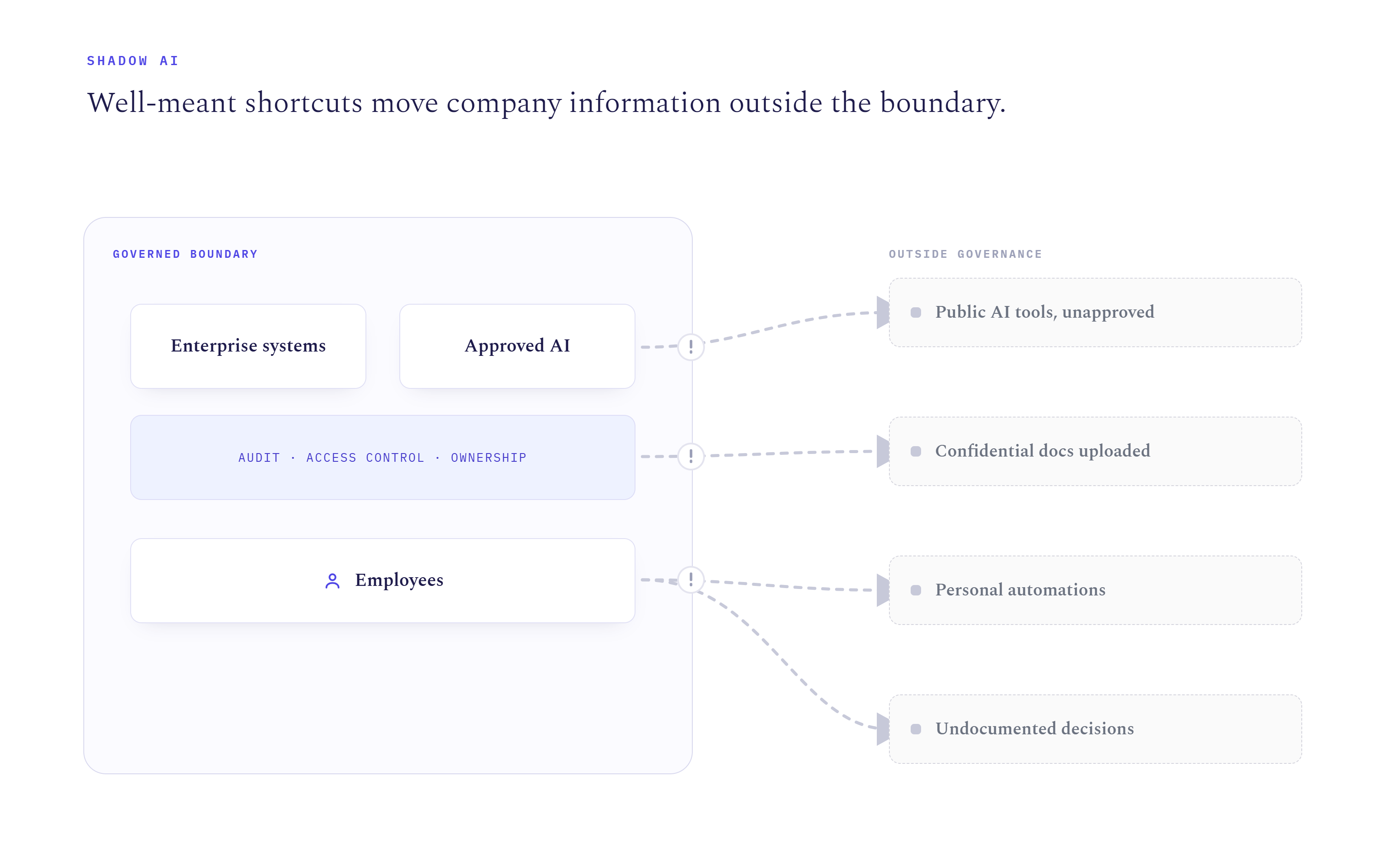
Many organisations are already experiencing AI adoption without formally introducing enterprise AI. Employees download browser extensions, connect public AI tools to internal spreadsheets, upload confidential documents into consumer applications, or build unofficial automations to remove repetitive work from their day. These individual decisions are usually well intentioned, but collectively they create an environment where business information moves beyond established governance.
Common warning signs include:
- Teams using different public AI tools without organisational approval or visibility.
- Sensitive business documents being uploaded into consumer AI platforms outside company policy.
- Employees building personal automations that no one else understands or maintains.
- Business decisions influenced by AI-generated outputs without documented review or accountability.
- Critical operational knowledge becoming embedded inside unofficial workflows rather than enterprise systems.
None of these activities necessarily indicate malicious behaviour. More often, they reflect employees attempting to work more efficiently than existing systems allow. The challenge is that informal automation scales organisational risk just as quickly as it scales productivity. Without governance, leadership loses visibility into where AI is being used, what information it accesses, and how business decisions are ultimately being made.
Building AI Agents the Enterprise Can Trust
The organisations making the strongest progress with AI are not necessarily deploying more agents than everyone else. They are deploying them within an environment designed for accountability, consistency, and continuous improvement. Trust is established long before the first agent is introduced, through clear governance, connected systems, and well-defined operational responsibilities.
This approach changes how AI is implemented across the enterprise. Instead of building individual automations around isolated tasks, organisations create a governed foundation that every future AI capability can use. Customer service agents, procurement assistants, document processing, forecasting models, and finance automation all operate against the same operational rules, drawing from the same trusted information and following the same governance framework. The result is an AI environment that scales without creating additional complexity.
Governed AI also changes how organisations respond to change. As new regulations emerge, new business units are acquired, or new technologies become available, AI capabilities can evolve without requiring every workflow to be redesigned from scratch. Governance provides the stability that allows innovation to continue over time.
What Mature AI Governance Looks Like
There is no universal governance framework that applies to every organisation, but the most mature enterprises consistently build their AI environments around a common set of principles.
These organisations typically:
- Connect AI agents directly to authoritative enterprise systems instead of relying on exported spreadsheets or duplicated data.
- Define ownership for business rules, operational decisions, and data domains before introducing automation.
- Apply existing security policies, identity management, and access controls consistently across both employees and AI agents.
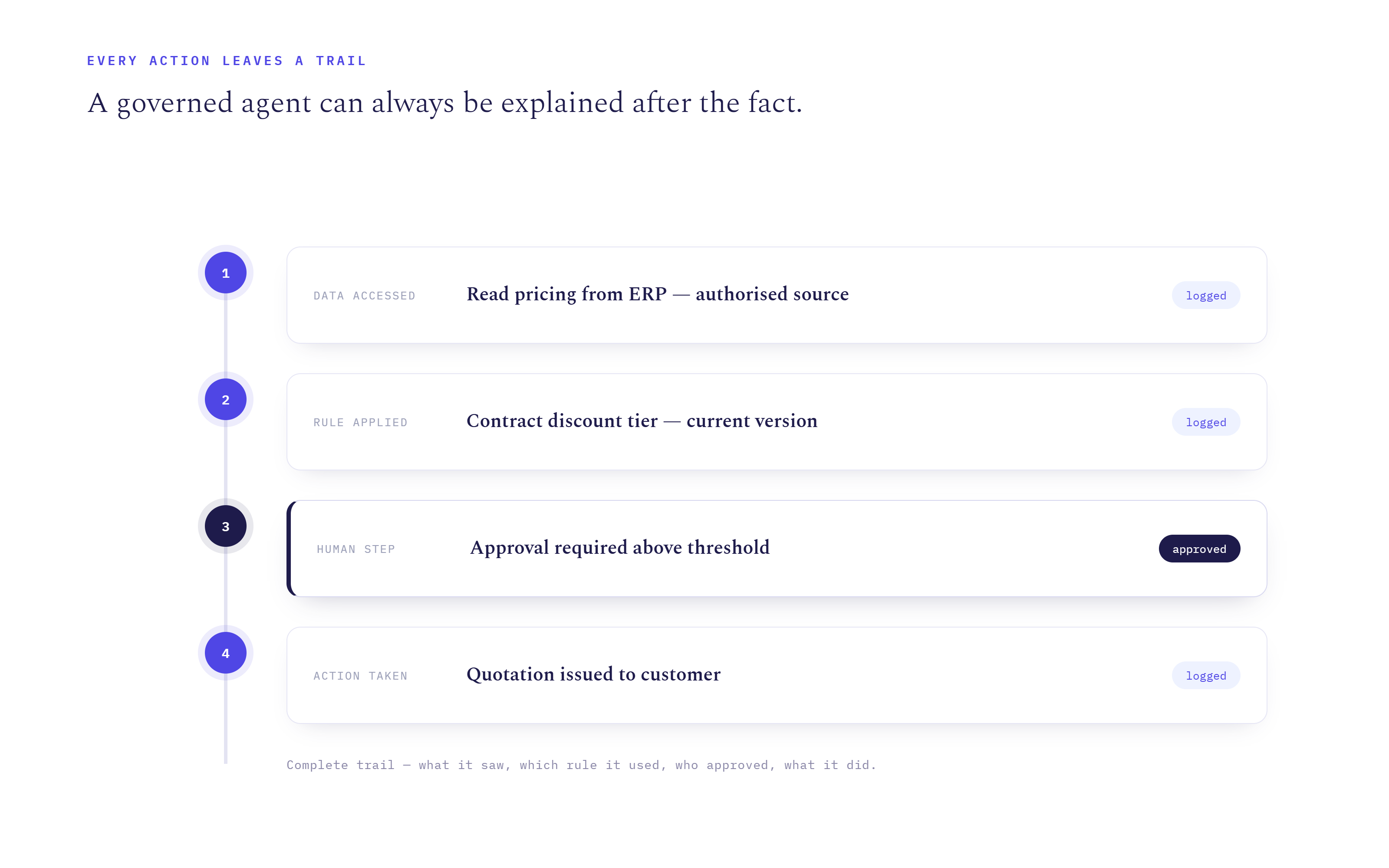
- Maintain complete audit trails showing what information an AI agent accessed, what actions it performed, and where human approvals occurred.
- Continuously monitor AI performance against business outcomes, refining workflows as operations evolve rather than treating deployment as a finished project.
What stands out is that none of these characteristics are unique to artificial intelligence. They reflect good operational management. AI simply raises the importance of applying those principles consistently because automated decisions occur more frequently, influence more business processes, and operate at a much greater scale than manual work ever could.
Governance Accelerates Innovation Rather Than Slowing It
One of the most persistent misconceptions surrounding enterprise AI is that governance delays innovation. In practice, the opposite is often true. Organisations with well-defined governance can adopt new AI capabilities more confidently because they already know how decisions are made, where trusted data resides, and who remains accountable for outcomes.
Without those foundations, every new AI initiative becomes a separate risk assessment. Security teams question data access, compliance teams review operational impacts, and business leaders debate ownership for each implementation. Progress slows not because governance exists, but because governance was never established before automation began. Mature organisations avoid this cycle by creating reusable governance frameworks that support future initiatives instead of rebuilding oversight every time a new capability is introduced.
This is becoming increasingly important as enterprises move from isolated AI projects to environments containing dozens, or eventually hundreds, of intelligent agents supporting different functions. Governance provides the consistency that allows innovation to scale without sacrificing operational control.
Governance Enables Sustainable AI Adoption
Effective governance supports long-term enterprise AI by providing:
- Operational consistency — AI agents follow common business rules regardless of department or function.
- Regulatory confidence — Decision-making processes remain transparent, auditable, and easier to review as requirements evolve.
- Technology flexibility — New AI capabilities can be introduced without redesigning governance from the beginning.
- Business trust — Employees, customers, and leadership understand how AI contributes to decisions rather than viewing it as an unpredictable black box.
Organisations that recognise governance as an enabler rather than an obstacle are generally better positioned to expand AI responsibly while maintaining confidence across the business.
 Trust Is the New Advantage
As AI becomes responsible for increasingly important business activities, trust will become just as valuable as automation itself.
Enterprise AI Will Be Defined by Trust
The next phase of enterprise AI is unlikely to be determined by which organisation deploys the greatest number of agents. Competitive advantage will belong to those that can operate intelligent systems safely, consistently, and at scale. As AI becomes responsible for increasingly important business activities, trust will become just as valuable as automation itself.
That trust is built through connected systems, reliable data, clear operational ownership, transparent decision-making, and governance that evolves alongside the business. Organisations investing in these foundations are creating an environment where AI can continue expanding without introducing unnecessary operational risk. Those relying on informal automations and disconnected tools may achieve short-term productivity gains, but they are also increasing the complexity they will eventually need to untangle.
Enterprise AI is no longer simply about introducing smarter technology. It is about creating an operating model capable of supporting intelligent automation over the long term. The organisations that understand this distinction will not only deploy AI more effectively today, they will also be better prepared for the capabilities that emerge tomorrow.
Automation Without Governance Creates New Operational Risks
What Governed AI Actually Means
The Hidden Cost of Shadow AI
Building AI Agents the Enterprise Can Trust
What Mature AI Governance Looks Like
Governance Accelerates Innovation Rather Than Slowing It
Governance Enables Sustainable AI Adoption
Enterprise AI Will Be Defined by Trust
Identify and Execute AI Opportunities With Clouda
Fill out the form and schedule a session with our team to assess your operations and identify where AI can create real impact.
Learn how our seven-stage engagement framework turns AI opportunities into practical, measurable business outcomes.
Fill out the form and schedule a session with our team to assess your operations and identify where AI can create real impact.
Learn how our seven-stage engagement framework turns AI opportunities into practical, measurable business outcomes.