How B2B Buyers Research Vendors in 2026: Why AI Is Now the First Touchpoint

B2B buying has changed, and it happened faster than most marketing teams could adjust for. In 2026, the first place many buyers go isn't Google, a review site, or a sales rep's inbox. It's an AI assistant.
A growing share of B2B buyers now start vendor research with a conversational AI instead of a traditional search engine. Practically, that means the first version of your brand a prospect encounters might not be your homepage or your best case study. It might be a synthesized answer: a model comparing vendors, weighing trade-offs, and quietly filtering out the options it considers weaker.
That shift matters because buyers aren't browsing casually anymore. They're asking sharper, more specific questions, things like: "Compare top enterprise supply chain software for mid-market manufacturing. Include pricing, pros and cons, implementation effort, and ideal use cases."
In seconds, the AI returns a shortlist. Some brands make it. Some get left out entirely. Some are described accurately; others get flattened into a couple of generic lines that don't do them justice.
If your company is missing from that answer, you haven't just lost a click. You've lost consideration before the buyer ever reaches your site.
 Key Takeaways
B2B buyers increasingly start vendor research with AI assistants instead of search engines. Showing up means winning across three layers at once: SEO (discovery), AEO (direct answers), and GEO (being cited and recommended), with content that's specific, sourced, and structured to be extracted, not just read.
SEO, AEO, and GEO: What Actually Changed
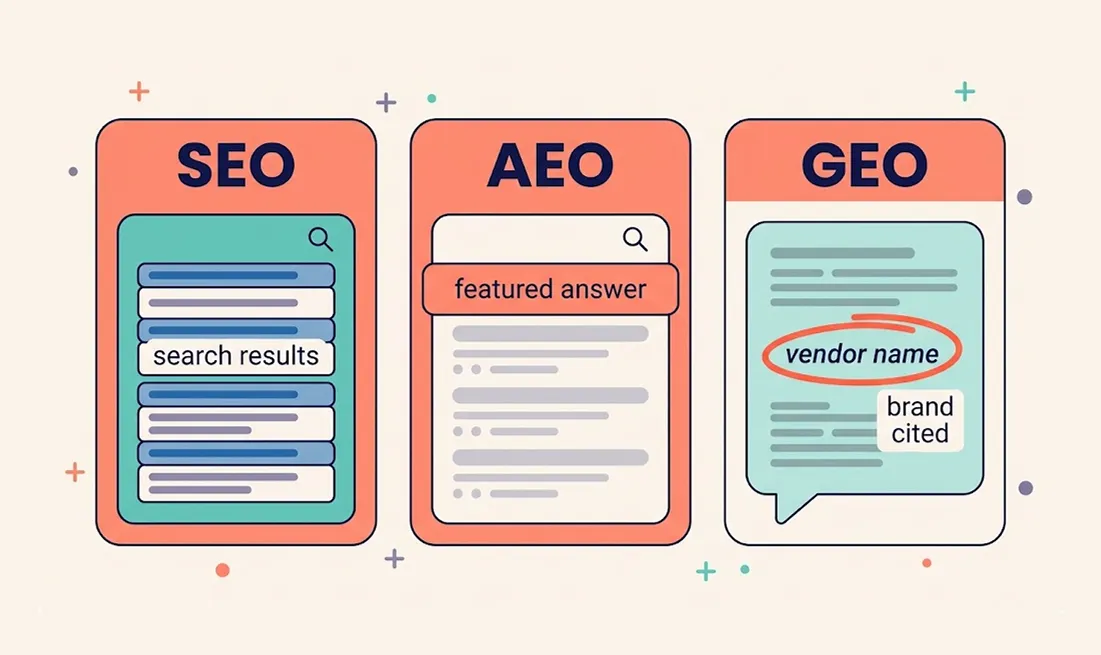
A lot of teams talk about SEO, AEO, and GEO like they're competing strategies. They're not, they're different layers of the same visibility problem.
- SEO (Search Engine Optimization): gets your content discovered in search engines.
- AEO (Answer Engine Optimization): gets your content pulled into direct answers and snippets.
- GEO (Generative Engine Optimization): gets your brand cited and recommended inside AI-generated responses.
Put simply: SEO gets you found. AEO gets you pulled in. GEO gets you chosen.
For B2B brands, that distinction matters more than it sounds. Buyers aren't just hunting for pages anymore, they're looking for answers they can trust, compare, and justify to the rest of their team.
Why This Matters Now
This isn't a future trend. It's already reshaping how B2B buying decisions begin.
AI-assisted discovery is changing the top of the funnel, but it hasn't made the buying process any simpler. If anything, it's raised the bar. Buyers still loop in their teams, procurement, and trusted peers before committing to anything. AI has just become the first filter they run everything through.
That puts brands in a position where they have to win two battles at once:
- Be visible when AI systems assemble the shortlist.
- Be credible enough for humans to actually approve it.
This is exactly where a lot of SaaS companies get exposed. They have content that ranks but doesn't get cited. They have traffic but not authority. They have pages but not enough proof behind them.
What Buyers Actually Want From AI Answers
When buyers turn to AI for vendor research, they're usually trying to cut down on effort and risk. What they want is faster clarity on:
- What the product actually does
- Who it's genuinely built for
- How it stacks up against alternatives
- What it costs, or at least a realistic range
- What implementation actually involves
- Whether the vendor is credible enough to trust
This is why generic marketing copy falls flat. AI systems and human buyers respond to the same thing: specific, grounded information beats broad claims like "streamline operations" or "maximize efficiency" every time.
If your content doesn't clearly answer the questions a buyer is actually asking, it's not going to get cited, used, or remembered.
What Strong AI-Friendly Content Looks Like
To show up in answer engines, content has to work on two levels at once: easy for a person to scan, and easy for a model to interpret. Strong content usually includes:
- Clear definitions near the top
- Specific use cases
- Concrete numbers and outcomes
- Comparison logic
- Direct answers to common buyer questions
- Evidence from real customers, research, or internal data
Compare these two lines:
Weak: "Our platform improves operational efficiency for mid-market manufacturers."
Stronger: "Our platform cuts supply chain processing time by roughly a third for mid-market manufacturers, based on data from our enterprise rollouts."
The second version gives AI systems something concrete to extract, and gives readers something they can actually believe.
Different AI Engines Behave Differently
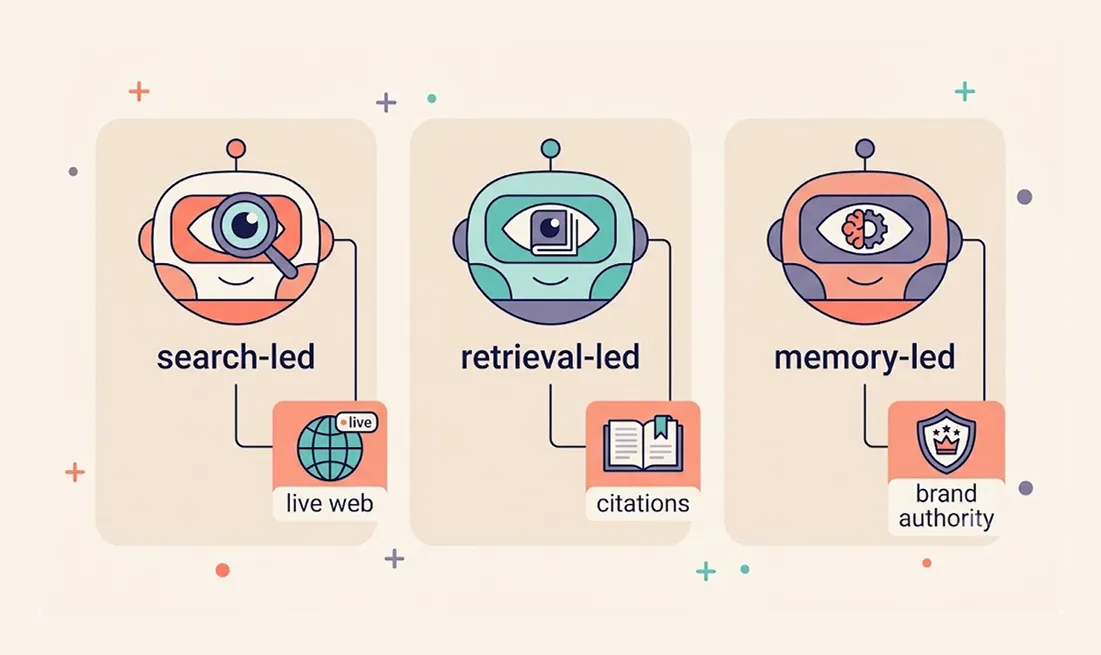
Not every AI product discovers and ranks information the same way, which is why a one-size-fits-all approach falls short. Some systems lean heavily on live web retrieval. Others rely more on training data, brand familiarity, or ecosystem signals. In practice, that means your visibility strategy needs more than one type of asset:
- Search-led systems reward strong indexing, clean page structure, and freshness.
- Retrieval-led systems reward citations, authoritative sources, and clear, direct answers.
- Memory-led systems reward brand authority, PR coverage, and repeated mentions across trusted sources.
If you're only optimizing for one of these, you're missing a real part of the discovery journey.
What B2B Teams Should Do Next
If you want your brand to show up more often in AI-driven research, the mindset needs to shift from "publish more blogs" to "build more answerable authority." In practice, that means investing in structured assets like:
- Comparison pages
- Use-case pages
- Pricing explainers
- FAQ blocks
- Original research
- Industry-specific landing pages
- Customer stories with measurable outcomes
It also means tightening your site architecture so your best content is easy to crawl, easy to quote, and easy to trust. For SaaS and B2B companies, this is the point where content stops being a traffic tactic and starts working like a growth system.
The Real Metric Shift
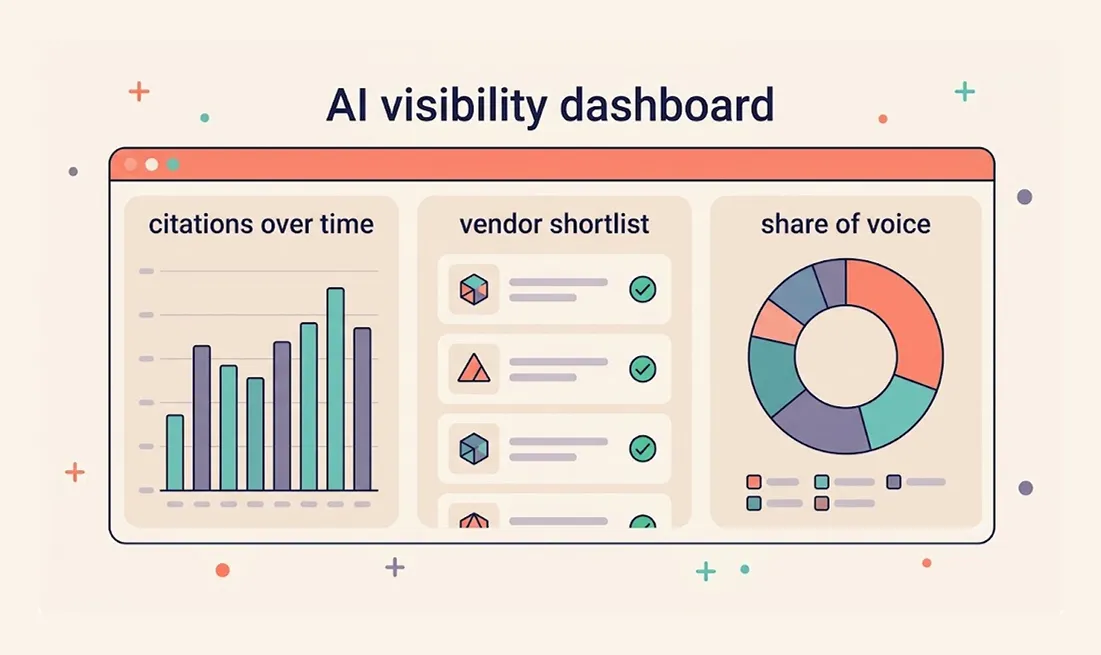
Traditional metrics still matter, but on their own they're no longer enough. A modern content strategy should also track:
- AI citation presence: how often your domain gets cited as a source
- Brand inclusion in comparison prompts: how often you land on vendor shortlists
- Share of voice in AI-generated answers: your presence relative to competitors
- Visibility across key category questions: how well you own the intent-heavy queries in your space
- Assisted pipeline influenced by answer engines: whether AI discovery is actually contributing to revenue
These are the signals that tell you whether your brand shows up at the moment decisions actually begin.
The Guardrail
Here's the honest reality check: no one can guarantee placement inside an AI answer.
These systems are non-deterministic: the same query can return different results depending on prompt phrasing, context, source mix, and model behavior. Any agency or tool promising guaranteed AI rankings is overselling what's possible.
The Real Goal Isn't to Game the ModelIt's to become the most useful, credible, consistently referenced source in your category, and that comes from original insight, third-party validation, structured content, and genuine authority, not shortcuts.
Frequently Asked Questions
What is Generative Engine Optimization (GEO)?
GEO is the practice of structuring and positioning content so it gets cited and recommended inside AI-generated answers, as opposed to SEO, which gets content discovered in search engines, or AEO, which gets it pulled into direct answers and snippets.
How is AEO different from SEO?
SEO optimizes for search engine discovery and rankings. AEO (Answer Engine Optimization) optimizes for being pulled directly into a featured answer, snippet, or AI-generated response, rather than just appearing as a ranked link.
Why do B2B buyers use AI to research vendors?
AI assistants let buyers get a synthesized comparison of vendors, pricing, pros and cons, implementation effort, and use cases, in seconds, instead of manually reading multiple vendor sites and review pages.
Can a brand guarantee it will be cited by AI tools?
No. AI systems are non-deterministic, so the same query can return different results depending on phrasing, context, and source mix. No agency or tool can guarantee placement. The sustainable path is building genuine, structured, well-sourced authority in your category.
What This Means for Clouda.io
For SaaS and B2B brands, AI discovery is reshaping how buyers evaluate vendors long before they ever reach a sales page. The companies that win this shift won't be the ones publishing the most content. They'll be the ones building answerable authority: clearer positioning, stronger proof, and content built to be cited by buyers and AI systems alike.
SEO, AEO, and GEO: What Actually Changed
Why This Matters Now
What Buyers Actually Want From AI Answers
What Strong AI-Friendly Content Looks Like
Different AI Engines Behave Differently
What B2B Teams Should Do Next
The Real Metric Shift
The Guardrail
Frequently Asked Questions
What This Means for Clouda.io
Identify and Execute AI Opportunities With Clouda
Fill out the form and schedule a session with our team to assess your operations and identify where AI can create real impact.
Learn how our seven-stage engagement framework turns AI opportunities into practical, measurable business outcomes.
Fill out the form and schedule a session with our team to assess your operations and identify where AI can create real impact.
Learn how our seven-stage engagement framework turns AI opportunities into practical, measurable business outcomes.