One Content Strategy Won't Win Every AI Search Engine

The conversation around AI search has matured rapidly over the past year. Businesses have largely accepted that appearing in traditional search results is no longer enough, but many have replaced one misconception with another. Instead of assuming Google is the only platform that matters, they now assume every AI assistant works the same way.
It doesn't.
A page that is frequently cited by Perplexity may rarely appear in ChatGPT responses. Content that performs exceptionally well inside Google's AI Overviews may receive little visibility in Microsoft's Copilot. Even authoritative companies discover that their visibility changes dramatically depending on which assistant their customers happen to use.
The reason is surprisingly straightforward. Each platform retrieves information differently, trusts different signals and evaluates authority through its own lens. Understanding those differences is becoming an essential part of digital strategy because modern buyers are increasingly asking AI systems to research suppliers, compare vendors and explain complex purchasing decisions before they ever visit a website.
Optimizing for AI visibility is therefore less about finding a universal ranking formula and more about understanding how each system thinks.
AI Search Is Not One Platform
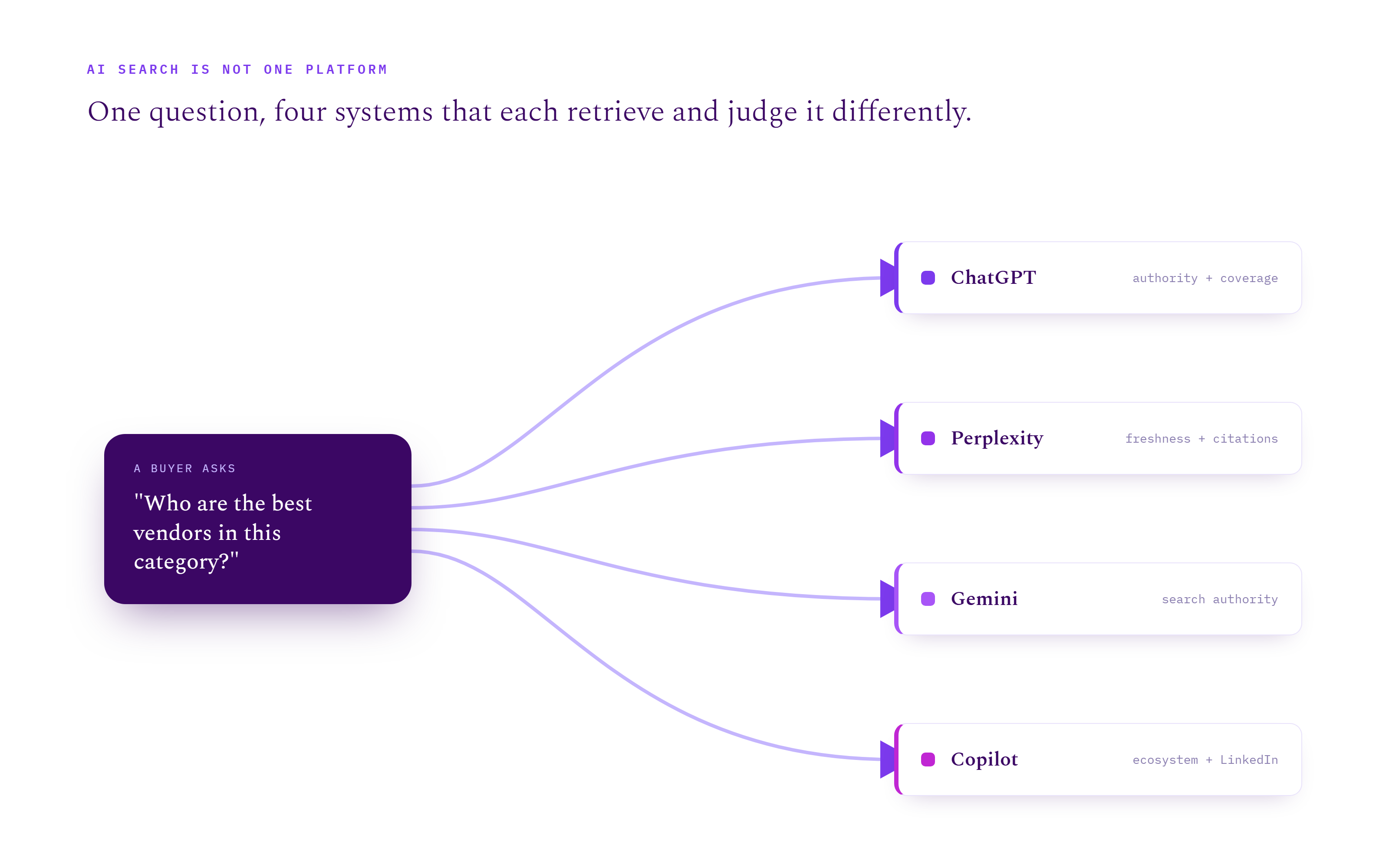
The phrase "AI search" often suggests a single technology, but today's market is made up of multiple systems built on different architectures.
Some assistants retrieve live information every time a user asks a question. Others rely heavily on previously indexed knowledge combined with selective web retrieval. Some favour established authority. Others reward freshness and detailed citations.
This means businesses should stop asking, "How do we rank in AI?" and instead ask, "Which AI systems matter most to our buyers, and how do those systems evaluate information?"
Treating every platform identically often produces content that performs adequately everywhere but exceptionally nowhere.
The organisations seeing the strongest results are designing content for credibility first, while understanding the retrieval behaviour of the major AI ecosystems.
Four Major AI Platforms, Four Different Evaluation Models
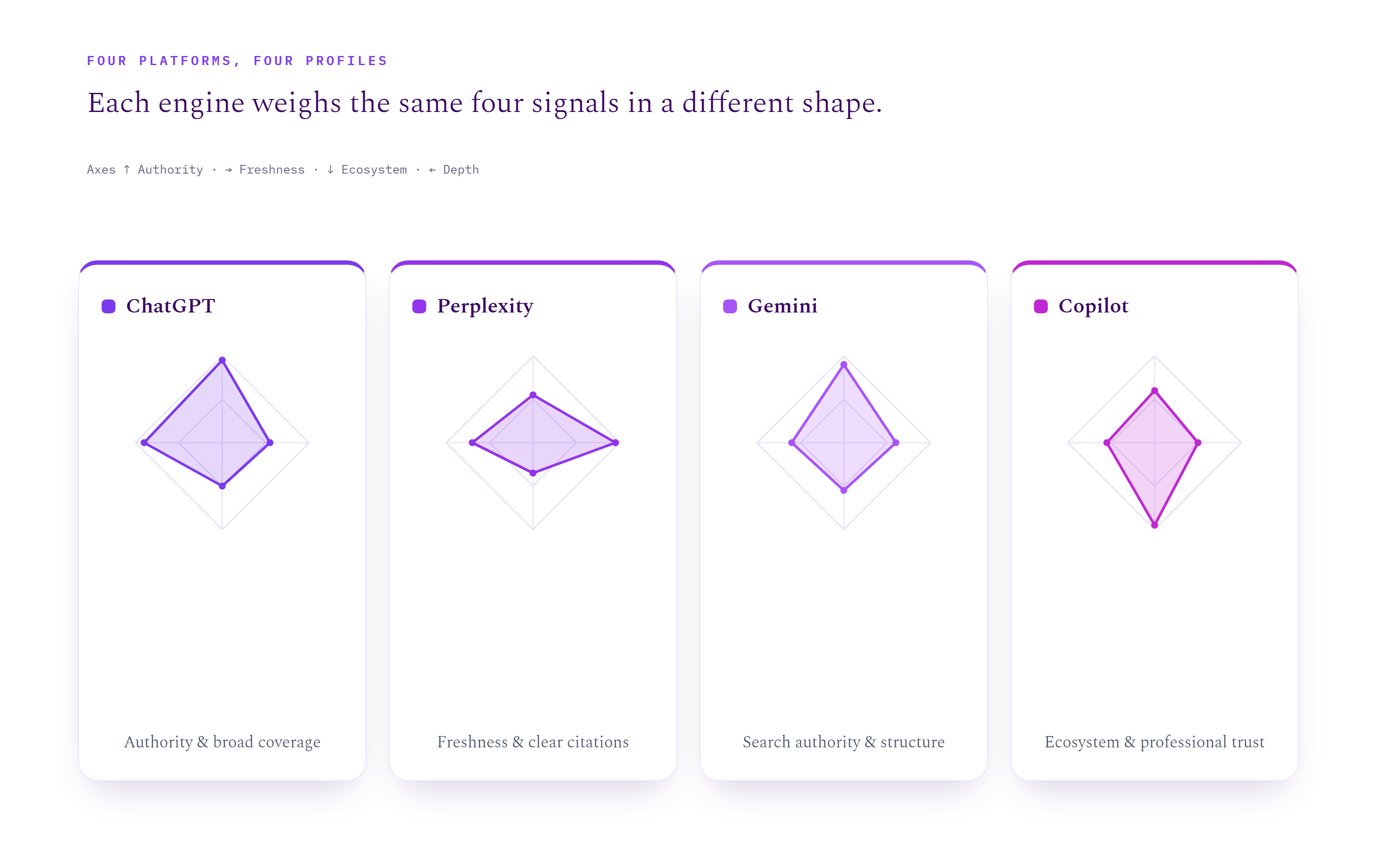
Although every platform continues to evolve rapidly, research already shows meaningful differences in how the leading AI assistants surface information.
ChatGPT
OpenAI increasingly combines its language models with live web retrieval for many queries, but it also relies heavily on recognised authoritative sources and established knowledge. Comprehensive content, strong expertise and broad topical coverage remain consistent advantages.
Perplexity
Perplexity behaves much more like a research assistant than a traditional chatbot. It retrieves live information, cites sources directly and places significant emphasis on freshness, well-supported claims and clearly referenced evidence.
Google Gemini and AI Overviews
Google combines its existing search infrastructure with generative responses. Strong organic SEO, structured content, technical quality and topical authority remain closely connected to AI visibility because Google's retrieval layer is still built upon its search ecosystem.
Microsoft Copilot
Copilot draws heavily from Microsoft's search technologies while also integrating business data, LinkedIn and Microsoft 365 environments. For B2B organisations, corporate credibility, executive expertise and trusted professional content can influence visibility more than many marketers realise.
Understanding these distinctions changes the objective. Instead of chasing a mythical "AI ranking factor," businesses begin strengthening the signals that matter across multiple retrieval systems.
Why The Same Article Can Produce Completely Different Results
Many marketing teams become frustrated after publishing high-quality content because they assume success should be consistent across every AI assistant.
In reality, each platform values different combinations of signals.
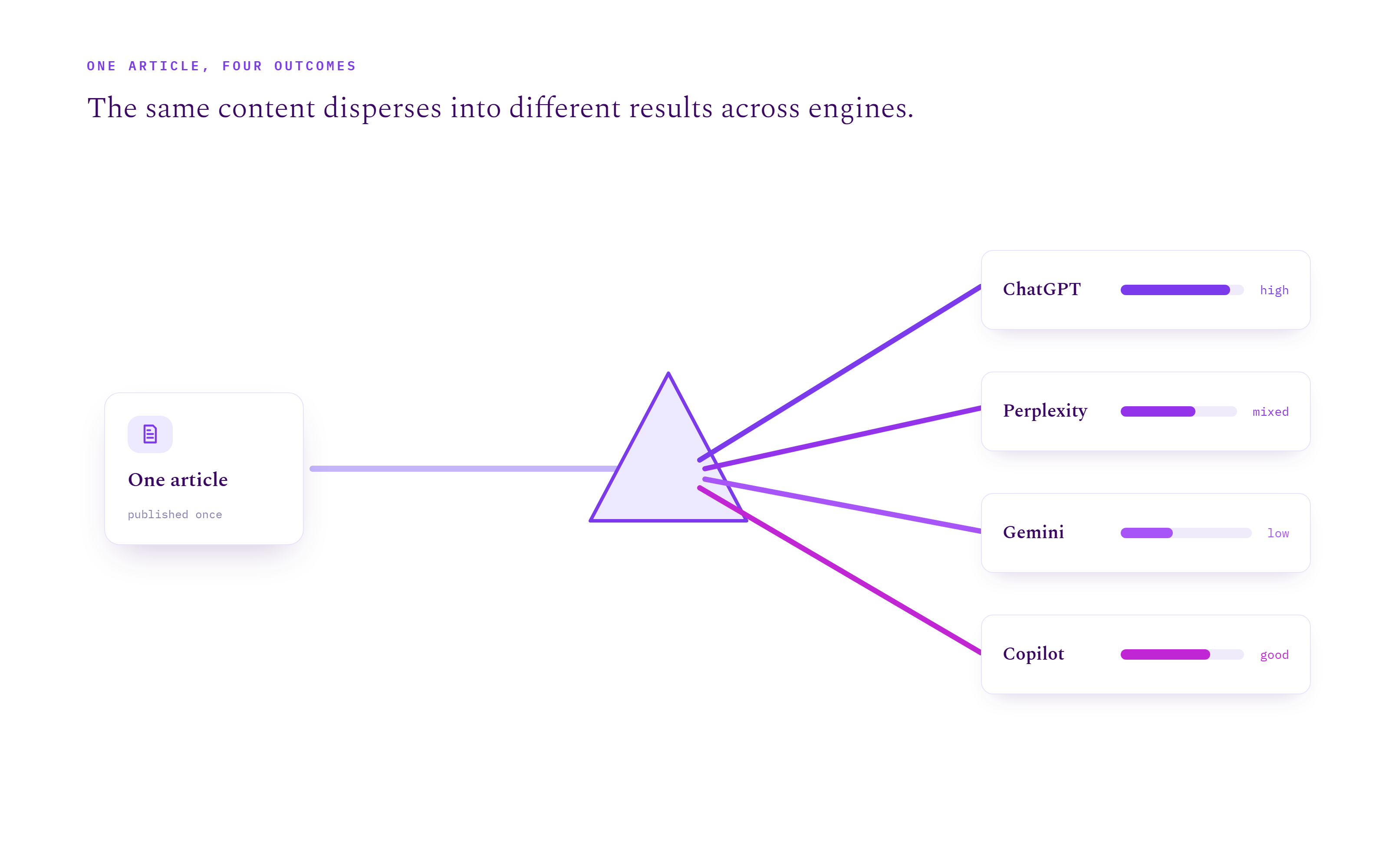
A recent product announcement may appear quickly inside Perplexity because freshness is central to its retrieval process. The same announcement might receive limited visibility elsewhere until the company establishes broader authority around that topic.
Similarly, an extensive educational guide may perform extremely well in ChatGPT because it demonstrates deep expertise, while Google's AI systems may still prioritise another publisher whose technical SEO, backlinks and overall search authority remain stronger.
Content quality alone is no longer the entire equation. Retrieval strategy has become equally important.
One article can therefore produce four different outcomes depending on how each platform discovers, evaluates and trusts the underlying information.
Authority Is Built Differently Than Visibility
Appearing in an AI response is only the beginning. The organisations that become consistently recommended over time usually demonstrate something deeper than technical optimisation—they demonstrate authority.
Authority is accumulated through repeated evidence. Independent research, original thinking, expert commentary, cited statistics, transparent sourcing and consistent publishing all strengthen an organisation's credibility. This explains why research-backed articles tend to outperform opinion pieces across multiple AI systems.
The Princeton GEO study, which analysed thousands of AI search responses, identified several patterns that consistently improved citation frequency. Rather than relying on marketing language, the strongest-performing content shared measurable evidence and clear expertise.
Among the most effective characteristics were:
- Expert quotations that introduced genuine subject-matter expertise rather than generic commentary.
- Original statistics and credible third-party research supporting key arguments.
- Clear citations allowing AI systems to verify claims against reliable sources.
- Comprehensive topic coverage instead of shallow keyword-focused articles.
- Structured explanations that answer complete questions rather than isolated search terms.
These characteristics improve more than AI visibility. They also produce stronger human content, making them a worthwhile investment regardless of how search technology evolves.
Different Retrieval Models Require Different Publishing Strategies
Many organisations continue to follow publishing strategies developed exclusively for Google Search. While those practices remain valuable, AI search introduces additional considerations because not every platform retrieves information in the same way.
A practical strategy recognises where each engine places its emphasis.
For Google and Gemini
Continue investing in technical SEO, structured content, topical authority and high-quality internal linking. Google's AI products remain closely connected to its search ecosystem.
For Perplexity
Publish current information supported by credible references. Regular updates, transparent sourcing and detailed explanations increase the likelihood of being retrieved during live searches.
For ChatGPT
Develop comprehensive resources that demonstrate expertise beyond basic definitions. Long-form educational content often performs better than fragmented articles focused on narrow keywords.
For Microsoft Copilot
Strengthen organisational credibility across Microsoft's ecosystem. Executive thought leadership, professional profiles and trusted corporate content contribute alongside traditional web authority.
The objective is not to create four different versions of every article. Instead, it is to produce authoritative content that naturally satisfies the evaluation methods shared across these platforms while recognising where individual engines place greater emphasis.
Optimising for Every AI Starts Long Before Publishing
Businesses often treat AI optimisation as the final stage of content production. In reality, the work begins much earlier—with the quality of the information itself.
AI systems cannot reliably recommend organisations whose own content lacks consistency, clarity or evidence. Conflicting product information, outdated service pages, duplicate explanations and unsupported claims weaken the signals every retrieval engine depends upon.
This is why organisations investing in AI visibility should first examine the quality of their knowledge assets before chasing new optimisation techniques.
A practical review often begins with questions such as:
- Is our expertise clearly demonstrated across our website?
- Are our statistics current and properly attributed?
- Does each article answer complete buyer questions instead of targeting isolated keywords?
- Is our service information consistent across every page?
- Can an AI system easily understand what differentiates our business?
These questions rarely appear on traditional SEO checklists, yet they increasingly influence whether AI systems consider a company trustworthy enough to reference.
 Build What Every Engine Rewards
The organisations that succeed will not chase each platform individually—they will build the kind of expertise that all of them are designed to recognise.
The Future Belongs to Brands AI Can Trust
The next generation of digital visibility will not be determined by who publishes the greatest volume of content. It will belong to organisations whose expertise is consistently recognised across multiple AI ecosystems.
That requires a shift in mindset. Rather than attempting to manipulate individual algorithms, businesses should focus on becoming the most reliable source within their field. Strong research, original insights, structured information and demonstrated expertise remain the signals every AI platform is ultimately trying to identify, even if each retrieves and evaluates them differently.
For marketing leaders, this represents an important opportunity. The companies that understand retrieval behaviour today will build authority while many competitors are still producing content designed exclusively for yesterday's search engines. As conversational AI becomes a standard part of B2B buying journeys, those early investments compound into greater visibility, stronger credibility and more meaningful customer conversations.
The future of AI search is unlikely to converge around a single platform or a single optimisation tactic. It will continue to be shaped by multiple engines with different retrieval models, different trust signals and different strengths. The organisations that succeed will not chase each platform individually—they will build the kind of expertise that all of them are designed to recognise.
AI Search Is Not One Platform
Four Major AI Platforms, Four Different Evaluation Models
Why The Same Article Can Produce Completely Different Results
Authority Is Built Differently Than Visibility
Different Retrieval Models Require Different Publishing Strategies
Optimising for Every AI Starts Long Before Publishing
The Future Belongs to Brands AI Can Trust
Identify and Execute AI Opportunities With Clouda
Fill out the form and schedule a session with our team to assess your operations and identify where AI can create real impact.
Learn how our seven-stage engagement framework turns AI opportunities into practical, measurable business outcomes.
Fill out the form and schedule a session with our team to assess your operations and identify where AI can create real impact.
Learn how our seven-stage engagement framework turns AI opportunities into practical, measurable business outcomes.