Redesign the Workflow Before You Pick the AI

Artificial intelligence has become the starting point for many transformation conversations. Executive teams are evaluating copilots, automation platforms, intelligent assistants, and industry-specific AI tools at an unprecedented pace. Yet despite this momentum, the financial outcomes remain inconsistent. Organizations continue to launch pilots, expand technology budgets, and announce ambitious AI initiatives, while relatively few can point to measurable improvements across their operations.
The difference is rarely the quality of the technology. Increasingly, research suggests that successful organizations follow a different sequence altogether. Rather than beginning with AI and looking for places to apply it, they begin by understanding how work actually moves through the business. McKinsey has reported that organizations redesigning workflows before selecting AI technologies are twice as likely to achieve significant financial returns. That finding shifts the conversation away from software selection and toward operational design, where long-term value is ultimately created.
Technology Rarely Fixes an Inefficient Process
Many AI initiatives inherit the same assumption that shaped earlier digital transformation programs: if a process is slow, adding better technology will improve it. In reality, technology usually accelerates whatever already exists. Efficient processes become faster, while inefficient ones become automated sources of confusion that are simply harder to detect.
Consider a customer quotation process involving sales, finance, operations, and procurement. Pricing approvals may pass through several departments, product availability may be checked in different systems, and final quotations may still rely on spreadsheets or manual calculations. Introducing AI into this environment can reduce some repetitive work, but it cannot eliminate unnecessary approvals, disconnected responsibilities, or conflicting business rules. Instead, those inefficiencies become embedded inside automated workflows.
This explains why organizations often report successful demonstrations but disappointing business outcomes. The technology performs exactly as expected, yet the underlying operation remains fundamentally unchanged.
Workflow Design Defines the Quality of AI
Workflow redesign is frequently misunderstood as process documentation or incremental optimization. In practice, it is a broader exercise focused on simplifying how decisions move through an organization before automation is introduced.
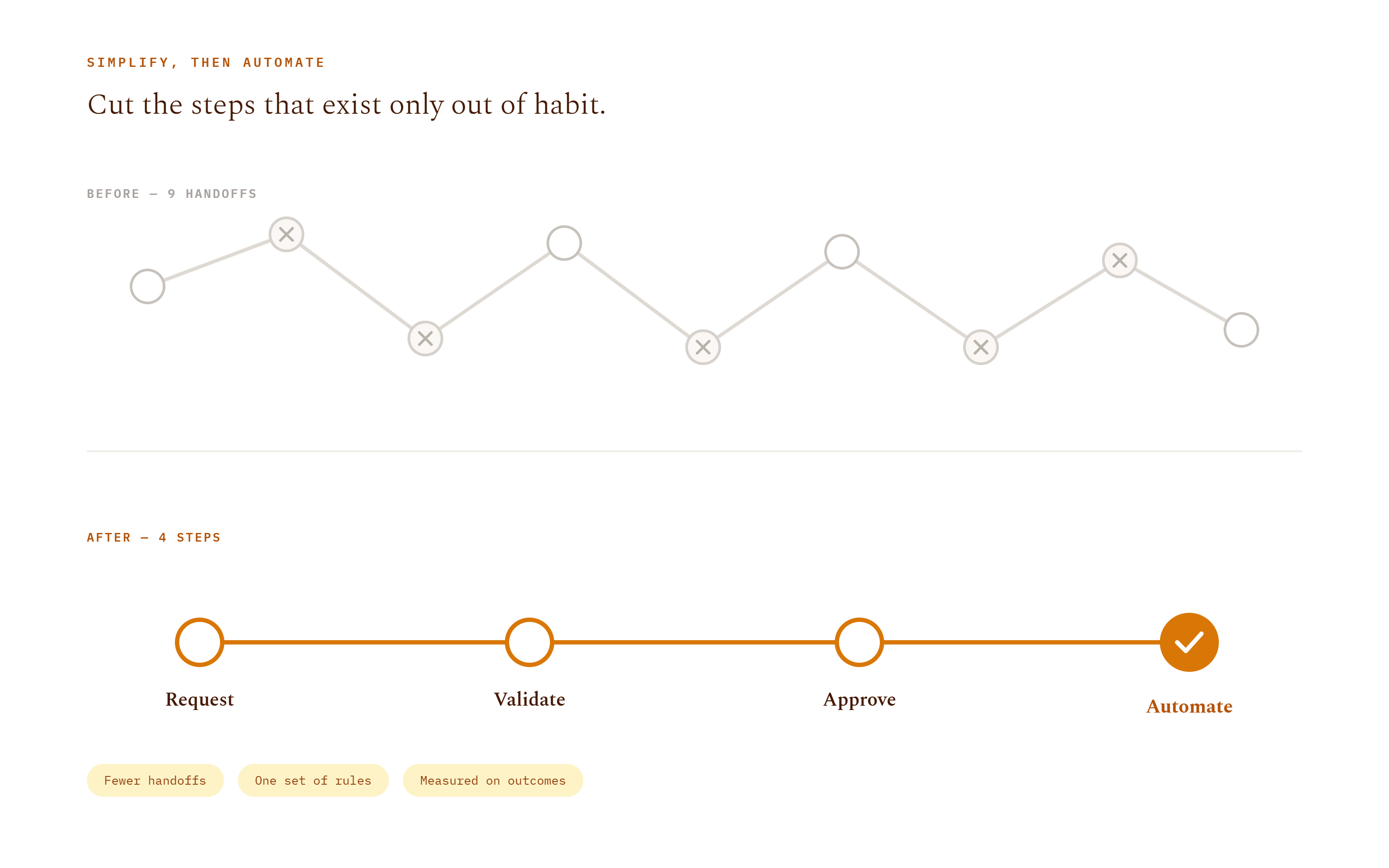
Eliminate unnecessary decisions
Many operational workflows contain approval steps that exist because of historical practices rather than genuine business requirements. Removing unnecessary decision points often creates greater efficiency than automating them.
Connect information where work happens
Employees should not need to search multiple systems simply to complete one task. Effective workflows ensure that relevant information is available at the point of decision instead of requiring people to reconcile conflicting records across departments.
Standardize repeatable activities
Processes that depend heavily on individual experience are difficult to automate consistently. Establishing common rules for approvals, pricing, documentation, and customer interactions creates predictable workflows that AI can support reliably.
Measure outcomes instead of activity
Organizations often evaluate performance by counting approvals completed, tickets closed, or forms processed. Better workflow design focuses on outcomes such as customer response times, fulfillment accuracy, conversion rates, or operational cost reductions. These are the measures that determine whether AI is delivering genuine business value.
Where AI Initiatives Commonly Go Off Course
Many enterprise AI programs encounter similar obstacles because they begin with technology selection instead of operational redesign. The symptoms differ between organizations, but the underlying causes are remarkably consistent.
Common patterns include:
- Purchasing AI platforms before defining the operational problem they are expected to solve.
- Automating approval processes that already contain unnecessary complexity.
- Running isolated pilot projects without considering how they integrate into broader business workflows.
- Measuring user adoption instead of measurable business improvements.
- Treating AI implementation as an IT initiative rather than an operational transformation program.
These decisions rarely prevent an AI project from launching. They do, however, make it significantly harder to scale beyond individual use cases because the surrounding business processes remain fragmented.
From Automation Projects to Operational Transformation
Organizations that consistently achieve value from AI tend to share one characteristic: they treat AI as part of a broader operational transformation rather than a standalone technology initiative. The focus shifts from implementing individual tools to improving how work flows across departments, systems, and customer interactions. AI becomes one capability within a redesigned operating model instead of the centerpiece of the strategy.
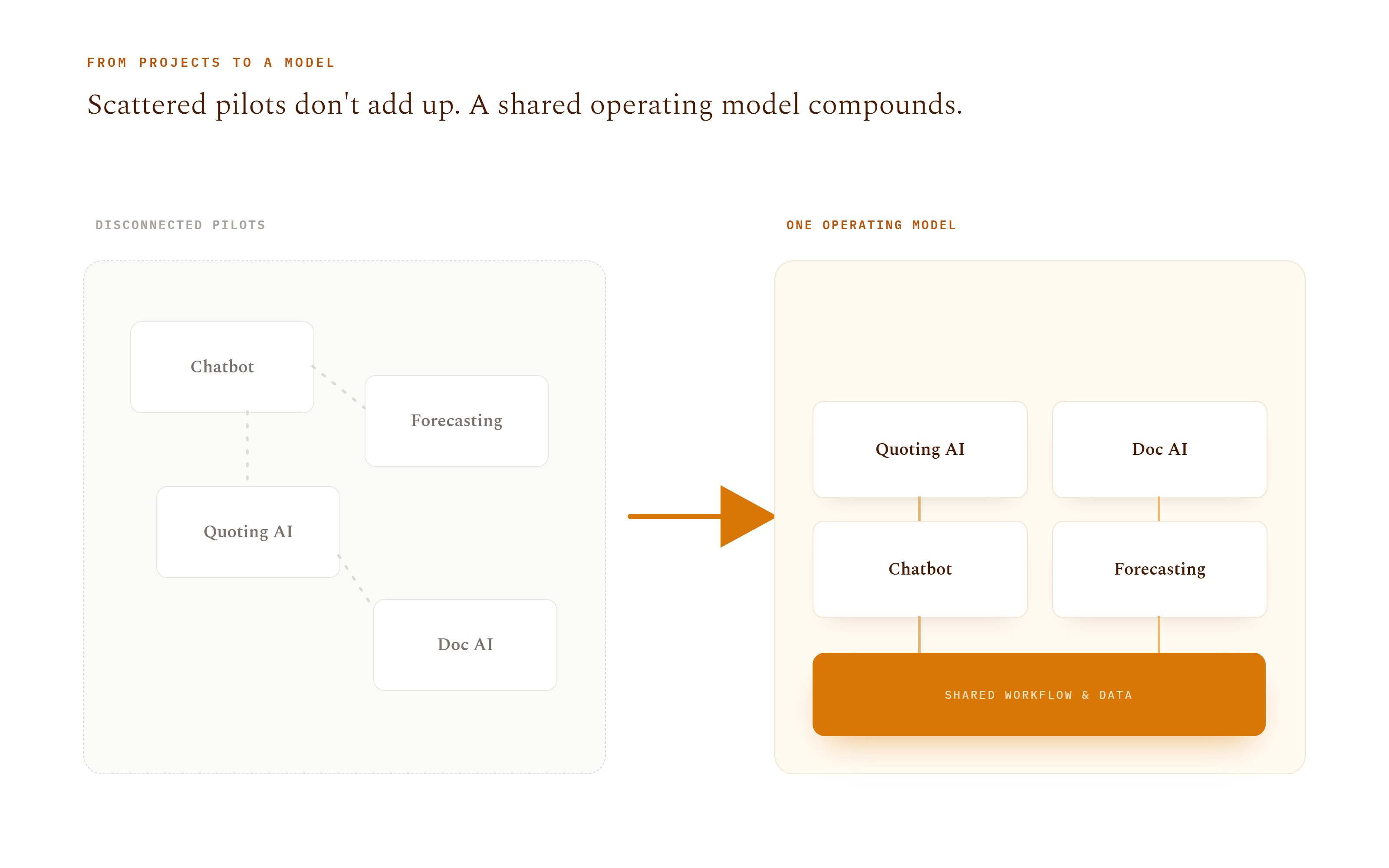
This distinction becomes increasingly important as organizations scale. A customer service assistant, an AI-powered quoting tool, and a forecasting model may all perform well independently, but they deliver limited value if each operates against different workflows and disconnected business rules. Sustainable returns emerge when every capability supports the same operational framework, with consistent processes and shared objectives across the business.
The Organizations Seeing the Best Results Follow a Different Sequence
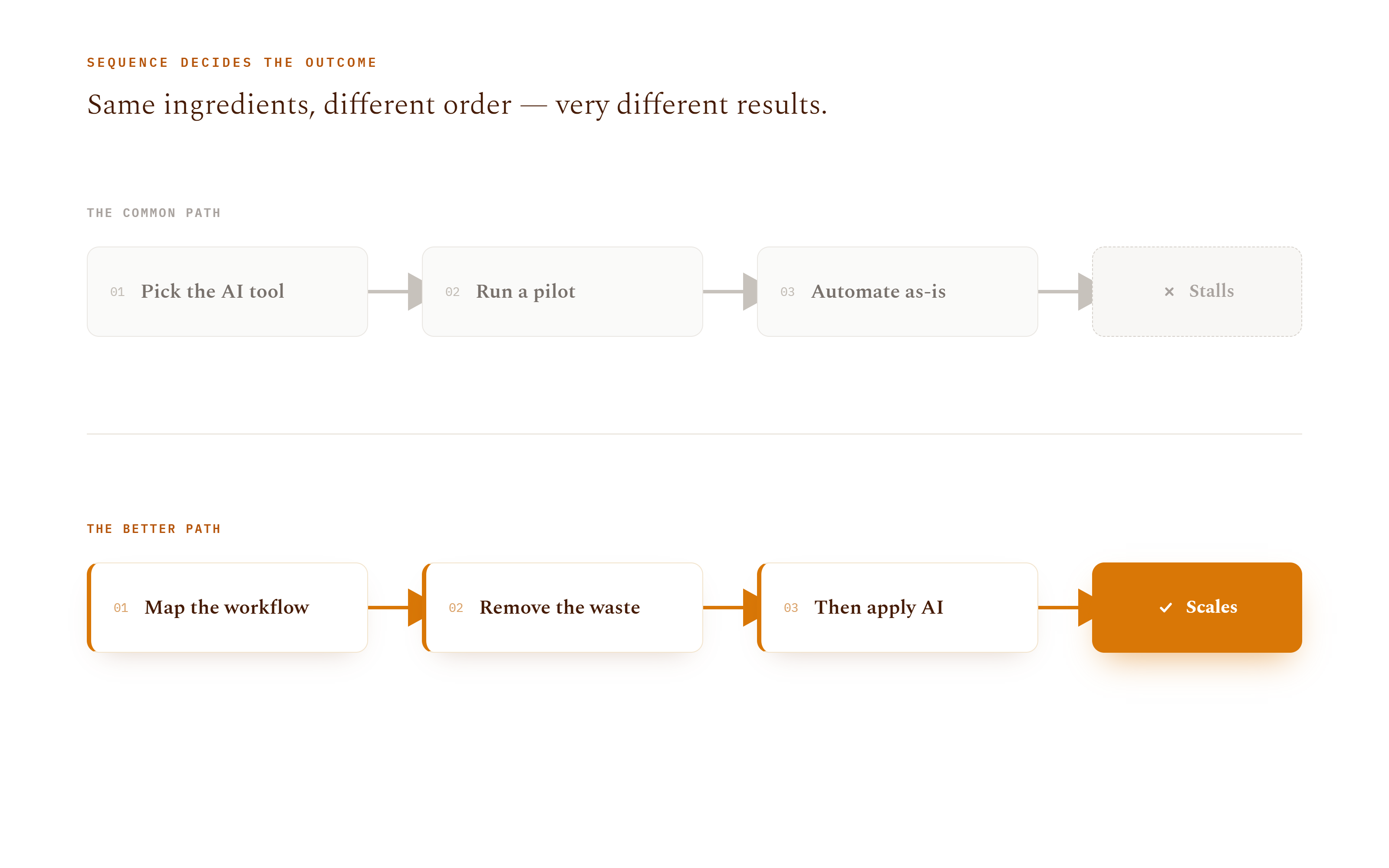
Successful AI programs rarely begin with software evaluations. They begin with understanding how value is created, where operational friction exists, and which activities genuinely benefit from automation. Technology decisions become significantly easier once those questions have been answered.
The organizations making measurable progress typically follow principles like these:
- Map end-to-end workflows before evaluating AI platforms or vendors.
- Remove unnecessary approvals, duplicate handoffs, and manual work before introducing automation.
- Standardize operational processes across departments instead of optimizing isolated teams.
- Define success using business outcomes such as cycle time, customer experience, operational cost, or revenue growth.
- Introduce AI incrementally, expanding only after each implementation demonstrates measurable value.
This sequence may appear slower than launching multiple pilots simultaneously, but it usually produces stronger long-term results. Instead of accumulating disconnected AI projects, organizations build a connected operational environment where each new capability strengthens the next. That creates momentum that is difficult to achieve when every initiative starts from scratch.
Why Workflow Design Has Become a Leadership Responsibility
Workflow redesign is no longer a responsibility confined to process improvement teams or technology departments. As AI becomes embedded in core business operations, executive leadership increasingly determines whether transformation efforts succeed by deciding how work should move across the organization. Questions about ownership, accountability, customer experience, and operational priorities now have a direct influence on AI performance.
This shift also changes how technology partners contribute. Rather than simply implementing software, they help organizations understand existing operations, identify bottlenecks between systems and teams, modernize workflows, and establish the operational foundation that allows AI to deliver measurable outcomes. The objective is not to automate every task but to ensure the business itself is structured to benefit from automation where it creates genuine value.
Organizations that approach AI through this operational lens are often better positioned to respond to future changes as well. New technologies can be introduced without repeatedly redesigning the business because the underlying workflows have already been simplified, standardized, and connected.
 Sequence Beats Speed
The organizations achieving the strongest returns are not adopting AI faster than everyone else. They are following a more disciplined sequence.
AI Delivers the Greatest Value When Operations Come First
The conversation around AI often begins with technology because technology is visible. New models, assistants, and automation platforms attract attention and promise immediate improvements. What receives far less attention is the operational work that determines whether those tools produce lasting business value after deployment.
The organizations achieving the strongest returns are not necessarily adopting AI faster than everyone else. They are following a more disciplined sequence. They examine how work moves through the business, simplify unnecessary complexity, connect people and systems around common workflows, and introduce AI only where it strengthens those operations. McKinsey's findings reinforce this approach: organizations that redesign workflows before selecting AI technologies are significantly more likely to achieve meaningful financial outcomes.
For enterprise leaders, that changes the first question worth asking. Instead of beginning with "Which AI platform should we invest in?", the better starting point is "Are our operations designed to support AI in the first place?" Answering that question honestly creates a stronger foundation for every technology decision that follows—and ultimately determines whether AI becomes another isolated pilot or a capability that reshapes how the business performs.
Technology Rarely Fixes an Inefficient Process
Workflow Design Defines the Quality of AI
Where AI Initiatives Commonly Go Off Course
From Automation Projects to Operational Transformation
The Organizations Seeing the Best Results Follow a Different Sequence
Why Workflow Design Has Become a Leadership Responsibility
AI Delivers the Greatest Value When Operations Come First
Identify and Execute AI Opportunities With Clouda
Fill out the form and schedule a session with our team to assess your operations and identify where AI can create real impact.
Learn how our seven-stage engagement framework turns AI opportunities into practical, measurable business outcomes.
Fill out the form and schedule a session with our team to assess your operations and identify where AI can create real impact.
Learn how our seven-stage engagement framework turns AI opportunities into practical, measurable business outcomes.