Shopify Is Deprecating Legacy Customer Accounts — Act Before It Breaks Your Store

Shopify Is Deprecating Legacy Customer Accounts: Act Before It Breaks Your Store
Most Shopify merchants think of platform updates as optional.
Something to get to later. Something that can wait.
This one isn’t.
Shopify has officially deprecated key legacy systems, especially customer accounts, checkout customizations, and script-based logic. That means no new features, no support, and eventually, no functionality.
If you’re still relying on legacy architecture, you’re not just behind.
You’re operating on borrowed time.
The Reality: Legacy Shopify Is Already Unsupported
Many merchants assume they still have time. On the surface, everything may appear to be working as usual. But behind the scenes, Shopify has already made its move, and the shift is well underway.
As of February 26, Shopify officially deprecated legacy customer accounts.
That comes with real consequences:
• No new stores can use legacy systems
• No feature updates are being released
• Support is effectively gone
• A full shutdown date is coming (not yet announced)
This creates a dangerous position.
You’re running critical parts of your business on infrastructure that Shopify is actively moving away from.

Why This Shift Matters More Than Previous Updates
Shopify has rolled out updates before, but this is fundamentally different. This is not a feature release or a minor improvement. It’s a complete rethink of how the platform is built and how merchants are expected to operate going forward.
This is not a cosmetic upgrade. It’s a complete architectural shift from fragile, code-heavy customization into something mores structured and upgrade-safe extensibility.
Legacy Shopify offered:
•Liquid-based customization (checkout.liquid, account templates)
•Script injections and patchwork logic
•Multiple login systems across apps
•Breaks with theme updates
Whereas Modern Shopify offers:
•App-based UI extensions
•Native platform logic (Shopify Functions)
•Centralized, unified customer accounts
•Fully managed infrastructure
This shift eliminates entire categories of problems that merchants have been dealing with for years.
The Risks of Staying on Legacy Systems
Staying on legacy systems might feel like the easier option in the short term. After all, things are still working, and migration takes effort. But what many merchants fail to realize is that the real costs are already showing up, just not always in obvious ways.
Most merchants underestimate how much legacy systems are already hurting them.
1. Login Friction Is Killing Conversions
The login experience is one of the most overlooked parts of the customer journey, yet it plays a critical role in retention and repeat purchases. Legacy systems introduce unnecessary friction at this exact point.
Legacy accounts require:
• Passwords
• Separate logins across apps
• Reauthentication between sessions
Customers forget credentials, abandon sessions, and drop off.
While new systems require:
•Passwordless login (one-time codes)
•365-day session persistence
•One unified login across the entire experience
2. Security Risks Are Built Into Legacy Systems
Security is no longer just a technical concern. It directly impacts customer trust, compliance, and long-term brand reputation. Legacy systems were not designed with today’s security expectations in mind.
Passwords introduce:
•Credential stuffing attacks
•Password reuse vulnerabilities
•Reset friction
No passwords = no credential risk.
Customers instead log in via:
•One-time email codes
•Shop Pay (200M+ users globally)
•Google / Facebook login
It’s faster and more secure at the same time.
3. You’re Paying for Features Shopify Now Gives You Free
Over time, most Shopify stores accumulate a stack of apps to fill gaps in functionality. What many merchants don’t realize is that those gaps no longer exist in the new system.
Legacy setups rely heavily on third-party apps for basic functionality.
With new customer accounts, many of these are now native:
•Order tracking
•Reordering
•Returns
•Store credit
•Saved payment methods
•Subscription management (via Shopify app)
This reduces app dependency, cost, and complexity.
4. Customizations Break Constantly
Customization has always been one of Shopify’s strengths, but in legacy systems, it often came at the cost of stability. The more customized your store became, the more fragile it also became.
Legacy customization depends on Liquid templates and scripts.
Every update risks breaking something.
Modern Shopify replaces this with:
•UI Extensions (modular, sandboxed components)
•Fully upgrade-safe customization
•No direct dependency on theme code
Nothing breaks when Shopify updates the platform.
5. Fragmented Customer Experience
A seamless customer experience is no longer a luxury. It’s expected. Unfortunately, legacy systems often create fragmented, inconsistent journeys that confuse customers and reduce engagement.
Legacy systems create disjointed experiences:
•Different login flows per tool
•Inconsistent UI across pages
•No central “account hub”
Whereas Modern accounts unify everything into a single destination where customers can:
•Manage orders
•Track shipments
•Handle returns
•Access loyalty and subscriptions
This directly improves retention and repeat purchases.
What You Gain by Upgrading: The New Shopify Stack
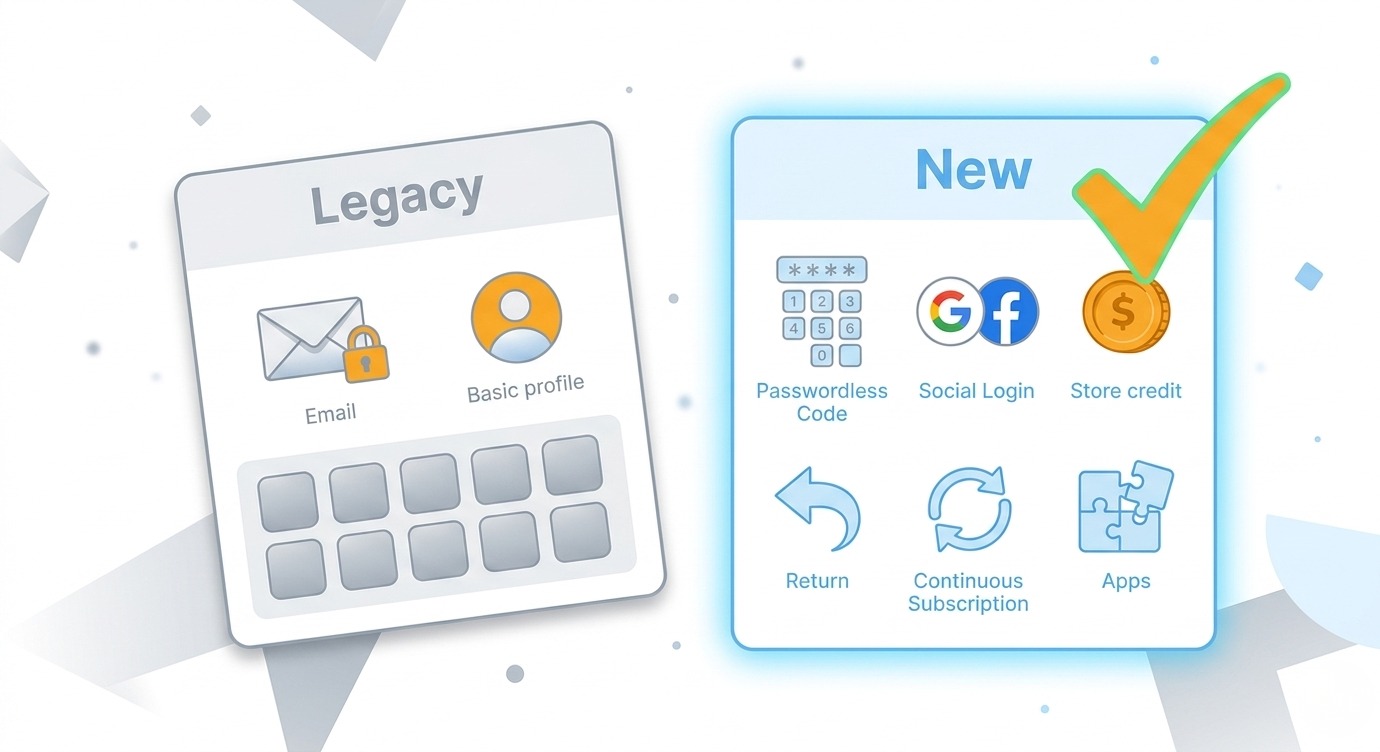
While the risks of staying on legacy systems are real, the upside of upgrading is even more important. This is not just about fixing problems, it’s about unlocking a more advanced and scalable way to run your store.
This isn’t just about avoiding risk. It’s about unlocking capabilities that weren’t possible before.
1. A Unified, High-Converting Login Experience The new customer account system is designed with conversion as a priority. By removing friction and simplifying access, it improves one of the most critical parts of the funnel.
The new customer account system is built for conversion:
• Passwordless authentication
• Persistent sessions (up to 365 days)
• One-tap login with Shop Pay
• Social login built-in
This removes friction at one of the most critical points in the funnel.
2. A Fully Extensible Customer Account Hub
Customer accounts are no longer just a place to view past orders. They’ve evolved into a powerful engagement layer that can drive retention, upsells, and long-term value.
Instead of static account pages, you now get a customizable system powered by extensions.
You can add the following:
• Loyalty dashboards
• Subscription management
• Promotions and upsells
• Post-purchase surveys
• Custom workflows (returns, exchanges, support flows)
There are already 800+ compatible apps in this ecosystem. And for advanced use cases, you can build custom extensions without publishing them publicly.
3. Upgrade-Safe Customization (No More Breakage)
One of the biggest advantages of the new system is stability. Shopify has redesigned customization in a way that allows flexibility without introducing risk.
Everything is built using:
• Defined extension points
• Sandboxed components
• Shopify-managed infrastructure
What this means is that there’s:
• No Liquid hacks
• No fragile dependencies
• No unexpected downtime after updates
4. Better Data, Tracking, and Post-Purchase Insights
Data is only valuable if it’s accurate and actionable. Legacy tracking setups often made this difficult, especially when it came to understanding post-purchase behavior.
Shopify now enables structured tracking through:
• Web pixels
• Customer events
• Post-purchase behavior tracking
This allows you to see:
• What customers do after buying
• How they interact with their accounts
• Where retention opportunities exist
This was extremely difficult with legacy setups.
5. Built-In Ecosystem and Faster Innovation
Shopify’s roadmap is fully aligned with its new architecture. That means all future improvements, features, and integrations are being built for the modern system.
New features are only being released on the new system.
This includes:
• Ongoing account feature rollouts
• Improved branding controls
• Enhanced APIs and integrations
• Future AI-assisted migration tools
So staying on legacy means that you'll be locked out of all of this.
Common Mistakes to Avoid
Migration is not just about moving from one system to another. It’s about making better decisions at every stage of the process, and the way you approach it will directly impact the results you get. Many of the biggest issues merchants face during migration don’t come from technical limitations, but from how they think about the transition itself.
Some of the most common mistakes include:
• Trying to replicate legacy setups exactly instead of improving them, which leads to missed opportunities to enhance conversion rates and user experience
• Treating login and customer accounts as secondary, even though they are now a major growth lever for retention and repeat purchases
• Over-relying on third-party apps without reassessing native features, resulting in unnecessary costs and added complexity
• Approaching migration as purely technical, rather than using it as a strategic opportunity to rethink the customer experience
Avoiding these pitfalls can be the difference between a simple migration and a meaningful upgrade to how your store performs.
The Strategic Opportunity Most Merchants Are Missing
Every major platform shift creates a clear divide between those who benefit and those who fall behind, and the difference almost always comes down to timing and mindset. This transition is no different. While many merchants will delay taking action, only to rush their migration later under pressure and risk breaking key functionality, a smaller group will approach it more strategically. These merchants will move early, take the time to redesign their customer experience, and fully leverage the capabilities of the new system. By doing so, they position themselves ahead of competitors who are still reacting. This gap, created simply by acting sooner and thinking more strategically, becomes a real and measurable competitive advantage.
Conclusion: This Is a Forced Change, But a Powerful One
Shopify is no longer maintaining legacy systems, it is actively replacing them with a new foundation. This means that waiting does not reduce risk, it increases it, and doing nothing is no longer a safe option. Migration is inevitable for every merchant still on legacy infrastructure. However, for those who choose to act early, this shift represents far more than a requirement. It becomes an opportunity to improve conversion rates, reduce operational costs, simplify technical complexity, and deliver a significantly better customer experience. The difference lies in whether you take control of the transition or let it happen to you. Upgrade now, and you stay ahead. Wait, and you risk falling behind.
The Reality: Legacy Shopify Is Already Unsupported
Why This Shift Matters More Than Previous Updates
The Risks of Staying on Legacy Systems
What You Gain by Upgrading: The New Shopify Stack
Migration Isn’t Optional, But It Is Manageable
Common Mistakes to Avoid
The Strategic Opportunity Most Merchants Are Missing
Conclusion: This Is a Forced Change, But a Powerful One
Plan Your Customer Account Upgrade With Clouda
Fill out the form and schedule a consultation with our team to review your current setup and understand the next steps.
We’ll walk you through what the transition involves, how it applies to your store, and the best approach based on your architecture.
Whether you're using themes, apps, or a custom storefront, this session will give you a clear path forward.
Fill out the form and schedule a consultation with our team to review your current setup and understand the next steps.
We’ll walk you through what the transition involves, how it applies to your store, and the best approach based on your architecture.
Whether you're using themes, apps, or a custom storefront, this session will give you a clear path forward.