The 5 Stages of a Strategic B2B Ecommerce Roadmap

Picking Up Where We Left Off
In our previous article, “Why B2B Digital Growth Stalls Without a Strategic Roadmap,” we established a clear hierarchy: company growth drives B2B growth, and B2B growth drives B2B digital growth. Digital initiatives do not operate independently; they function as a subsystem of overall business strategy. When digital decisions drift away from core business intent, complexity compounds, alignment erodes, and growth inevitably stalls.
We also drew an important distinction between two types of B2B organizations. High-frequency B2B businesses optimize for transaction volume and efficiency. High-touch B2B businesses, however, operate in layered environments defined by negotiated pricing, long-term contracts, multi-stakeholder buying journeys, ERP integrations, and operational dependencies. In these environments, digital growth cannot be improvised. It must be intentionally designed.
A strategic roadmap prevents fragmentation. But what does that actually look like in practice?
This is where the concept of a Strategic B2B Ecommerce Growth Map becomes tangible. A growth map is not a feature backlog. It is not a migration timeline or a technology shopping list. Instead, it is a structured progression that connects business ambition to digital capability over time.
What follows are the five critical stages that define how an effective B2B ecommerce growth map unfolds.
What a Strategic B2B Ecommerce Roadmap Is — and Is Not
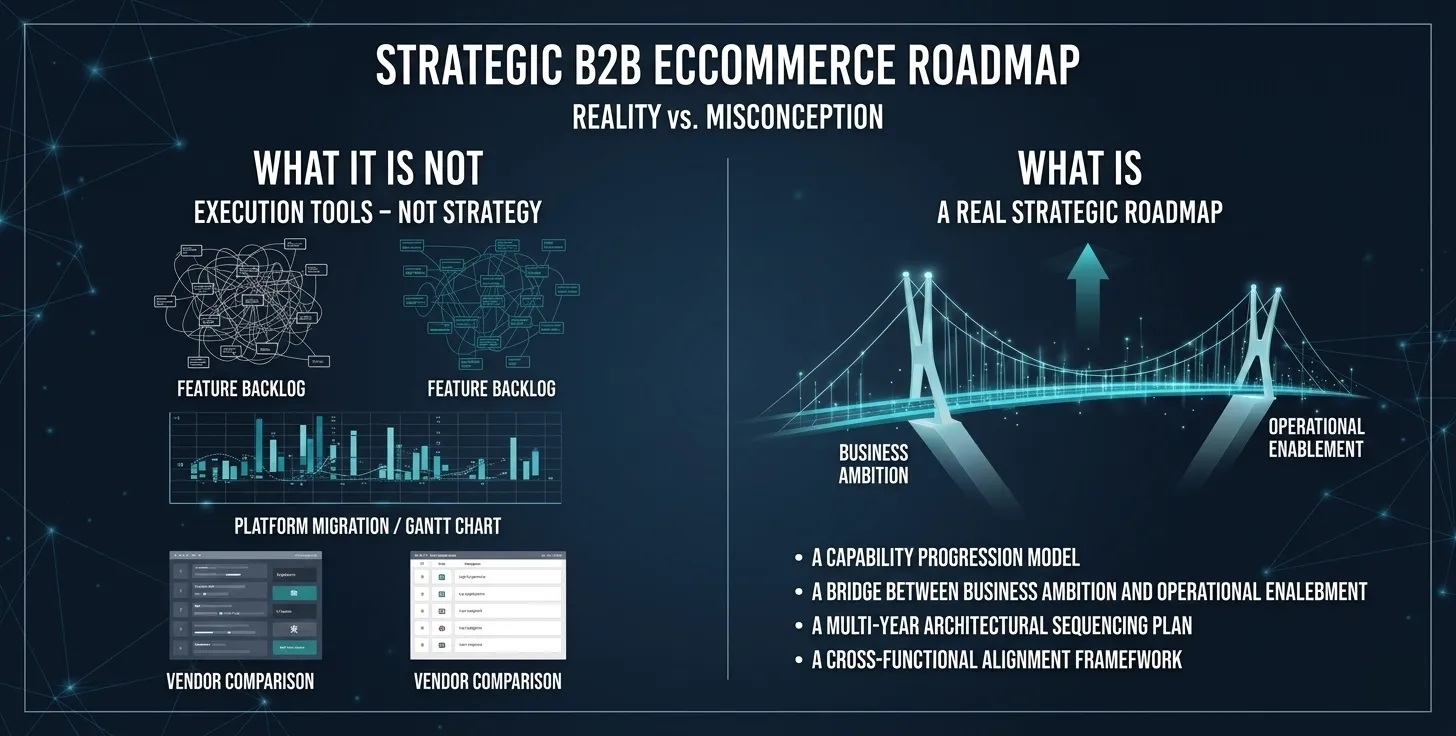
The term “roadmap” is often misunderstood. Many organizations use it to describe something much narrower than strategy.
A strategic roadmap is not a feature backlog, a platform migration plan, a Gantt chart for replatforming, or a vendor comparison spreadsheet. Those are execution tools. They are necessary, but they are not strategy.
A real strategic roadmap is a capability progression model. It acts as a bridge between business ambition and operational enablement. It provides multi-year architectural sequencing and creates cross-functional alignment across departments.
If visualized properly, business intent would sit at the top, followed by capability design, then architectural foundations, and only much later, specific features and experience enhancements. With that clarity in place, we can examine the five stages that create a scalable roadmap.
Here's a simple, concrete example to make that visualization clearer:
Imagine building a B2B ecommerce roadmap like a house:
• Top level (Business Intent):"We want to grow revenue by 30% over 3 years by shifting 40% of orders to self-service digital channels, while protecting margins and reducing sales rep time on routine orders."
• Next level (Capability Design): "To do that, the business must be able to: deliver account-specific pricing instantly, show real-time contract availability, handle multi-level approval workflows, and provide self-service reorder from past orders."
• Below that (Architectural Foundations): "To enable those capabilities reliably, we first need: a single, clean master data layer for customers/products/pricing, stable ERP–CRM–PIM integrations, consolidated pricing rules engine, and secure role-based access controls."
• Bottom level (Specific Features & Experience Enhancements): "Only after the foundations are solid do we add things like: a modern storefront redesign, predictive reorder suggestions, AI chat support, or personalized dashboards."
If you start at the bottom (e.g., picking a flashy new frontend or adding AI features first), the house has a beautiful roof but no solid walls or foundation—it collapses under real usage. Starting at the top ensures every layer supports the business goal.
That top-down clarity is exactly what the five stages help enforce.
Stage 1: Strategic Alignment — Defining the Business Intent
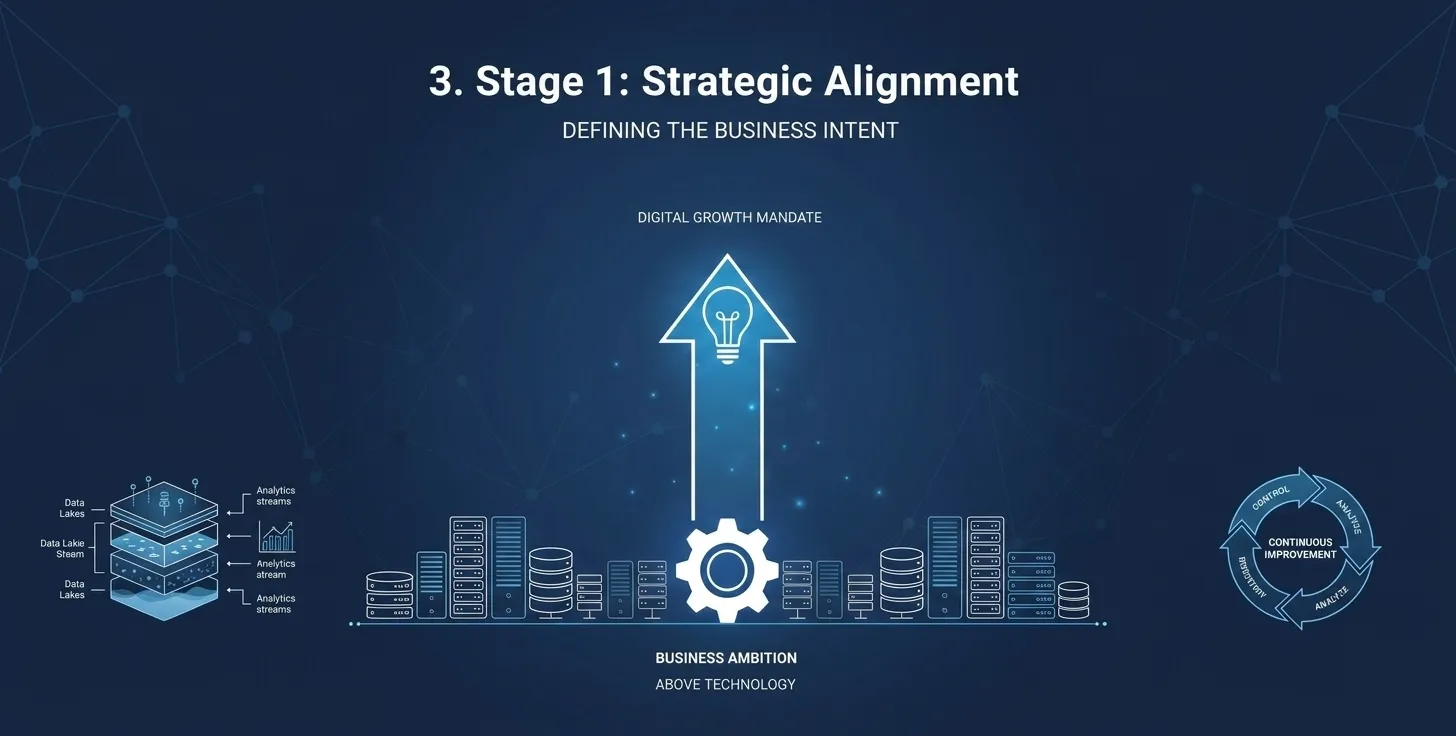
Roadmaps do not begin with technology. They begin with intent.
Before discussing platforms, integrations, or personalization engines, leadership must answer a fundamental question: what is digital actually supposed to accomplish for the business?
Digital strategy must align directly to corporate growth priorities. Is the company pursuing market expansion? Margin improvement? Operational efficiency? Competitive differentiation? Ecommerce cannot invent its own trajectory; it must support the broader one. For instance, if the company's top corporate priority is entering new geographic markets and growing revenue by 25% in untapped regions, then the digital strategy must focus on capabilities like multi-language support, localized pricing, and region-specific product catalogs—rather than pouring resources into advanced personalization for existing high-margin accounts
This stage requires asking difficult questions. Is ecommerce revenue incremental, or is it gradually replacing field sales? Is the priority margin expansion or cost reduction? Are we enabling sales teams, or digitizing them? Is self-service defensive, or a true growth accelerator?
Instead of vague aspirations, leadership must define measurable three- to five-year outcomes—such as the percentage of revenue influenced by digital channels, reduction in manual order processing, margin improvements tied to pricing automation, or measurable lifts in customer retention.
The outcome of Stage 1 is a clearly articulated digital growth mandate. Without this clarity, everything that follows becomes reactive.
Stage 2: Capability Mapping — Designing What the Business Must Be Able to Do
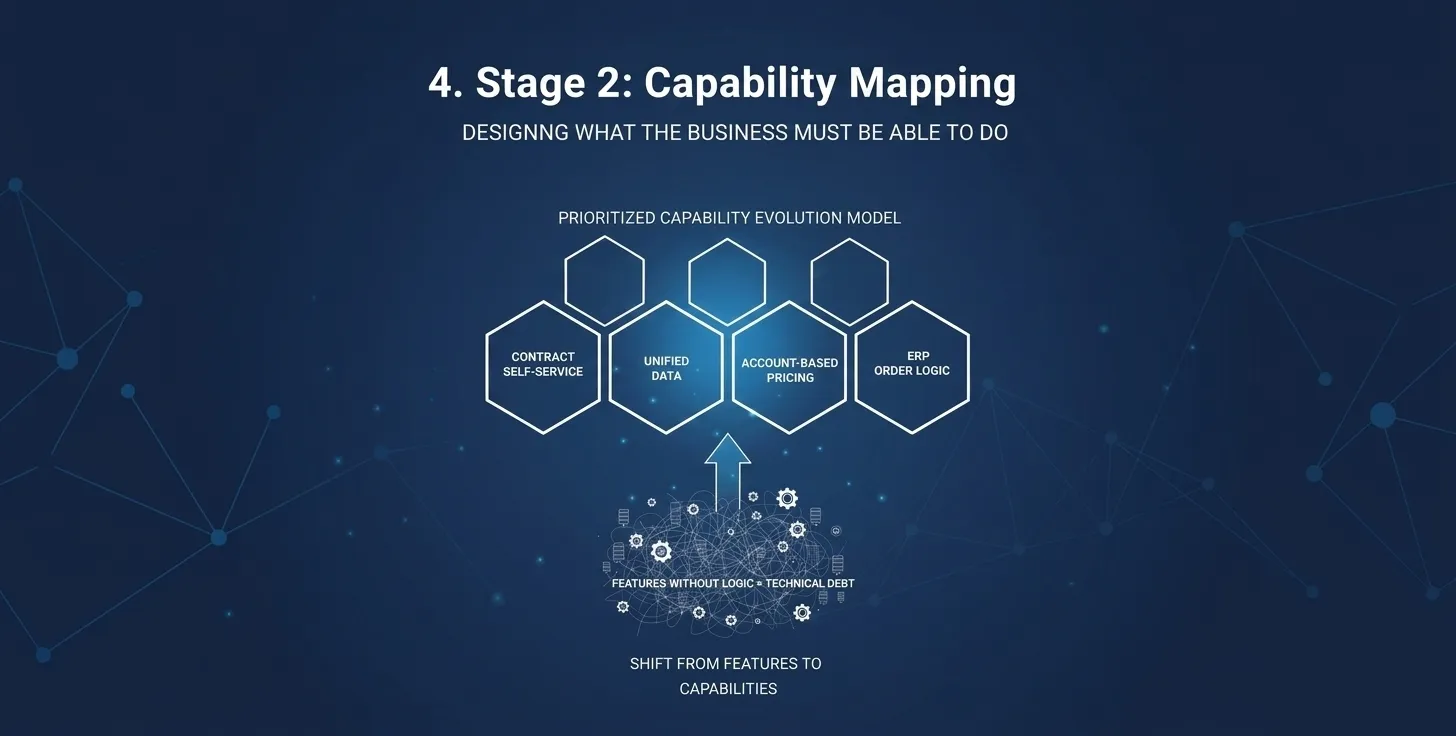
Most organizations make their first major mistake at this stage. They jump directly to features instead of defining capabilities. Features without capability logic create technical debt.
The conversation must shift from “Do we need advanced search?” to “What must our customers and internal teams be able to do frictionlessly?” That subtle reframing changes everything.
If the objective is margin expansion, the required capabilities may include account-based pricing automation, dynamic discount governance, and approval workflows. If operational efficiency is the priority, then ERP-integrated availability, automated reorder logic, and self-service contract visibility may be essential.
In high-touch B2B environments, additional capabilities often include unified customer data layers, role-based access controls, multi-site account hierarchies, and transparent credit management.
This stage also requires honest maturity assessment. What processes are still manual? Where do silos exist? What breaks when volume scales?
The outcome of Stage 2 is a prioritized capability evolution model—not a wishlist of disconnected features, but a structured plan for what the business must become capable of doing.
Stage 3: Architectural Sequencing — Building Foundations Before Features
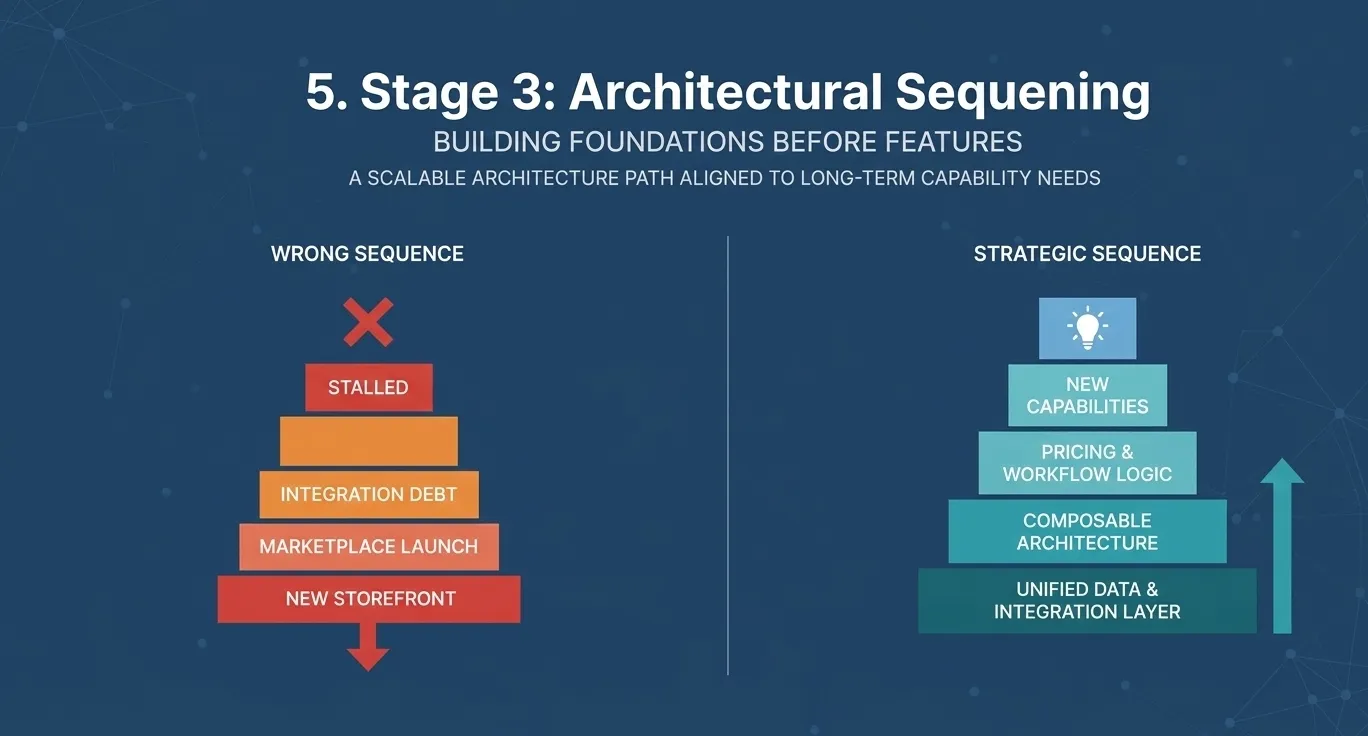
This is where growth frequently stalls. Organizations fall into front-end-first thinking. They redesign the experience or launch a new storefront while ignoring brittle ERP integrations, inconsistent data models, or fragmented pricing logic. In high-touch B2B, that integration debt compounds quickly.
Architectural sequencing means building foundations before layering complexity. Data models must be standardized before personalization. Integrations must be stabilized before scaling transactions. Pricing logic must be defined before enabling self-service quoting.
When companies sequence incorrectly, they launch new storefronts, experiment with personalization, or pursue marketplace strategies while patching integrations in the background. Strategic sequencing, by contrast, prioritizes data standardization, pricing consolidation, ERP and CRM integration layers, and role-based workflows before optimizing experience.
Debates about composable versus monolithic architectures belong here as well—but the underlying principle remains the same: architecture must serve future capabilities, not current hype.
The outcome of Stage 3 is a scalable architectural path aligned to long-term capability needs.
Stage 4: Governance & Ownership — Making Growth Structural, Not Political
Even the most well-designed roadmap will fail without governance.This happens so often because ecommerce spans multiple departments with competing priorities and no single owner, so decisions quickly turn political—driven by turf wars, the loudest voice, or protecting status quo—instead of shared outcomes, quietly sabotaging adoption and momentum despite strong strategy and tech.
In B2B organizations, ecommerce touches IT, sales, operations, finance, and customer service. Without clear ownership, roadmap decisions quickly become political.
Shared accountability must be established. Who owns prioritization? Who approves scope changes? Who tracks KPIs? How are trade-offs resolved when departments disagree?
Roadmaps are not rigid, but they are disciplined. Quarterly recalibration ensures performance is reviewed, capability maturity reassessed, and sequencing adjusted without compromising architectural direction.
This prevents silo-driven decisions, such as sales requesting features that undermine data integrity or IT prioritizing stability while ignoring customer friction. The outcome of Stage 4 is organizational alignment that sustains execution over time.
Stage 5: Continuous Evolution — Turning the Roadmap into a Living System
True maturity emerges in the final stage.
The roadmap should evolve—but its direction should not drift. Performance data must inform decisions intelligently, not emotionally. For instance, resist the urge to chase the latest AI trend just because it's generating hype in the industry; instead, only pursue it if hard metrics show it will measurably advance your defined capabilities and business outcomes.
Trend-driven initiatives—AI, marketplaces, headless architectures—may be powerful, but only if they align with the existing capability roadmap. Every new initiative must answer a critical question: does this strengthen long-term architecture, or introduce fragmentation?
When done correctly, the roadmap becomes a compounding digital growth engine rather than a series of disconnected projects.
How the Five Stages Work Together
These five stages are sequential, but they are also cyclical. As the business evolves, leadership revisits strategic alignment, refines capability models, and adjusts sequencing. However, this evolution always occurs within a deliberate structure.
That structure is what prevents digital chaos.
Common Failure Patterns in B2B Ecommerce Roadmaps
Across manufacturers and distributors, certain patterns consistently emerge.
Organizations start with platform selection instead of strategic alignment. They confuse backlogs with strategy. They treat integration as an afterthought. They underestimate change management. They measure traffic instead of transformation.
None of these are technology failures. They are sequencing failures.
From Strategy to Execution: Turning a Growth Map into Reality
Here is the uncomfortable truth: most internal teams are too embedded in day-to-day execution to orchestrate a neutral, cross-functional roadmap.
B2B environments are inherently multi-system ecosystems involving ERP, CRM, PIM, pricing engines, and sales enablement tools. Without structured capability modeling, implementation becomes reactive.
This is why a structured Ecommerce Strategic Roadmap is critical—not as a static document, but as an architectural discipline. Because execution without structure does not scale.
Conclusion: Digital Growth Is Designed — Not Discovered
Digital growth must serve business growth. Complexity requires sequencing. Structure creates compounding returns.
The difference between fragmented effort and scalable momentum is not budget, platform choice, or even technology maturity. It is architectural clarity. The organizations that win in B2B ecommerce are not those that launch the most features.
They are the ones that design their growth deliberately.
Picking Up Where We Left Off
What a Strategic B2B Ecommerce Roadmap Is — and Is Not
Stage 1: Strategic Alignment — Defining the Business Intent
Stage 2: Capability Mapping — Designing What the Business Must Be Able to Do
Stage 3: Architectural Sequencing — Building Foundations Before Features
Stage 4: Governance & Ownership — Making Growth Structural, Not Political
Stage 5: Continuous Evolution — Turning the Roadmap into a Living System
How the Five Stages Work Together
Common Failure Patterns in B2B Ecommerce Roadmaps
From Strategy to Execution: Turning a Growth Map into Reality
Conclusion: Digital Growth Is Designed — Not Discovered
Subscribe to learn more about content
Stay informed and never miss out on valuable insights. Subscribe today to access in-depth content, updates, and exclusive resources tailored just for you!