The Hidden Impact of Manual Quoting in B2B Commerce

Introduction
In many B2B organizations, quoting is still handled through manual processes. While these approaches may seem manageable on the surface, they introduce a range of challenges that affect both day to day operations and overall business performance.
Mostly the focus has largely been on understanding these issues such as delays, errors, and process inefficiencies. In this article, the focus shifts to the impact of those challenges, and how they influence sales cycles, team efficiency, and buyer experience over time.
A Common Challenge in B2B Sales Processes
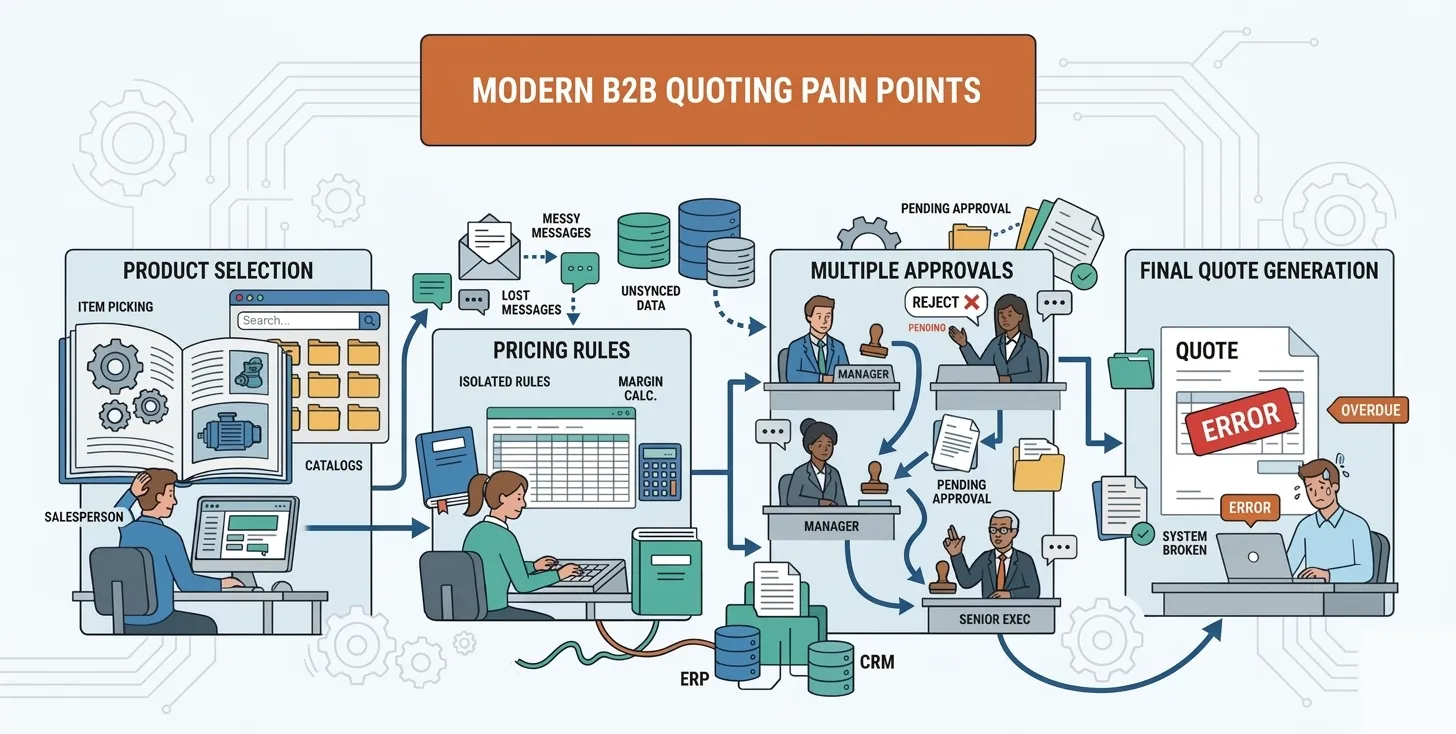
Quoting sits at the center of the B2B sales process, connecting product selection, contract based pricing, internal approvals, and the final purchase decision.
While these issues are part of everyday operations, their broader effect on the business is not always clearly understood.
Quoting is not just an internal step. It directly influences how quickly buyers can move forward and how effectively businesses can respond to demand. Even when teams manage to complete quotes accurately, the effort and time involved often slow down the overall process.
Over time, this raises a more important question. Not just what is happening inside the quoting process, but what it is costing the business as a whole.
How Delays in Quoting Affect Buyer Momentum
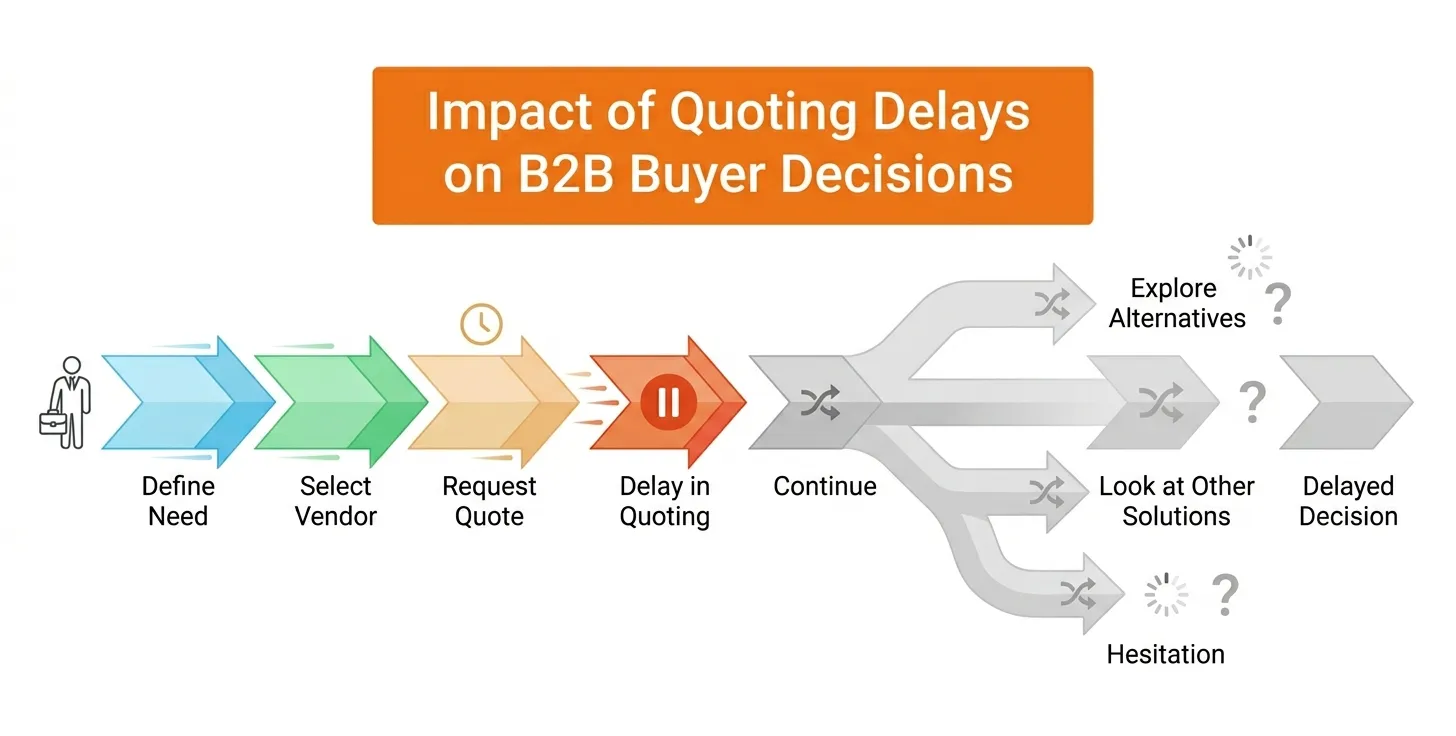
Time plays a central role in B2B purchasing.When quoting depends on multiple steps checking contract based pricing, confirming configurations, and waiting for approvals response times naturally increase. What starts as a straightforward request can stretch across hours or days.
During that time, the buying process does not stand still. Buyers pause their evaluation, internal priorities begin to shift, and alternative suppliers start to come into consideration.
In many cases, the delay itself starts to influence the decision.Even when the final quote is accurate, the time taken to deliver it can reduce urgency. Momentum is lost gradually, not all at once, but enough to change the direction of a deal.
Across multiple transactions, this shows up as:
• longer sales cycles
• slower response to incoming demand
• reduced ability to compete in time-sensitive opportunities
Speed in quoting is not only about efficiency. It shapes how and when decisions are made.
The Operational Load Behind Manual Quoting
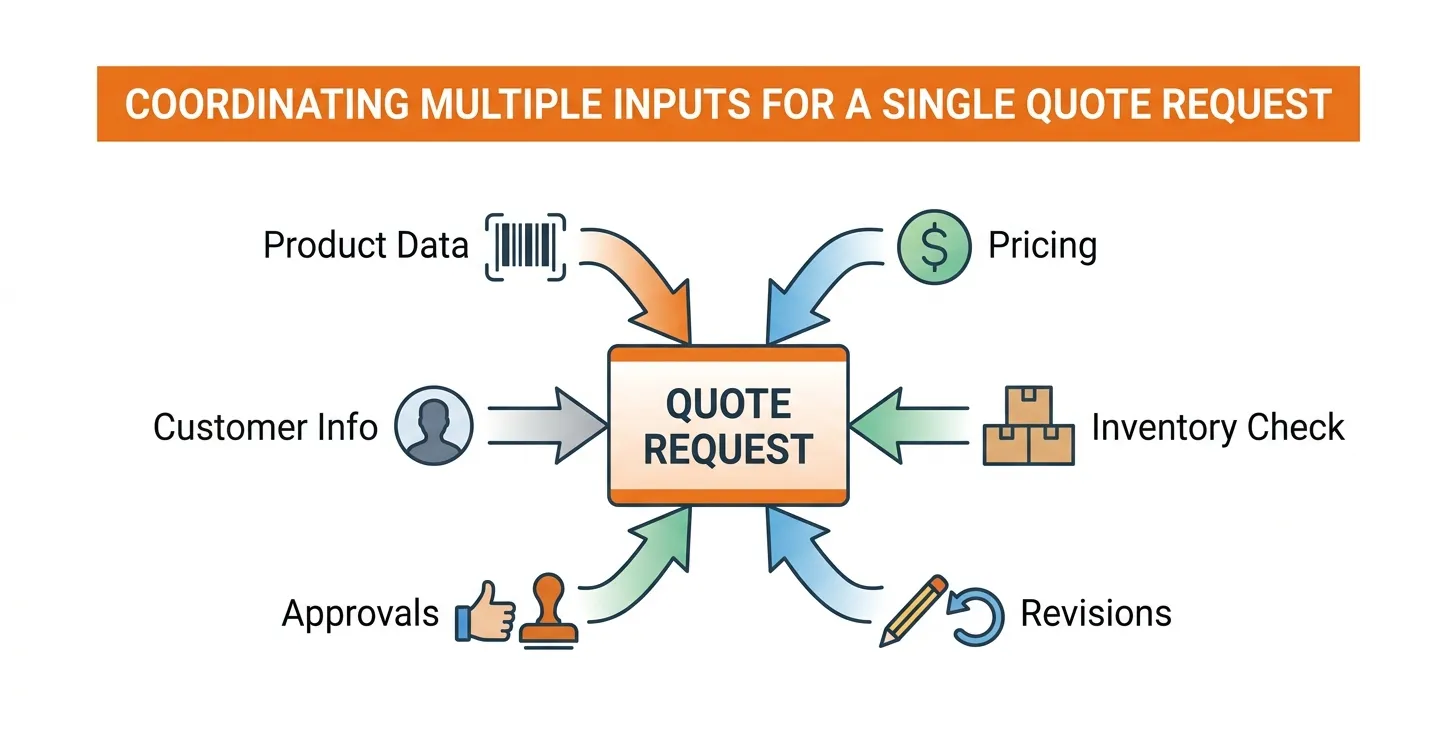
Manual quoting also brings a steady operational load that is often spread across teams.Sales representatives spend a significant portion of their time on what is often considered shadow work gathering product details, preparing quotes, coordinating approvals, and responding to revisions. In more complex scenarios, engineering and finance teams are brought in to validate configurations or pricing structures.
As a result, even routine requests begin to involve multiple steps, with information coming from different sources, approvals moving between teams, and updates handled through emails and shared files. Critical data often ends up scattered across inbox threads and disconnected complex catalogs.
Over time, sales teams spend more effort managing a fragmented process rather than focusing on customer conversations and progressing deals.
The impact is not always immediate, but it builds over time. Teams spend a significant portion of their effort managing the process rather than focusing on customer conversations or deal progression.
Instead of supporting scale, the quoting process begins to limit how efficiently teams can operate.
How Errors and Inconsistencies Impact Business Outcomes
When quoting relies on manual inputs, consistency becomes harder to maintain.Contract-based pricing often exists in disconnected silos. For example, pricing agreed in a customer contract may be stored in one system, while updated pricing rules or discounts are maintained elsewhere, leading to inconsistencies during quote creation.Product configurations can be interpreted differently depending on who is handling the request. Discounts are applied based on individual judgment rather than a shared structure.
Common issues tend to include:
• outdated or incorrect pricing
• mismatched configurations
• inconsistent discounting across similar requests
These issues are not always obvious at first. In many cases, they appear as small corrections or adjustments during the process. However, the effects tend to extend further.
• quotes need to be revised and resent
• internal discussions increase to resolve discrepancies
• confidence in the process begins to weaken
In environments where products or contract based pricing structures are complex, even minor inconsistencies can lead to delays or impact margins.
Accuracy in quoting is not just about getting the numbers right. It also affects how smoothly the process moves from one step to the next.
Limited Visibility Across the Quoting Process
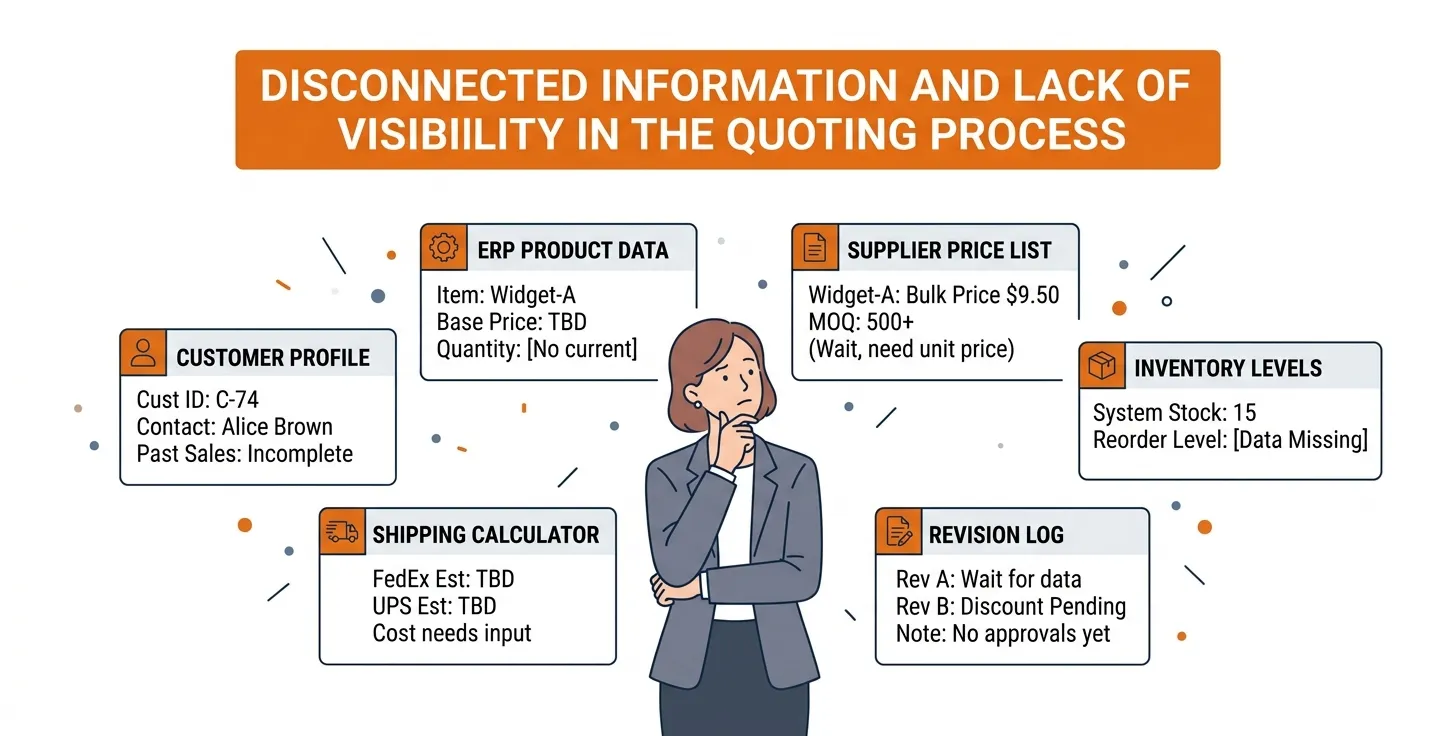
Another challenge that often comes with manual quoting is the lack of clear visibility.Without a centralized way to manage quotes, there is no single source of truth. Information is typically spread across different tools and individuals.Emails and local files each hold part of the picture, but not the full view.
This makes it difficult to understand where a quote currently stands, how long it usually takes to complete, and where delays tend to happen. As a result, teams rely on follow-ups and manual tracking just to stay updated.
From a business perspective, this creates a gap. Performance becomes harder to measure, recurring issues are not always visible, and improvements depend more on individual effort than on clear insight.
Over time, the process continues as it is, not because it is optimal, but because there is limited visibility into how it can be improved.
The Impact on Buyer Experience
Quoting is not only an internal activity. It is also a key part of the buyer’s experience.In many B2B environments, buyers expect quicker responses, clearer information, and a more straightforward path to decision-making. These expectations are shaped by broader digital experiences, even outside of B2B.
When quoting remains manual, the experience often feels different.
In practice, buyers often need to:
• wait for responses before moving forward
• clarify requirements multiple times
• follow up to understand the status of a request
Each step adds effort to what should be a more direct process.
Even when the final outcome is correct, the path to get there can feel slower than expected. Over time, this influences how buyers perceive the interaction.
The quoting process becomes part of the overall experience, not just a step behind the scenes.
Why This Matters as B2B Operations Grow
As businesses grow, the impact of these challenges becomes more visible.An increase in requests brings more coordination, more dependencies, and more pressure on existing processes. What worked at a smaller scale begins to show its limits.
Manual quoting makes it harder to:
• handle higher volumes consistently
• maintain alignment across teams
• support digital and self-service channels
As demand increases, so does the reliance on manual effort. This creates a pattern where growth is tied to the ability to add more people rather than improving the process itself.
Over time, this affects how quickly a business can respond and adapt.
Across the industry, there is a growing recognition that quoting plays a larger role than it once did. It sits close to the point where decisions are made and directly influences how smoothly those decisions move forward.
At Clouda, this is something we see as part of a broader shift in B2B commerce. Not just improving a single step, but rethinking how processes support both buyers and internal teams as complexity increases.
Introduction
A Common Challenge in B2B Sales Processes
How Delays in Quoting Affect Buyer Momentum
The Operational Load Behind Manual Quoting
How Errors and Inconsistencies Impact Business Outcomes
Limited Visibility Across the Quoting Process
The Impact on Buyer Experience
Why This Matters as B2B Operations Grow
Get Your Free Quote Feature list
Fill out the form and pick a time that works for you. We’ll walk you through how your current quoting process works today, and show you how it can be structured into a faster, more reliable flow.

Fill out the form and pick a time that works for you. We’ll walk you through how your current quoting process works today, and show you how it can be structured into a faster, more reliable flow.