The New First Impression: What Buyers Learn Before They Reach Out

For most of the last twenty years, digital visibility meant one thing: ranking in search engines. Marketing teams invested heavily in search engine optimisation, content production, paid advertising, and website performance because buyers were expected to visit websites, compare vendors, and make their own decisions.
That buying journey is changing remarkably quickly. Increasingly, decision-makers begin by asking ChatGPT, Microsoft Copilot, Claude, Gemini, or Perplexity a business question instead of opening a search engine. Rather than reviewing ten websites themselves, they ask an AI system to recommend vendors, explain differences between solutions, summarise market trends, or identify companies with relevant expertise.
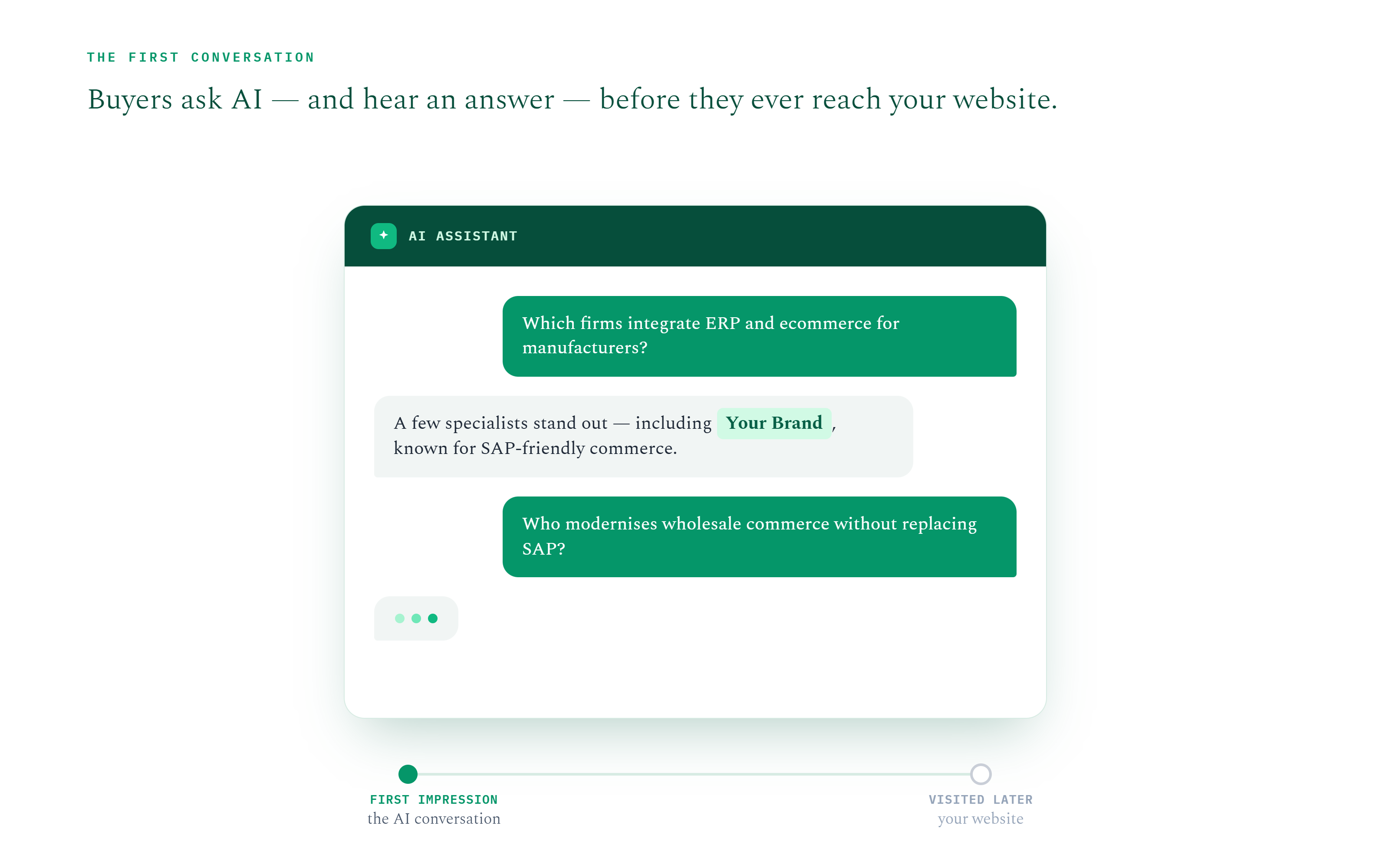
This changes far more than where traffic comes from. It changes who performs the research. Instead of presenting every company equally and allowing buyers to compare them manually, AI systems act as research assistants, filtering information before a potential customer ever visits your website. In many cases, the first impression of your company is no longer created by your homepage. It is created by an AI's answer.
That shift introduces an entirely new competitive question. When someone asks an AI about your category, does your company appear as an authority—or does it disappear behind competitors whose information is easier for AI systems to understand and trust?
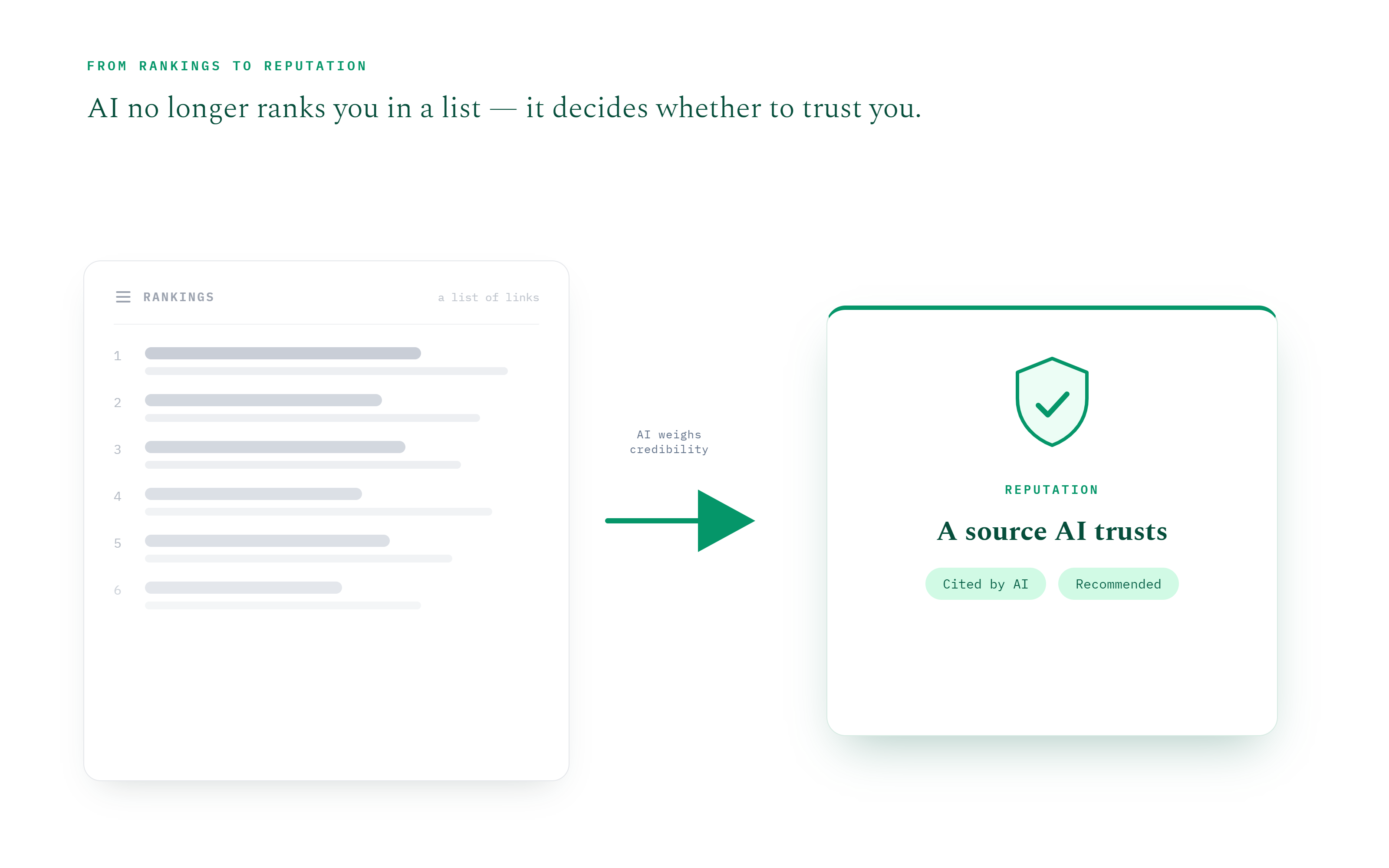
Visibility Has Shifted from Rankings to Reputation
Traditional SEO focused on visibility inside search results. Success depended on appearing near the top of a list of links that users could investigate themselves. AI systems work differently. Their objective is not simply to list pages but to generate a direct answer using information collected from multiple trusted sources.
This means AI evaluates companies differently than search engines do. Instead of asking, "Which page best matches these keywords?", it asks, "Which organisations consistently appear credible enough to support this answer?" Authority becomes more important than optimisation alone.
This is one reason why established companies sometimes receive fewer mentions than smaller competitors. An organisation may dominate search rankings while contributing very little content that AI systems consider reliable enough to reference. Meanwhile, a specialist firm publishing detailed research, practical guidance, original data, and expert commentary may become highly visible in AI-generated responses despite attracting less conventional search traffic.
The competitive advantage therefore shifts from simply being discoverable to becoming confidently recommendable.
AI Doesn't Recommend Websites. It Reconstructs Trust.
One of the biggest misconceptions surrounding AI search is that it behaves like Google with a conversational interface. In reality, large language models evaluate information differently depending on the platform, but they generally share one objective: producing an answer they can defend.
Rather than copying a single webpage, AI systems synthesise information from multiple authoritative sources. They compare consistency across documents, evaluate expertise, recognise established terminology, and prefer material that demonstrates subject knowledge instead of promotional language.
This explains why shallow marketing content rarely performs well inside AI-generated answers. Articles designed primarily around keywords often lack the depth necessary for AI systems to treat them as authoritative references. By contrast, detailed explanations supported by evidence, original insights, and practical examples are more likely to influence the responses buyers receive.
For B2B organisations, this represents an important shift in content strategy. The goal is no longer simply attracting clicks. It is becoming one of the sources AI systems trust when constructing an answer.
What AI Uses to Build Confidence in Your Brand
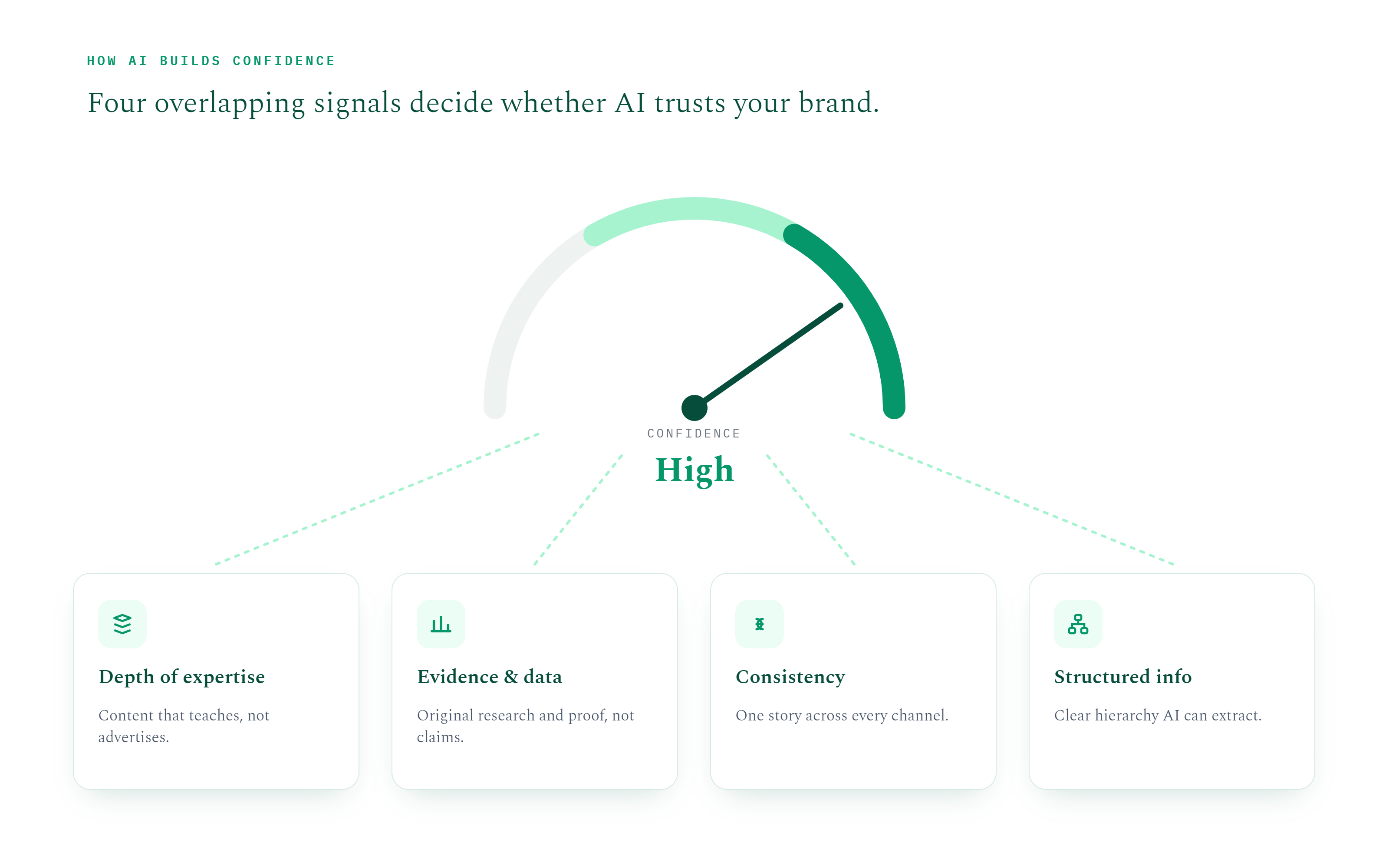
Unlike traditional search algorithms, AI models evaluate many overlapping signals before referencing an organisation. Individual platforms differ, but recent studies—including research discussed by Princeton, Surmado, Column Five, and Percepture—show remarkably consistent patterns.
Depth of expertise
Comprehensive articles explaining complex subjects generally outperform short promotional content. AI systems favour material that teaches rather than advertises because detailed explanations provide stronger evidence of genuine expertise.
Evidence and original information
Research, statistics, expert commentary, practical implementation experience, and original observations significantly improve the likelihood that content contributes to AI-generated answers. Unsupported marketing claims rarely survive this evaluation.
Consistency across your digital presence
Your website, LinkedIn presence, published articles, customer stories, documentation, speaking engagements, and third-party mentions collectively shape how AI interprets your organisation. Contradictory messaging weakens confidence, while consistent expertise reinforces it.
Structured information
Well-organised content helps AI understand relationships between ideas. Clear headings, logical progression, concise explanations, and structured data make it easier for language models to extract accurate information instead of guessing context.
The Trust Signal: What AI Learns About Your Business
Large language models do not recommend companies because of advertising budgets or clever homepage copy. They assemble answers from the information they can verify. If your expertise exists only inside sales presentations, proposal documents, or conversations with clients, AI has nothing meaningful to work with.
That is why many organizations are surprised when they ask ChatGPT or Perplexity to recommend providers in their own market. The answers often include competitors that publish extensively while ignoring companies with stronger capabilities but weaker public knowledge.
The important shift is this: visibility is no longer measured only by rankings. It is measured by understanding. Can an AI confidently explain what your company does, who it serves, and why it is different? If it cannot, then future buyers may never discover you, regardless of where your website appears in search results.
This creates a new strategic question for marketing leaders:
If someone asked an AI to recommend vendors in your category today, would the answer reflect the business you have actually built?
For many organizations, the answer is uncomfortable.
Designing Content for Retrieval Instead of Discovery
Traditional SEO often rewarded pages that targeted a keyword as efficiently as possible. AI systems reward something different. They reward documents that explain complex topics completely enough that they can safely reuse the information inside an answer.
That changes how content should be written.
Instead of producing dozens of similar articles targeting slight keyword variations, companies should focus on creating definitive resources that answer an important business question thoroughly. Strong explanations, evidence, original insight, and logical structure become competitive advantages because they reduce uncertainty for the AI selecting information.
Several content characteristics consistently appear in pages that perform well across answer engines:
- Clear section hierarchy that follows a logical progression.
- Original data, research, or industry experience that cannot be found elsewhere.
- Credible citations supporting important claims.
- Direct answers to common executive questions.
- Comprehensive coverage rather than isolated talking points.
Notice that none of these tactics are new because of AI. They are simply what authoritative content has always looked like. The difference is that AI systems reward those characteristics far more consistently than traditional ranking algorithms ever did.
AI Is Becoming the First Conversation Before Sales Ever Begins
One of the biggest shifts happening in B2B buying is invisible to most companies because it occurs before a prospect reaches their website.
Executives increasingly begin vendor research by asking conversational questions instead of searching for individual websites. They describe their business problem, request recommendations, compare providers, and ask follow-up questions that narrow the list before clicking a single link.
Instead of searching for "system integration consultant," they ask questions like:
- "Which companies specialize in integrating ERP and ecommerce platforms for manufacturers?"
- "Who has experience modernizing wholesale commerce without replacing SAP?"
- "Which consulting firms understand AI readiness rather than just AI implementation?"
These questions produce synthesized answers rather than pages of search results.
That changes competitive dynamics completely. Companies are no longer competing only for rankings. They are competing to become part of the answer itself.
Being absent from that conversation means losing consideration before the buying process officially starts. Marketing teams therefore need to think beyond generating traffic and begin thinking about shaping the information AI systems use to evaluate expertise.
Measuring Success in an AI-First Search Environment
The metrics organizations use to evaluate digital visibility are beginning to evolve.
Organic traffic, keyword rankings, and click-through rates remain valuable, but they no longer tell the whole story when AI increasingly answers questions without sending visitors to every source.
Marketing leaders should begin monitoring additional signals that indicate whether their expertise is becoming visible inside AI-generated responses.
These include:
- Frequency of brand citations across major AI platforms.
- Presence in AI-generated vendor comparisons.
- References within AI summaries of industry topics.
- Growth in branded searches after AI recommendations.
- Higher-quality inbound enquiries driven by informed buyers.
None of these measurements replace traditional analytics. Instead, they complement them by reflecting how modern discovery increasingly works.
Success is becoming less about winning individual keywords and more about becoming a trusted reference point within an industry's collective knowledge.
 From Discoverable to Recommendable
The competitive advantage is shifting from simply being discoverable to becoming confidently recommendable.
Authority Is Built Long Before AI Uses It
One misconception surrounding GEO is that companies can optimize for AI immediately before they want results. In reality, authority compounds over time.
AI systems learn from patterns of expertise built through consistent publishing, reputable citations, industry recognition, and technically accessible content. Organizations that have invested in those assets for years naturally become easier for AI to understand and recommend.
That makes GEO a long-term strategic discipline rather than a tactical campaign.
The companies likely to dominate AI-driven discovery over the coming years are not necessarily those producing the most content. They are the ones producing the most useful, evidence-based, and consistently updated knowledge in their field.
For Clouda, this aligns directly with the philosophy behind digital transformation itself. Sustainable competitive advantage rarely comes from shortcuts. It comes from building strong foundations that continue creating value long after the initial investment.
The same principle now applies to marketing. As buyers increasingly rely on AI to interpret markets, evaluate suppliers, and recommend partners, the brands that will be discovered are those whose expertise has already become part of the knowledge AI trusts.
Visibility in the AI era is therefore no longer just about appearing in search results. It is about becoming the source those systems rely on when someone asks the question that matters most:
"Who should we trust?"
Visibility Has Shifted from Rankings to Reputation
AI Doesn't Recommend Websites. It Reconstructs Trust.
What AI Uses to Build Confidence in Your Brand
The Trust Signal: What AI Learns About Your Business
Designing Content for Retrieval Instead of Discovery
AI Is Becoming the First Conversation Before Sales Ever Begins
Measuring Success in an AI-First Search Environment
Authority Is Built Long Before AI Uses It
Identify and Execute AI Opportunities With Clouda
Fill out the form and schedule a session with our team to assess your operations and identify where AI can create real impact.
Learn how our seven-stage engagement framework turns AI opportunities into practical, measurable business outcomes.
Fill out the form and schedule a session with our team to assess your operations and identify where AI can create real impact.
Learn how our seven-stage engagement framework turns AI opportunities into practical, measurable business outcomes.