Why B2B Digital Growth Needs a Strategic Roadmap

Why B2B Digital Growth Stalls Without a Strategic Roadmap
Company growth is rarely driven by a single lever. It emerges from the combined effect of market expansion, product relevance, operational efficiency, customer relationships, and the ability to scale execution as complexity increases. Sales strategy, supply chains, pricing models, service delivery, and technology decisions all play a role. When these elements reinforce one another, growth compounds. When they drift out of alignment, momentum slows.
Within this broader picture, B2B growth represents a distinct and critical layer. It is shaped by how organizations acquire, serve, and retain business customers over long cycles and high-value relationships. Traditionally, this growth has been driven by sales excellence, account management, and geographic or portfolio expansion. These fundamentals still matter. But they are no longer sufficient on their own.
B2B growth is increasingly shaped by digital decisions. Pricing logic, purchasing journeys, customer self-service, and system integrations now sit at the center of how B2B organizations scale. In many cases, digital channels are no longer supporting the business — they are the business. As a result, B2B digital growth has become a critical sub-system of overall B2B growth, directly influencing speed, efficiency, customer experience, and margin.
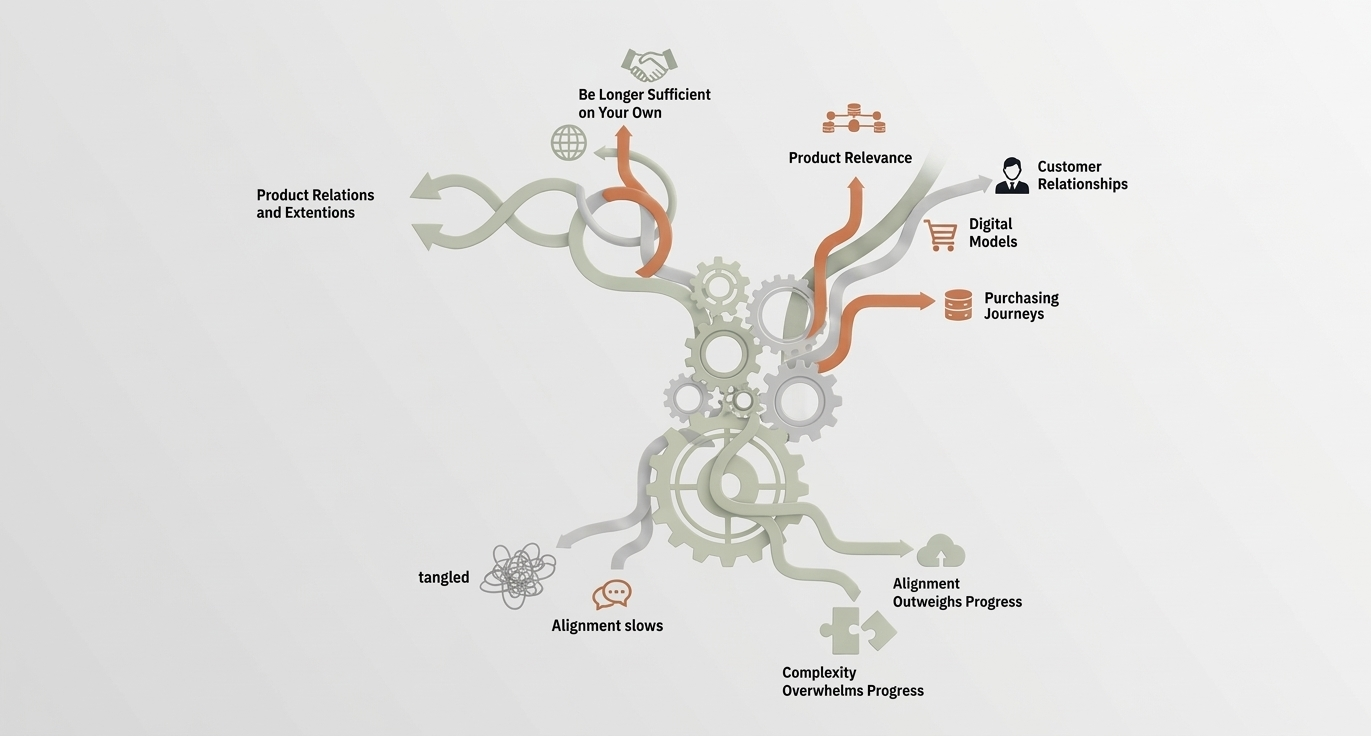
Yet digital growth does not emerge in a straight line. Most organizations arrive at the need for a digital roadmap gradually. A new platform is introduced to support sales. Automation is added to improve efficiency. Integrations are built as the business expands. Each step is sensible in isolation. Over time, however, when these initiatives are not guided by a shared strategic direction, complexity begins to outweigh progress. Teams move faster, but outcomes become harder to predict.
This is where the distinction between B2B growth and B2B digital growth becomes important. Traditional growth may come from new accounts, expanded territories, or stronger relationships. Digital growth — particularly in B2B eCommerce — depends on how well technology, operations, data, and customer experience work together over time. Without alignment across these layers, even well-executed initiatives can pull the organization in different directions. Not all B2B models experience this challenge in the same way. High-frequency B2B businesses often optimize for speed, volume, and transactional efficiency. High-touch B2B organizations operate in a far more interconnected environment. Long sales cycles, negotiated pricing, account-specific experiences, and deep operational dependencies mean that digital decisions carry broader consequences. For these organizations, digital growth cannot be improvised.
For high-touch B2B organizations operating across eCommerce and connected platforms, growth often stalls not because of a lack of investment, but because complexity grows faster than alignment. A strategic B2B digital roadmap provides the structure needed to connect digital decisions back to business outcomes — restoring clarity as scale increases.
When Roadmaps Lose Alignment, Digital Growth Stalls
In high-touch B2B organizations, digital growth is rarely driven by a single roadmap. Instead, it emerges from a hierarchy of plans — business strategy, commercial priorities, operating models, technology platforms, and delivery initiatives. Each layer serves a purpose. Problems arise when these layers evolve independently.
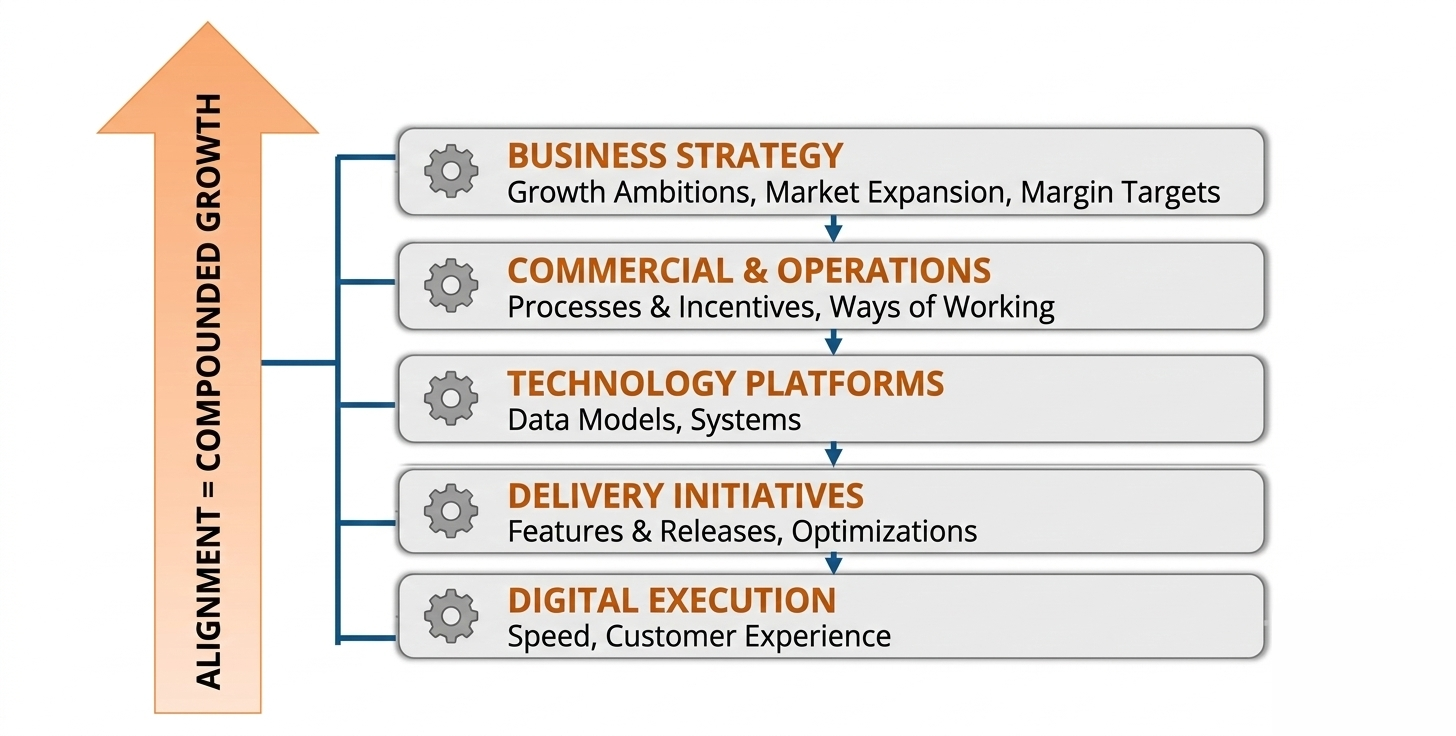
At the top, business leadership defines growth ambitions: market expansion, customer segments, margin targets, or service differentiation. Below that, commercial and operational teams translate those ambitions into processes, incentives, and ways of working. Technology teams then select platforms, integrations, and data models to support execution. Finally, delivery teams turn these decisions into features, releases, and optimizations.
When this hierarchy is aligned, digital investments reinforce one another. When it is not, progress becomes fragile. A common failure pattern looks like this: a B2B organization invests in a new eCommerce platform to improve customer experience and scalability. At the same time, sales continues to operate on account-specific workflows built for offline processes, pricing remains managed outside the digital stack, and regional teams customize the platform to meet local needs. Each decision is defensible in isolation. Collectively, they create a system where digital channels cannot fully support the business model.
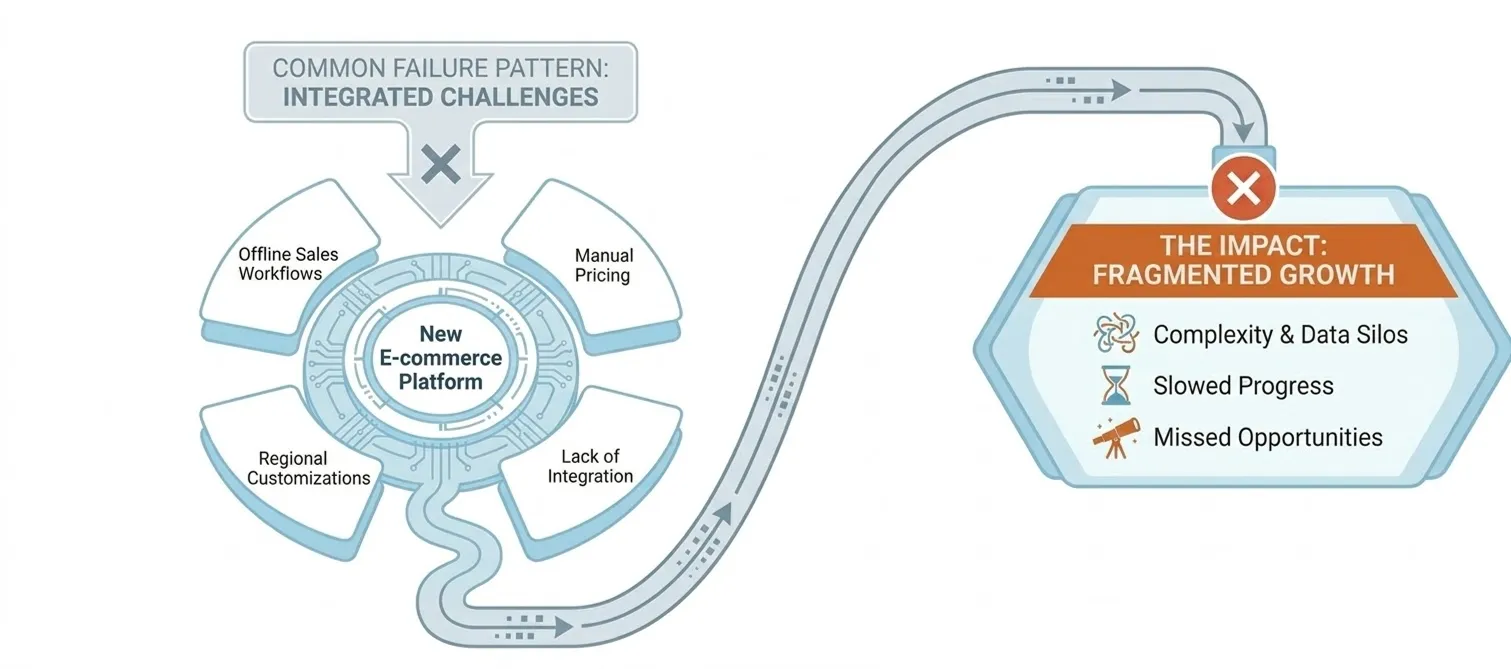
Over time, the impact compounds. Delivery slows as integrations become harder to maintain. Data becomes fragmented across regions and tools. Leadership struggles to measure performance consistently or prioritize the next investment. Growth does not stop abruptly — it stalls under the weight of misalignment.
A strategic B2B digital roadmap exists to prevent this outcome. Its role is not to replace individual plans, but to connect them — ensuring that business intent, operating reality, and digital execution move in the same direction as complexity increases.
Why B2B Digital Growth Is Uniquely Difficult
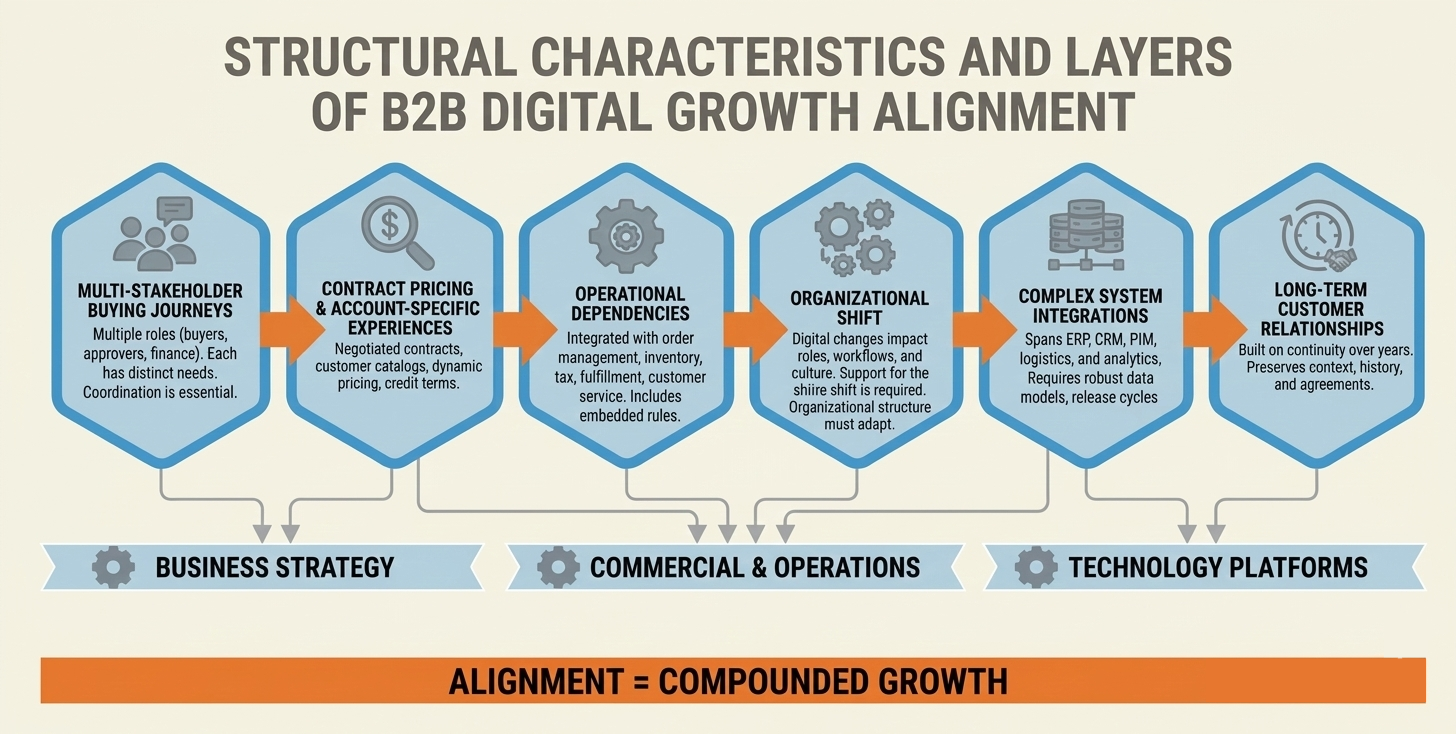
B2B digital growth unfolds in an environment where scale, complexity, and coordination increase simultaneously. Progress is rarely driven by optimizing a single experience or channel. Instead, it depends on how well multiple commercial, operational, and technical layers evolve together over time. Several structural characteristics make B2B digital growth inherently more demanding.
Multi-Stakeholder Buying Journeys
B2B purchasing decisions are rarely made by one individual. Buyers, approvers, procurement teams, finance, and operations often interact with digital channels at different points in the journey, each with distinct needs and constraints. Digital experiences must support negotiation, approvals, contract visibility, and repeat purchasing, not just discovery and checkout. Designing for one role in isolation can easily degrade the experience for another, making coordination essential but difficult.
Contract Pricing and Account-Specific Experiences
Unlike standardized pricing models, B2B organizations frequently operate with negotiated contracts, customer-specific catalogs, volume pricing, credit terms, and service agreements. Digital systems must accurately reflect these realities across channels while remaining flexible enough to evolve as relationships change. This introduces complexity not only in pricing logic, but also in data governance, access control, and integration across systems.
Deep Operational Dependencies
B2B eCommerce does not sit at the edge of the organization. It is deeply embedded in core operations. Front-end experiences depend on order management, inventory availability, credit rules, tax logic, fulfillment workflows, and customer service processes. A seemingly simple digital change, such as enabling self-service order edits — can impact contracts, finance approvals, warehouse operations, and customer support. As a result, digital growth becomes an organizational shift, not a surface-level optimization.
Complex System Integrations
B2B digital ecosystems typically span ERP, CRM, PIM, pricing engines, logistics systems, and analytics platforms. Each system has its own data models, constraints, and release cycles. Maintaining consistency and reliability across this landscape requires intentional design and sequencing. Without coordination, integrations become brittle, data fragments across tools, and the cost of change increases over time.
Long-Term Customer Relationships
B2B growth is built on long-term relationships rather than one-time transactions. Digital channels must support continuity — preserving context, history, preferences, and commercial agreements over years, not sessions. This shifts the focus from short-term optimization to sustained capability building, where trust, reliability, and consistency matter as much as speed or innovation.
When Complexity Outpaces Direction
In the absence of a strategic framework, teams naturally optimize from their own vantage points. Marketing focuses on demand generation, sales pushes for enablement tools, IT prioritizes stability and security, and operations pursue efficiency. Each decision is rational in isolation.
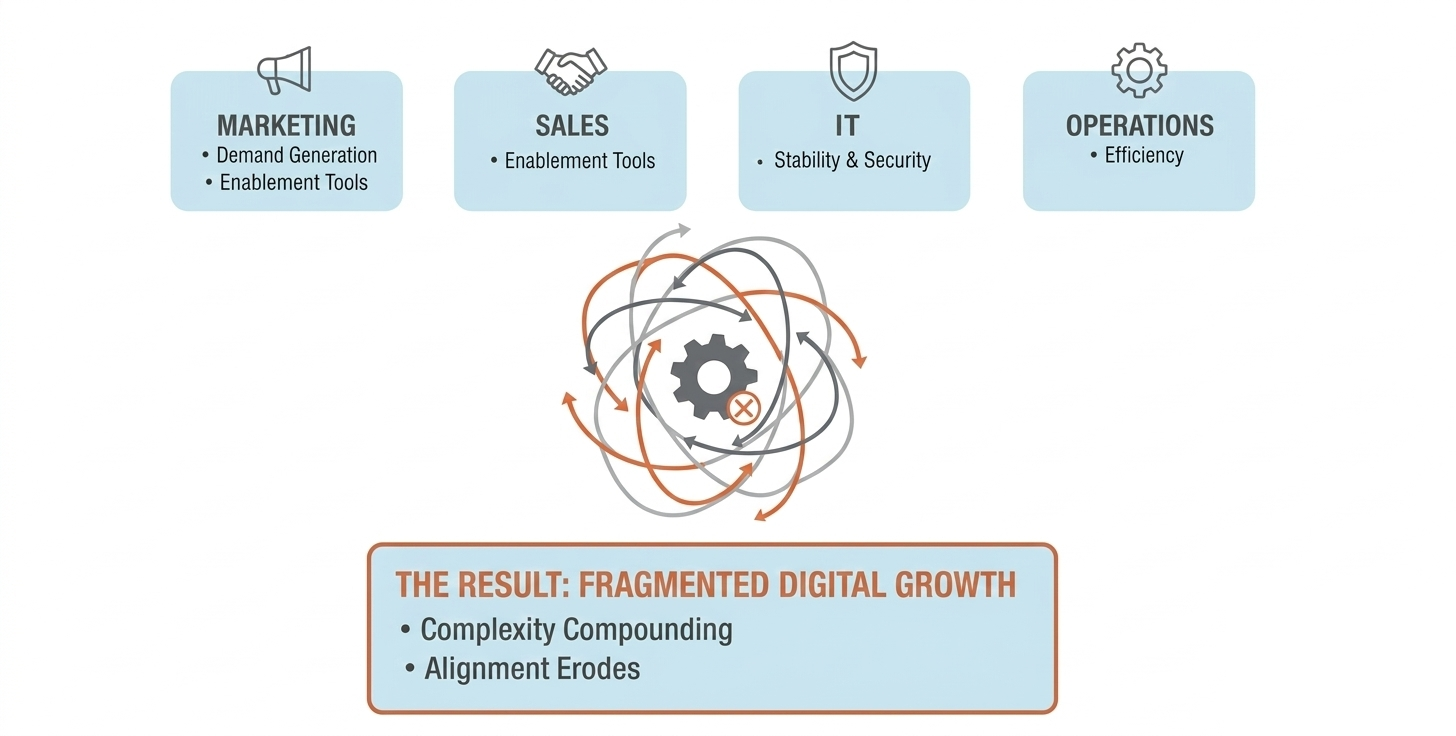
Collectively, however, these efforts can pull the organization in different directions. Complexity compounds, alignment erodes, and digital growth becomes a collection of disconnected initiatives rather than a coordinated strategy. This is why B2B digital growth is uniquely difficult and why it demands a roadmap that connects decisions across functions, systems, and time.
Where Digital Growth Most Often Breaks Down
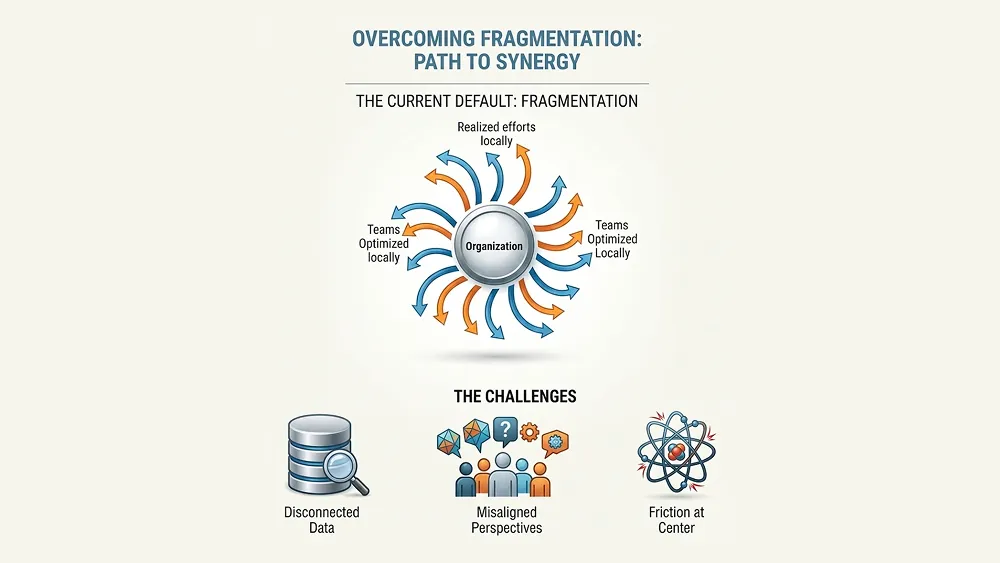
Fragmentation Becomes the Default
As organizations scale, regions, business units, and functions often optimize locally. Different tools are adopted, parallel experiments are run, and metrics are defined slightly differently across teams.
Over time, data drifts out of sync. Leadership spends more time reconciling numbers and aligning perspectives than making confident decisions. What looks like flexibility at the edges becomes friction at the center.
Technology Starts Driving Direction
Another common breakdown occurs when technology choices precede strategic clarity. Platform migrations, AI initiatives, or automation programs are launched before the organization has aligned on:
- The business outcomes that matter most now
- The current level of digital and operational maturity
- The next capabilities required to support growth
The result is often advanced technology that organizations struggle to extract value from.
 Short-Term Pressure Erodes Long-Term Coherence
B2B organizations operate under constant performance pressure. Quarterly targets, customer demands, and operational constraints encourage short-term fixes. Without a guiding roadmap, these decisions accumulate. What begins as pragmatic adaptation gradually hardens into structural constraint — limiting flexibility, increasing cost, and slowing future growth.
Why More Activity Rarely Creates More Growth
When B2B digital growth slows, the instinctive response is to increase effort. New tools are introduced, additional integrations are built, and optimization initiatives multiply. Activity rises. Reporting becomes more granular. Teams appear productive.
Yet progress often remains elusive.
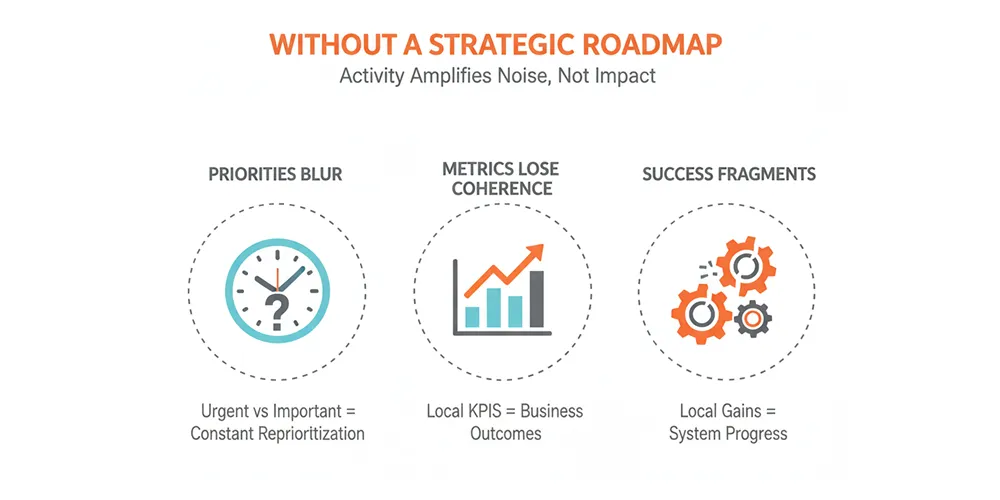
Without a strategic roadmap to provide context, increased activity amplifies noise rather than impact. Decisions are made faster, but not necessarily in the right direction.
Several patterns emerge:
-
Priorities blur
Teams struggle to distinguish between what is urgent and what is important, leading to constant reprioritization. -
Metrics lose coherence
KPIs are optimized within functions, but disconnected from broader business outcomes. -
Success fragments
Local improvements fail to compound into system-wide progress.
How to Recognize When You Need a Strategic Roadmap
Organizations rarely reach a clear moment where they decide to "create a strategic roadmap." More often, the need becomes visible through a pattern of signals—subtle at first, then increasingly difficult to ignore. These signals do not point to failure or underperformance. They indicate that complexity has begun to outpace the structures guiding decision-making.
For many B2B organizations, growth continues on the surface. Investment increases. Teams deliver. Digital initiatives move forward. Yet beneath that activity, coordination becomes harder and confidence in direction begins to erode.
Several signals commonly appear when a strategic roadmap is missing:
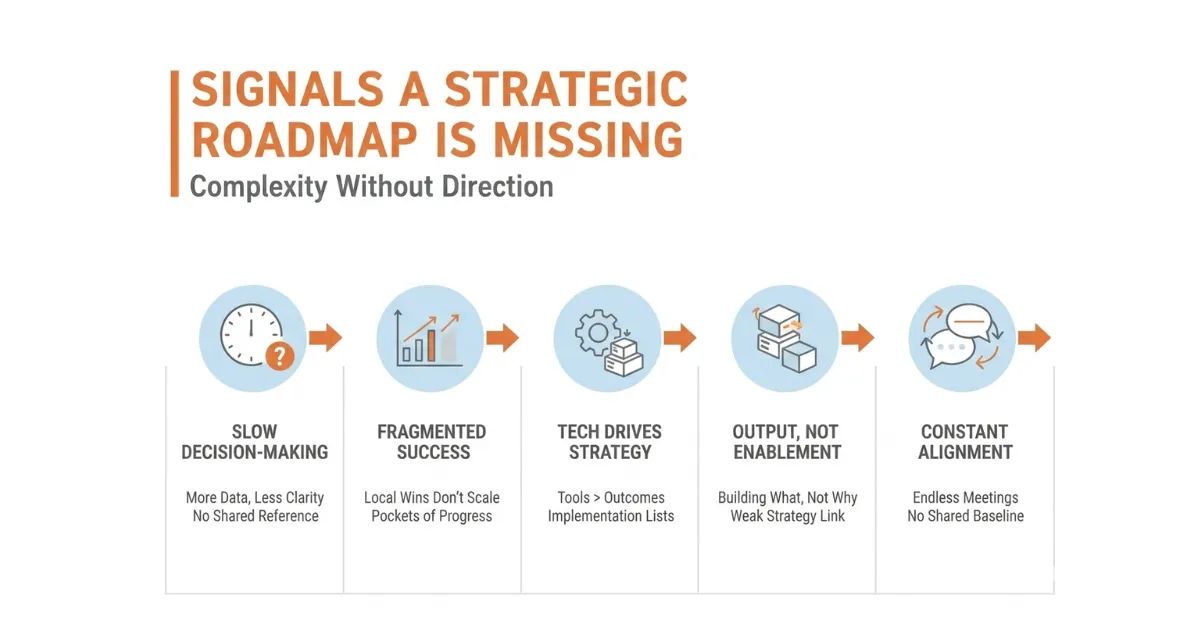
Decision-Making Slows Despite More Data
Leadership teams often invest heavily in analytics, dashboards, and reporting. Paradoxically, decisions begin to take longer rather than becoming clearer. More time is spent debating interpretations, aligning stakeholders, and justifying trade-offs. The issue is not a lack of information, but the absence of a shared strategic reference point against which decisions can be evaluated.
Digital Initiatives Succeed Locally but Stall Globally
Individual teams or regions may deliver strong results, a successful platform rollout, an improved customer journey, or a new automation capability. However, these wins fail to scale or translate into broader business impact. Over time, the organization accumulates pockets of progress without a coherent system connecting them.
Technology Conversations Begin to Dominate Strategy
Discussions about growth increasingly center on platforms, tools, and features rather than outcomes and capabilities. Roadmaps become lists of implementations rather than expressions of intent. When technology starts driving priorities instead of enabling them, it is often a sign that strategic direction has not been clearly articulated.
Teams Optimize for Output, Not Enablement
Delivery teams ask, "What should we build next?" rather than "What should the business be able to do next?" Work continues, but it becomes harder to explain how individual initiatives contribute to long-term goals. Effort remains high, yet the link between execution and strategy weakens.
Alignment Requires Constant Reinforcement
Cross-functional alignment becomes an ongoing effort rather than a shared baseline. Meetings are spent re-explaining context, resolving overlaps, and negotiating priorities. Progress depends increasingly on individual coordination rather than structural clarity.
These signals are often misinterpreted as performance issues, resourcing gaps, or tooling limitations. In reality, they point to a structural challenge: the organization has outgrown its implicit assumptions about direction. A strategic B2B digital roadmap addresses this by making intent explicit. It provides a shared frame for decision-making, clarifies how initiatives connect over time, and allows complexity to be managed deliberately rather than reactively. Recognizing these signals early creates the opportunity to restore alignment before growth stalls under its own weight.
The Hidden Cost of Growing Without a Roadmap
The absence of a strategic roadmap rarely appears as a single line item on a budget. Its impact accumulates quietly, revealing itself over time as friction, inefficiency, and lost momentum rather than immediate failure. In high-touch B2B environments, these costs are often systemic:
Rework and Duplicated Initiatives
Teams invest in overlapping solutions to similar problems, only to revisit the same decisions months later. Time, effort, and budget are spent correcting direction instead of advancing it.
Tool Sprawl and Integration Debt
New platforms are introduced to solve isolated needs, increasing complexity across the digital ecosystem. Over time, integrations become harder to maintain, slower to change, and more expensive — reducing the organization's ability to adapt.
Talent Burnout and Disengagement
When priorities shift frequently or lack clear rationale, high-performing teams lose confidence in decision-making. Energy is spent navigating uncertainty rather than creating value, quietly increasing the risk of attrition.
Slower Executive Decision-Making
Without a shared strategic reference point, leadership discussions require more alignment and justification. Decisions take longer, and the organization's ability to respond decisively to market changes weakens.
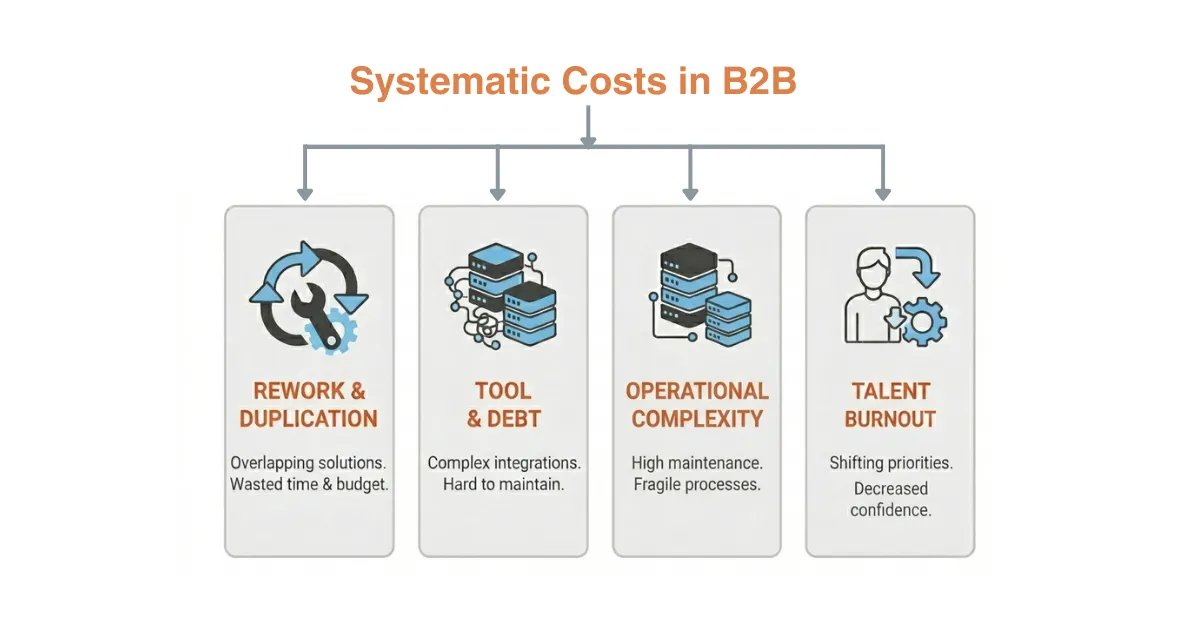
Taken together, these effects do not stop growth outright. They gradually erode it ,making scale harder, riskier, and more expensive than it needs to be.
How Strategic Roadmaps Transform B2B Growth
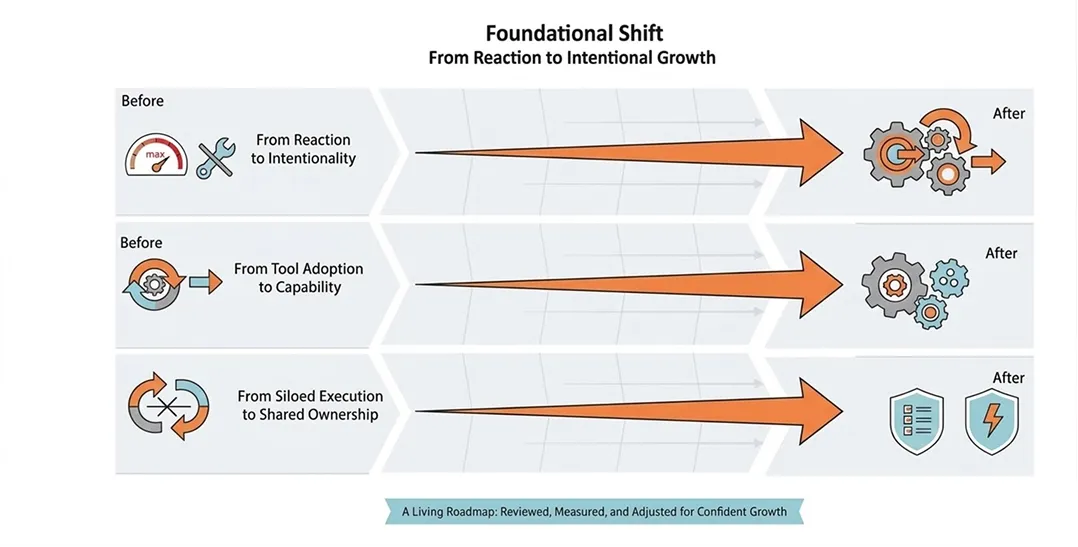
A strategic roadmap changes B2B growth from a sequence of reactions into a deliberate, coordinated effort. Instead of responding to immediate pressure, decisions are evaluated through a long-term lens based on how they contribute to where the business is heading, not just how quickly they can be delivered. This shift fundamentally changes how organizations operate.
From Reaction to Intention
Growth becomes purposeful. Decisions are made against clear north-star objectives, allowing teams to act with direction rather than reacting to urgency, trends, or the loudest request.
From Tool Adoption to Capability Building
Features and platforms still matter, but they are chosen to support specific capabilities — customer experience, operational efficiency, data maturity — rather than driving decisions on their own. Over time, this creates a stronger foundation for sustainable growth.
From Siloed Execution to Shared Ownership
Because the roadmap is co-created across functions, priorities are shared. Sales, marketing, IT, operations, and finance can see how their work fits into the broader picture and where dependencies exist. Conversations shift from “our project” versus “their project” to “our roadmap.”
From Risk Accumulation to Risk Management
Trade-offs and dependencies are made explicit. Instead of discovering risks late in delivery or production, leaders can stage changes, apply mitigation strategies, and deliberately decide which risks to accept, defer, or avoid.
For high-performing B2B organizations, the roadmap does not remain static. Markets evolve, customer expectations shift, and technologies change. As a result, effective roadmaps are treated as living systems reviewed regularly, measured against real performance, and adjusted based on data and learning. This approach preserves strategic clarity while maintaining flexibility, enabling organizations to grow with confidence rather than uncertainty.
Direction Before Speed
B2B digital growth rarely fails because organizations lack effort, investment, or ambition. It fails when complexity grows faster than clarity. As systems expand, teams scale, and customer expectations rise, progress depends less on how much work is done and more on whether that work is aligned.
Without a shared strategic roadmap, even well-executed initiatives struggle to compound. Decisions are made in isolation, trade-offs remain implicit, and effort disperses across competing priorities. Activity increases, but momentum weakens.
A strategic B2B digital roadmap does not promise certainty. It provides something more valuable: shared direction. It aligns business intent with operating reality and digital execution, making complexity manageable rather than paralyzing.
Sustainable growth is not defined by moving faster than competitors. It is defined by the ability to move forward deliberately — with clarity, consistency, and purpose — even as scale and complexity increase.
Why B2B Digital Growth Stalls Without a Strategic Roadmap
When Roadmaps Lose Alignment, Digital Growth Stalls
Why B2B Digital Growth Is Uniquely Difficult
Where Digital Growth Most Often Breaks Down
Why More Activity Rarely Creates More Growth
How to Recognize When You Need a Strategic Roadmap
The Hidden Cost of Growing Without a Roadmap
How Strategic Roadmaps Transform B2B Growth
Direction Before Speed
Get Your Free Pre-Roadmap
Fill out the form and choose a time that works for you to schedule your call. Connect with our experts to uncover high-impact strategies and unlock personalized growth insights tailored to your unique business goals.

Fill out the form and choose a time that works for you to schedule your call. Connect with our experts to uncover high-impact strategies and unlock personalized growth insights tailored to your unique business goals.