Why Most Enterprise AI Initiatives Fail Before They Deliver Value

Artificial intelligence has become one of the largest technology investments organizations have made in decades. Boards expect measurable returns, executives are under pressure to demonstrate progress, and software vendors continue to promise faster decisions, greater efficiency, and entirely new ways of working. Despite this momentum, the reality inside many organizations is far less convincing. AI pilots are launched with enthusiasm, only to stall before reaching production, while projects that do make it into day-to-day operations often struggle to produce the commercial outcomes that justified the investment in the first place.
The research tells a remarkably consistent story. RAND's analysis of more than 2,400 enterprise AI initiatives found that close to 80% fail to achieve their intended business value. MIT's Project NANDA reported that the overwhelming majority of generative AI pilots delivered no measurable financial impact, while McKinsey continues to find a significant gap between AI adoption and organizations realizing meaningful improvements in profitability. These findings span industries, company sizes, and technology platforms, suggesting that the issue extends well beyond the capabilities of any individual AI model.
For many organizations, the instinctive conclusion is that the technology itself still needs time to mature. However, the evidence points somewhere else. Enterprise AI rarely fails because models cannot perform the required tasks. More often, projects struggle because organizations expect AI to compensate for fragmented operations, disconnected systems, and inconsistent data. The technology becomes responsible for solving problems that existed long before AI entered the conversation.
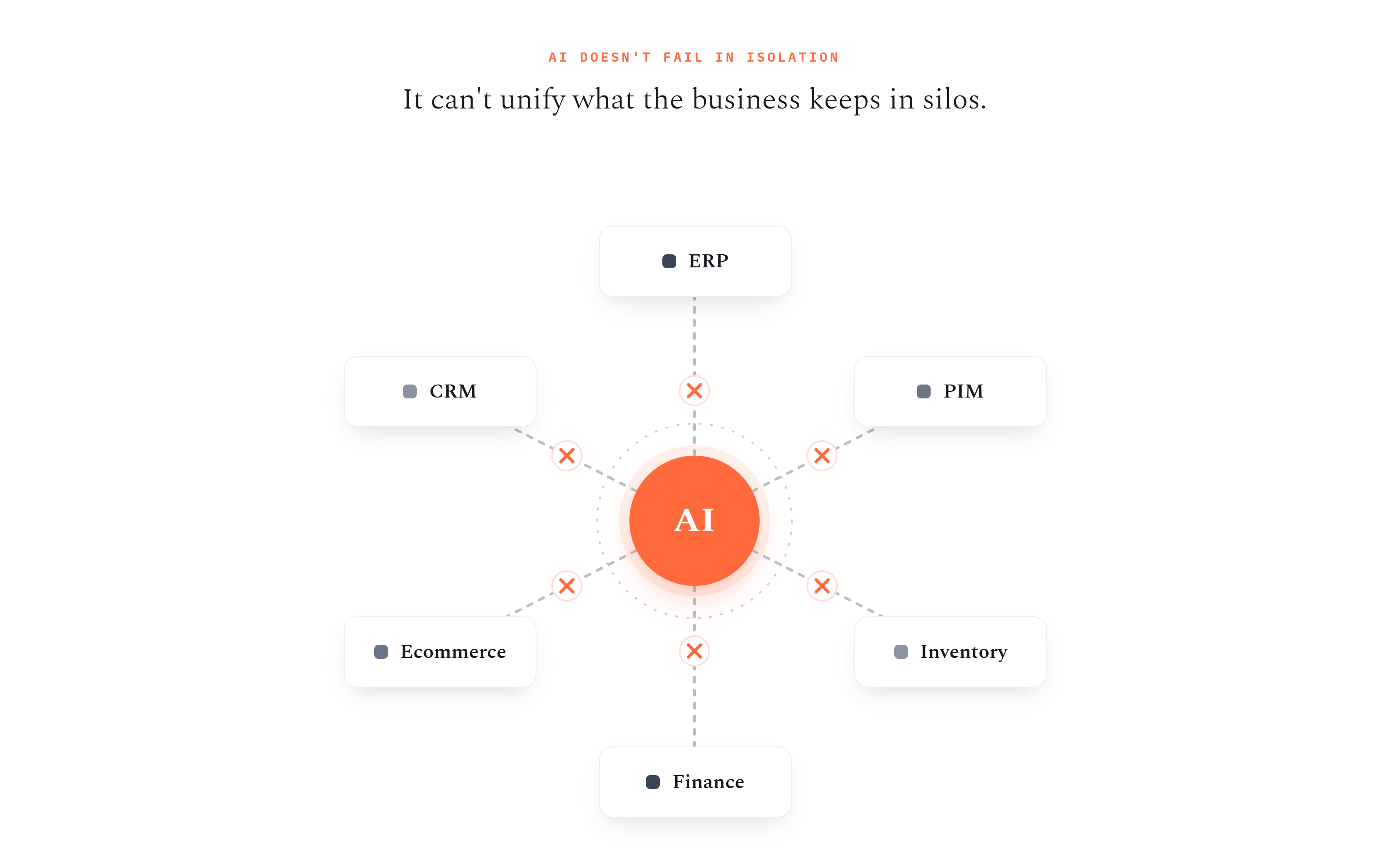
AI Doesn't Fail in Isolation But Businesses Do
Successful AI projects are rarely defined by the sophistication of the model. Instead, they are shaped by the quality of the environment in which the model operates. AI depends on accurate data, reliable processes, and connected systems. When those foundations are missing, even the most advanced models produce inconsistent or limited results.
Consider a typical enterprise environment. Customer information may exist in a CRM, product information in a PIM, inventory inside an ERP, order history in an ecommerce platform, and financial data within an accounting system. Each application performs its intended role, yet none provides a complete operational picture. Employees compensate by exporting spreadsheets, manually reconciling information, or relying on institutional knowledge built over years of experience.
Introducing AI into this environment does not remove those dependencies. Instead, it magnifies them. A forecasting model cannot generate reliable recommendations from inconsistent inventory data. A customer service assistant cannot provide complete answers when order history is scattered across multiple systems. Document automation cannot eliminate manual intervention if approvals still move between disconnected workflows.
This explains why demonstrations often create unrealistic expectations. During a pilot, the data is carefully prepared, exceptions are handled manually, and specialists remain closely involved throughout the process. Production environments are fundamentally different. Business rules evolve, data quality varies, operational exceptions become routine, and information flows across multiple departments that each maintain their own priorities and processes. AI performs within that complexity rather than outside it.
The organizations achieving meaningful returns are not necessarily deploying more advanced technology. They are creating operational environments where information flows consistently, responsibilities are clearly defined, and business processes support automation rather than resisting it.
The Patterns Behind Enterprise AI Failure
Although every organization approaches AI differently, the reasons projects underperform tend to follow the same patterns. They are rarely caused by a lack of ambition or investment. More often, they stem from decisions made before the first model is ever deployed.
Common characteristics of underperforming AI initiatives include:
- Treating AI as a standalone technology project rather than an operational transformation initiative.
- Automating fragmented workflows instead of redesigning them to remove unnecessary complexity.
- Relying on disconnected systems that produce conflicting versions of critical business data.
- Measuring the success of a pilot instead of defining how the solution will operate at enterprise scale.
- Prioritizing rapid deployment over governance, ownership, and long-term maintainability.
Individually, each of these decisions may appear manageable. Collectively, they create environments where AI struggles to deliver sustained value. A successful pilot becomes difficult to expand because every new department introduces additional systems, different data standards, and new operational exceptions. What initially appeared to be a technology challenge gradually reveals itself as an organizational one.
Research increasingly supports this conclusion. Studies examining enterprise AI adoption consistently show that technical implementation represents only part of the journey. Data governance, workflow integration, process design, and organizational alignment account for much of the work required to move beyond experimentation. The challenge is not simply teaching AI to perform a task, but enabling the business to operate in a way that allows AI to contribute consistently over time.
Operational Design Should Come Before Automation
One of the most valuable lessons emerging from enterprise AI adoption is that successful organizations rarely begin with the technology. Instead, they begin by understanding how work actually moves through the business.
McKinsey has reported that organizations redesigning workflows before selecting AI technologies are approximately twice as likely to generate significant financial returns. That finding reinforces a principle that has existed long before AI entered the mainstream: technology delivers the greatest value when it improves a well-designed process rather than attempting to compensate for a poorly designed one.
Consider customer onboarding within a financial institution. An AI model may be capable of extracting information from identity documents, validating application forms, and identifying missing information. However, if those documents continue to move through multiple disconnected systems requiring manual approvals, duplicated checks, and inconsistent business rules, automation delivers only marginal improvements. The technology accelerates individual tasks while the overall process remains constrained by the same operational bottlenecks.
The same principle applies across manufacturing, distribution, retail, healthcare, and professional services. Whether the objective is improving demand forecasting, automating order processing, accelerating claims management, or enhancing customer support, the underlying workflow determines the value AI can ultimately create. Organizations that understand their operational landscape before introducing automation consistently place themselves in a stronger position to scale successful initiatives beyond isolated pilots.
Building an AI-Ready Organization
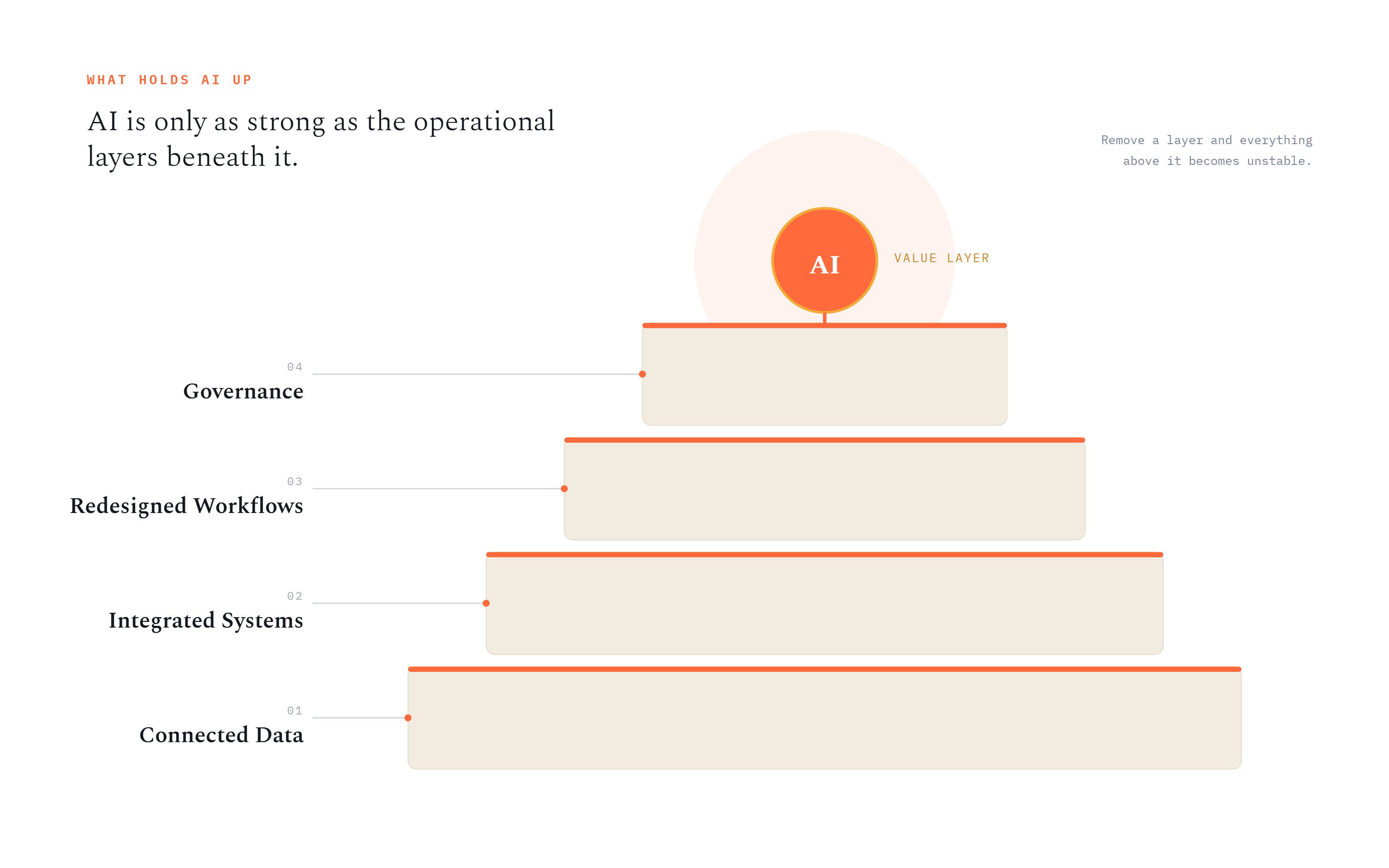
Organizations that consistently generate value from AI tend to follow a similar path. Rather than viewing AI as a standalone initiative, they treat it as the next stage in modernizing how information flows across the business. Technology becomes an accelerator for operational excellence instead of a substitute for it.
Connect Systems Before Connecting AI
Enterprise AI performs best when it operates across complete business processes rather than isolated applications. Customer data, product information, financial records, inventory, and operational metrics need to move between systems consistently and reliably. Integration is no longer simply an IT concern; it determines whether AI has access to the context required to make accurate recommendations, automate decisions, and support employees with confidence.
Organizations that invest in building a connected operational foundation often discover that many long-standing business problems become easier to solve even before AI enters the picture. Manual reconciliation decreases, reporting becomes more reliable, and teams spend less time searching for information spread across different applications.
Redesign Workflows Before Introducing Automation
Automating an inefficient process simply enables the business to perform the wrong process faster. Successful organizations begin by understanding where work slows down, where manual intervention adds little value, and where approvals exist primarily because systems cannot communicate with one another.
Once those processes are simplified, AI can automate document handling, assist customer service teams, improve forecasting, or support operational decision-making without introducing unnecessary complexity. The result is not just faster execution but more consistent outcomes across the organization.
Establish Governance from the Beginning
As AI becomes responsible for increasingly important business activities, governance moves from a compliance exercise to an operational necessity. Organizations need clear ownership of data, defined approval processes for automated decisions, role-based access controls, and visibility into how AI-generated outputs are created and reviewed.
Governance should not be viewed as a barrier to innovation. Instead, it provides the confidence needed to expand AI into more valuable parts of the business while maintaining accountability, security, and trust. This is particularly important in regulated industries such as healthcare and financial services, but the principle applies equally to manufacturing, retail, distribution, and every organization handling sensitive operational data.
Scale What Works Instead of Chasing What's New
One of the most common characteristics of successful AI programs is disciplined expansion. Rather than launching dozens of disconnected pilots, organizations identify use cases that deliver measurable operational improvements and then extend those capabilities across departments using the same connected foundation.
This approach reduces implementation risk, simplifies governance, and allows knowledge gained in one area of the business to benefit others. AI becomes part of the organization's operating model rather than a collection of unrelated experiments competing for attention and budget.
What High-Performing Organizations Do Differently
The difference between organizations that struggle with AI and those that achieve lasting results is rarely determined by budget or access to technology. More often, it comes down to the decisions made before implementation begins and the discipline maintained as projects move from experimentation into production.
Organizations that consistently generate value tend to share several characteristics:
- They begin with business objectives rather than technology selection.
- They establish a reliable, connected data foundation before introducing advanced AI capabilities.
- They redesign workflows to remove unnecessary complexity instead of automating existing inefficiencies.
- They define governance, ownership, and success metrics before scaling AI across the business.
- They measure long-term operational improvements rather than short-term pilot success.
These organizations also recognize that AI maturity is built progressively. Every successful implementation strengthens the underlying operational foundation, making future initiatives easier, faster, and more valuable. Rather than treating each project as a separate investment, they develop capabilities that compound over time.
This perspective aligns closely with BCG's AI maturity research, which identifies only a small proportion of organizations as truly "future-built." Those organizations are distinguished not by how many AI tools they purchase, but by how effectively they integrate AI into redesigned workflows, connected systems, and well-governed business operations. Their competitive advantage comes from operating differently, not simply adopting technology earlier.
 The Real Competitive Advantage
Enterprise AI is no longer defined by the quality of the model alone. It is defined by the quality of the business that surrounds it.
Moving Beyond the AI Pilot
The conversation around enterprise AI is gradually shifting. A year ago, the focus centred on experimenting with generative AI, identifying potential use cases, and proving that the technology could perform specific tasks. Today, the more important question is whether organizations can embed those capabilities into everyday operations in a way that creates measurable business value.
That shift requires a broader perspective than selecting models or evaluating software vendors. It demands an understanding of how information moves across departments, how decisions are made, where manual work accumulates, and which operational constraints continue to limit performance. AI becomes one component of a larger transformation rather than the transformation itself.
Organizations that approach AI through this operational lens are far more likely to build solutions that endure. They create systems capable of supporting future technologies without requiring another major restructuring each time the next innovation emerges. As new models, agents, and automation capabilities continue to evolve, the businesses with connected operations will be able to adopt them more quickly because the foundation is already in place.
Enterprise AI is no longer defined by the quality of the model alone. Increasingly, it is defined by the quality of the business that surrounds it. Companies that invest in connected systems, well-designed workflows, and governed operations are positioning themselves to benefit not only from today's AI capabilities but from every advancement that follows. In the years ahead, the organizations that generate the greatest value from AI are unlikely to be those experimenting with the newest tools first. They will be the ones that built the strongest operational foundation before everyone else recognized it was the real competitive advantage.
Identify and Execute AI Opportunities With Clouda
Fill out the form and schedule a session with our team to assess your operations and identify where AI can create real impact.
Learn how our seven-stage engagement framework turns AI opportunities into practical, measurable business outcomes.
Fill out the form and schedule a session with our team to assess your operations and identify where AI can create real impact.
Learn how our seven-stage engagement framework turns AI opportunities into practical, measurable business outcomes.