Why Product Discovery Is Still a Challenge in B2B Commerce

A Common Challenge in B2B Ecommerce Platforms
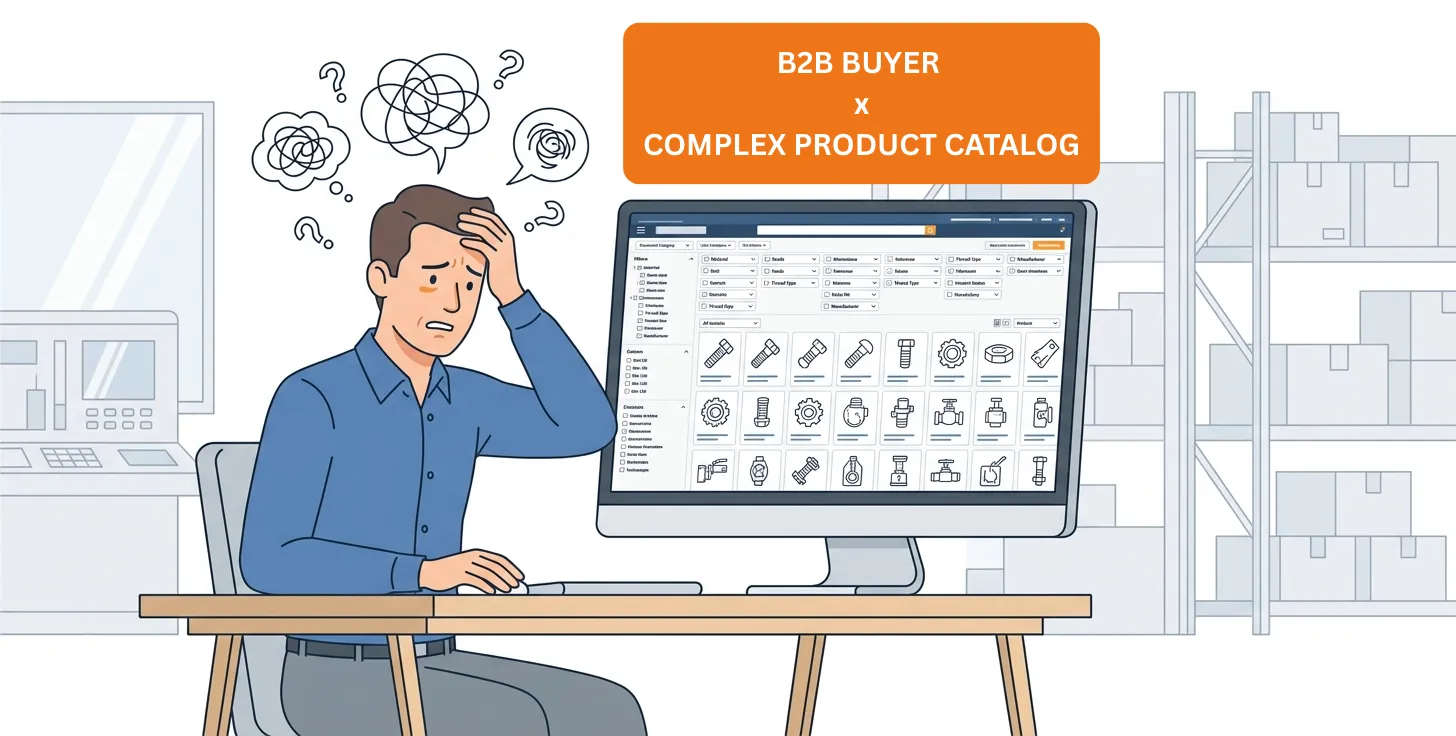
In many B2B environments, product catalogs are far from simple. They often include tens of thousands of SKUs, each with its own technical attributes, variations, and compatibility requirements. Choosing the right product can require understanding specifications, operating conditions, industry standards, or environmental constraints.
When companies invest in improving their digital commerce capabilities, the focus usually goes to areas like ERP integration, complex pricing, customer portals and quote based purchasing (RFQ and negotiated orders).
These areas keep operations running and support how transactions are processed, but they don’t fully address how buyers decide what to purchase in the first place.
That gap shows up clearly in product discovery. When customers struggle to find the right product, it slows decisions, increases dependency on support, and directly affects conversion . Despite this, the discovery experience has barely changed. Most platforms still rely on a search bar, category navigation, and filters to guide users through highly technical catalogs.
Over time, other parts of B2B commerce have moved forward. Payment models have become more flexible, pricing engines more advanced, and backend integrations more reliable. But the experience of finding the right product has remained largely the same.
For companies selling complex products, this gap is becoming harder to ignore.
Why Product Discovery Works Differently in B2B Purchasing
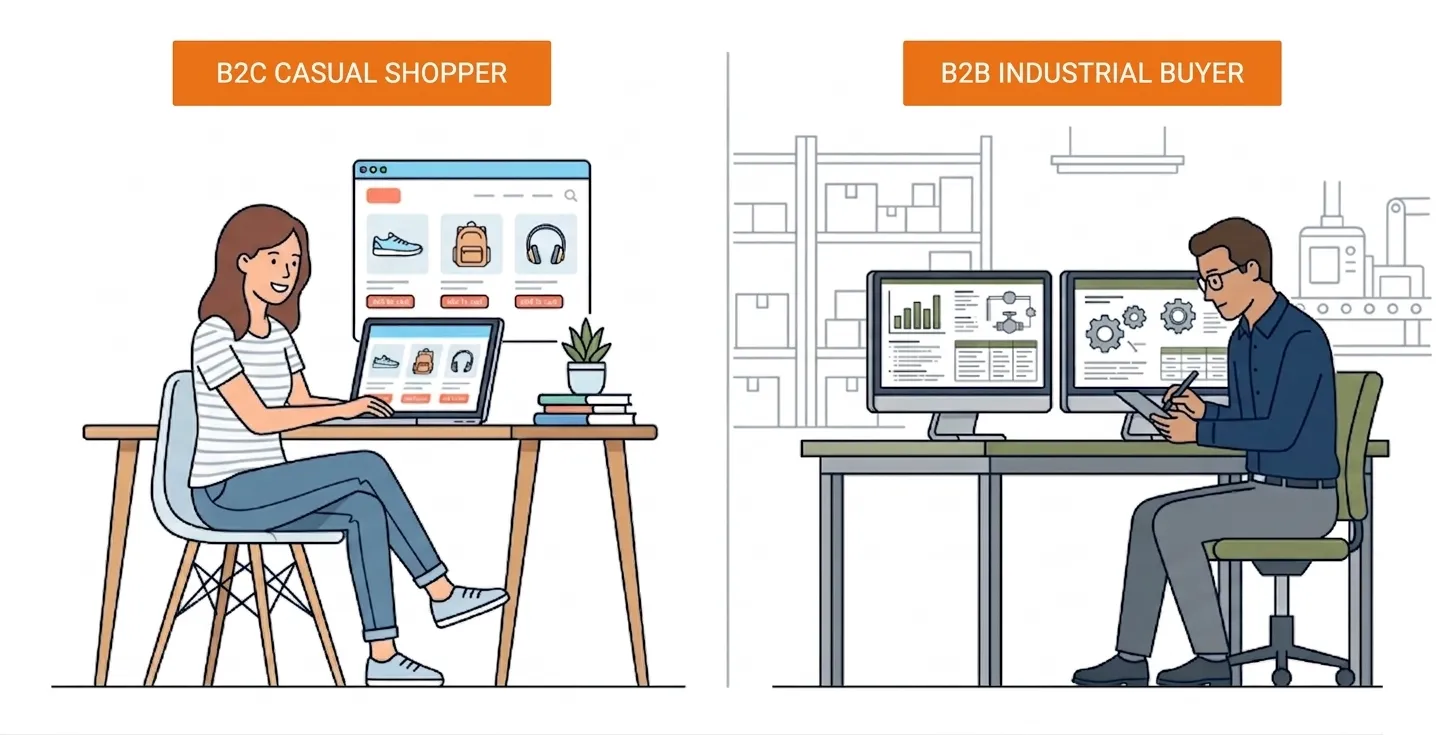
Product Discovery in B2B purchasing works differently from standard B2C models.In retail settings, customers usually explore options before deciding.
They compare products, look at pricing, consider design or brand, and choose what feels right for their needs. Even when they use search, there is room to adjust. More than one product can work, and choosing a different option rarely creates a serious issue.
In B2B environments, the situation is more constrained.In many industries, selecting a product is tied to whether it will actually work in a given context. The product has to perform under specific conditions, fit into existing systems, and meet defined standards. Two products that look similar in a catalog can behave very differently once used in a real environment.
Because of this, buyers approach the process differently. They are usually trying to answer questions such as:
• Can this component handle the required operating conditions?
• Will it fit with the rest of the system?
• Does it meet the relevant industry or engineering standards?
This changes the nature of product discovery. It is not about exploring a range of options. It is about narrowing down to a product that meets a set of requirements.
As catalogs become more complex, this difference becomes more noticeable in day-to-day purchasing.
The Growing Complexity of B2B Product Catalogs
Over time, B2B product catalogs have expanded in both scale and detail. In many industries, it is now common to manage tens of thousands, more frequently hundreds of thousands, of products. Each product may exist in multiple variations based on dimensions, materials, coatings, performance ratings, or compliance requirements.
As the number of products has grown, so has the level of detail attached to each one. Catalog entries now include specification fields such as material composition, dimensional tolerances, corrosion resistance, temperature limits, and environmental ratings.
That level of detail is important. It allows companies to represent complex products accurately and support demanding use cases. The difficulty starts when this information has to be used in real decisions.
For buyers, the challenge is not just finding products, but figuring out which one is actually correct for a specific use case.
Products that look similar can differ in ways that are not obvious at first glance. Small differences in material, coating, or tolerance can affect performance, compatibility, or compliance. These details are often buried in specification data and require careful interpretation.
As catalogs grow, this becomes more demanding. Finding a product is one step. Confirming that it is the right one is where most of the effort goes.
Why Search Tools Struggle with Technical Products
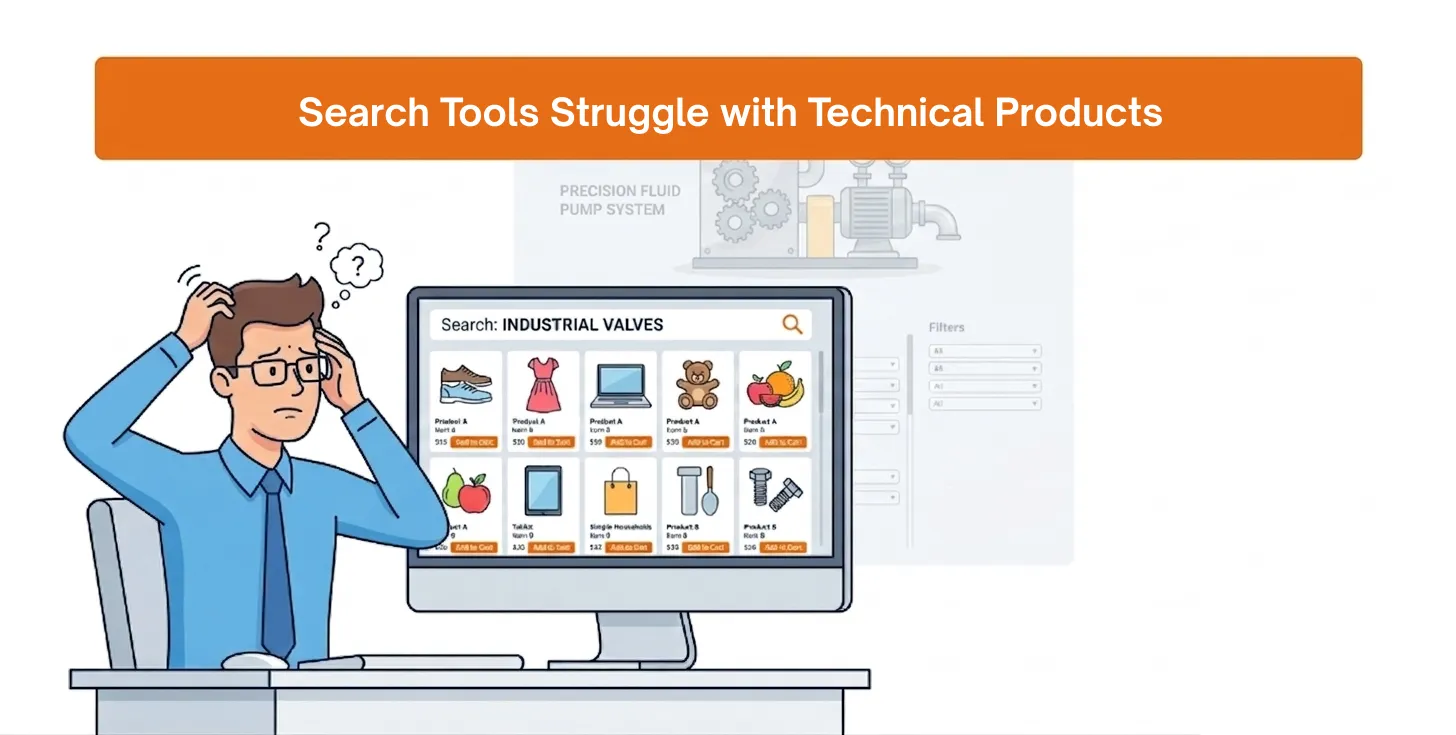
Most B2B commerce platforms rely on keyword search, category navigation, and attribute filters as the primary ways for buyers to find products.
These tools are built around known inputs. They assume the buyer already has a product name, part number, or clear category in mind.
The difficulty starts when the search begins with a problem instead of a predefined product.
In many real situations, buyers start with a requirement. For example:
• a component that can handle corrosion in marine environments
• a part that can withstand repeated vibration
• a material suitable for high temperature use
Here, the way buyers describe their requirements does not match how products are organized in the catalog.
Most catalogs are structured around product types and specification fields. Buyers, however, often think in terms of conditions and use cases. When these don’t align, results become harder to work with.
In many cases, the correct product exists in the catalog, but the buyer never reaches it.
From a business perspective, this creates clear issues:
• longer time to find and validate products
• increased reliance on sales or technical teams
• slower quote and order cycles
• lower conversion when buyers cannot confidently proceed
How Product Discovery Challenges Affect Business Operations
When finding the correct product becomes difficult, the impact goes beyond just the interface.Time is usually the first thing affected. Buyers spend longer reviewing products, going through technical documents, and double checking specifications before they feel confident in a decision.
This often leads to more back and forth with internal teams. Engineers or product specialists are brought in to confirm whether a component is suitable for the intended use. While this input is valuable, it slows things down when it becomes part of everyday purchasing.
The impact shows up clearly in a few areas:
• more time spent validating product choices
• repeated internal discussions before decisions are made
• slower quote preparation, especially for spec-heavy requests
Sales teams mostly feel this pressure. Preparing a quotation is no longer just about pricing. It often includes checking whether the selected product actually meets the requirement.
As these delays add up, procurement cycles stretch, more people get involved, and moving from inquiry to order takes longer than it should. Even when the final decision is correct, the effort behind it still adds friction.
For companies trying to grow their digital channels, this becomes harder to ignore. What starts as a product selection issue gradually turns into an operational concern.
The Manual Processes Behind Many B2B Purchasing Decisions
When the platform doesn’t make it easy to find the right product, buyers start looking elsewhere.
They may go through technical documents, ask for clarification, or reach out to suppliers to confirm what will actually work. In some cases, the process moves outside the platform completely.
On the other side, internal teams step in to fill the gap. Sales reps guide customers based on past experience, while engineering teams review requirements and validate decisions when things get more technical.
These approaches work, but they rely heavily on people and experience built over time.
However, they also come with trade-offs.
• Response times depend on who is available
• As requests increase, delays become more noticeable
• It becomes harder to keep things moving at the same pace
When product discovery depends heavily on people, consistency becomes difficult.In many cases, finding the right product becomes something handled through back and forth rather than through the system itself.
The Disconnect Between Engineering Decisions and Ecommerce Systems
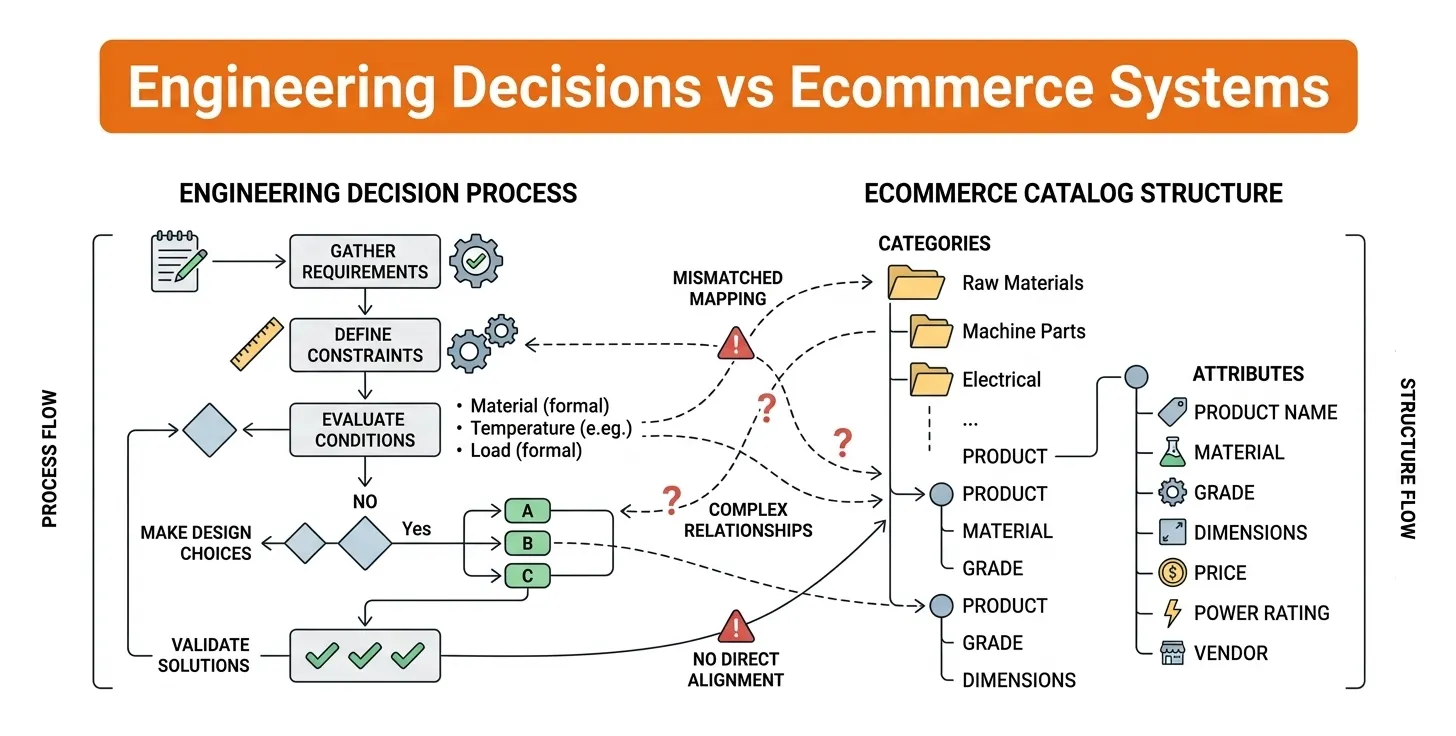
Engineering teams typically evaluate products based on performance requirements and operating conditions. They look at factors such as environmental stress, durability, and compliance with industry standards. The focus is on whether a component will perform reliably in a specific context.
Commerce systems organize information differently. Products are structured as catalog entries with categories, attribute fields, and pricing data.
Both approaches make sense, but they follow different starting points.
Engineering decisions begin with the conditions in which a product will operate. Catalog systems begin with the product itself and its defined attributes.
Because of this, the process of identifying the correct product often happens outside the ecommerce platform.
• engineers review the requirements
• buyers interpret the outcome
• the search for specific SKUs happens after
This gap is one of the reasons product discovery remains difficult in many B2B environments. The systems used to present products are not always aligned with how technical decisions are actually made.
Rethinking Product Discovery in Modern B2B Commerce
Across many industries, product discovery is starting to get more attention.As catalogs grow and technical requirements become more specific, finding the right product is no longer a simple step in the process. It plays a direct role in how decisions are made.
The challenges are clear. Catalogs are larger and more detailed. Search tools depend on structured data, while buyers often describe needs based on real-world conditions. In many cases, teams still rely on internal expertise to connect those two.
Because of this, product discovery is no longer just about navigation. It sits closer to the decision itself, linking requirements to the final product choice.
This is where many digital commerce investments fall short. Systems are built to manage transactions, but not always to support how products are actually selected.
For companies working with complex catalogs, improving this part of the experience can reduce friction on both sides. Buyers make decisions faster, and internal teams spend less time stepping in to support routine requests.
It’s also an area where new approaches are starting to take shape. Some organizations are beginning to rethink how product data, search, and decision support come together.
At clouda this is something we’ve been looking at closely.Not as a feature to add but as a problem that needs to be solved differently,based on how b2b buying actually works.Most platforms are built around products and attributes, while buyers are working from requirements and real-world conditions. Closing that gap requires a different approach to how product discovery is handled.
A Common Challenge in B2B Ecommerce Platforms
Why Product Discovery Works Differently in B2B Purchasing
The Growing Complexity of B2B Product Catalogs
Why Search Tools Struggle with Technical Products
How Product Discovery Challenges Affect Business Operations
The Manual Processes Behind Many B2B Purchasing Decisions
The Disconnect Between Engineering Decisions and Ecommerce Systems
Rethinking Product Discovery in Modern B2B Commerce
Get Your Free Product Discovery Feature list
Fill out the form and choose a time that works for you. Before the call, we’ll share a Product Discovery feature overview, so you can see how the system approaches real-world product selection.

Fill out the form and choose a time that works for you. Before the call, we’ll share a Product Discovery feature overview, so you can see how the system approaches real-world product selection.